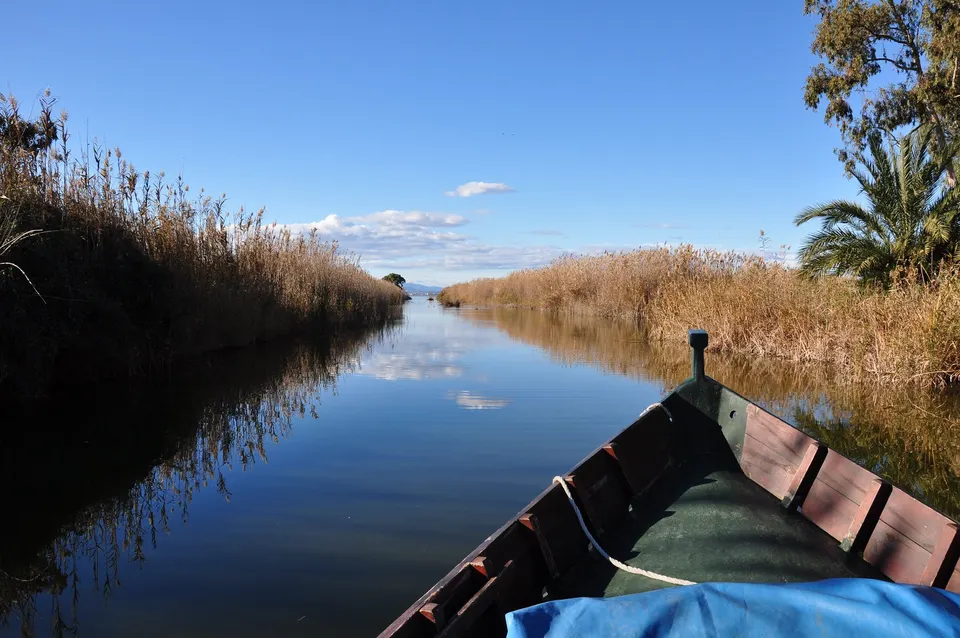
Tamed Nature
Albufera Natural Park Audio Guide (Parque Natural de la Albufera)
A wetland that humans have been shrinking and taming at will for centuries. Discover the hidden machinery behind the postcard.
- 120 min of audio
- Critical History
Everyone sells this landscape as an unaltered paradise. Be suspicious. What you will see here is not wild nature, but a massive factory of rice, fish, and costumbrist literature that has barely survived economic ambition. We explain what to see in Albufera Natural Park, clearing the fog of the romantic filter.
From kings who expropriated the water to an ecological collapse that almost turned it into a dead swamp. You will walk along the edges of a lake that is, in reality, a territorial ground zero.
Highlights
- Lake reduction: from about 30,000 to 2,800 hectares due to cultivation.
- Mechanical water management using floodgates or 'golas'.
- El Palmar: codes of honor and underwater knife duels.
- The 'tancats': the literal and geometric theft of land from the lagoon.
If you are looking for the typical friendly story of a pristine lake, you have come to the wrong place. When planning what to see in Albufera Natural Park, you must assume that you are facing a work of severe agricultural manipulation. The true secret history of this wetland is how human action has transformed, looted, and managed it as if it were a company. The architecture of Albufera Natural Park is not measured in stone monuments, but in kilometers of artificial mud to create rice fields and sunken barracks in the marsh. This is not a visit for passive strolling; through the audio guide, we will reveal the gears of an ecosystem that is absolutely not spontaneous.
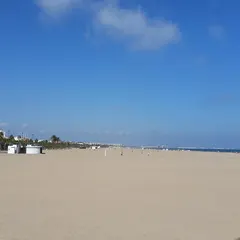
To stay by the water, Malvarrosa Beach is the city’s urban beach, and the way back to the centre passes the City of Arts and Sciences.
El Palmar: Blood, mud, and literature
El Palmar
Summary of this stop
El Palmar seems today a harmless island of restaurants, but its origin dictates otherwise. Already in the times of the Taifa of Valencia (year 1000), this place, known as Al-buhayra, was state property and an exclusive hunting reserve. The dynamic did not improve much when James I incorporated it into the Crown in 1238 and, in 1250, granted fishing to locals while reserving ownership. It was always a landscape of subjects, never of owners.
Vicente Blasco Ibáñez portrayed this harshness in 1902 with his novel Cañas y Barro. Behind the folklore, a strict and brutal code of honor operated. Disputes over fishing quotas were routinely settled in knife duels. Local memory assumes with an astonishing coldness that more than one loser ended up at the bottom of the lake, serving as fertilizer for the eels. What other secrets do the roots of these piers keep? The narration in the app will put you in context.
The tancats: The systematic theft of the lake
Albufera Rice Fields
Summary of this stop
Look out over the fields and do not be fooled by the scale. What seems like a natural horizon is the result of the largest silent expropriation in the region. Starting in the 18th century, farmers began to dry out and fence off portions of the lake, creating perfect rectangular plots. These are the tancats.
The figures cancel any ecological mirage: the lake went from having about 30,000 original hectares to less than 2,800 today. The rice cultivation literally swallowed the water. You are stepping on a landscape that was manufactured by stealing space from the lagoon. In the audio guide, we will detail how this relentless advance over the water was executed without anyone stopping it.
From green asphyxiation to minimum protection
Albufera Lake
Summary of this stop
Look at the dark water. If you had walked here in the 1970s, the smell would have made you step back. La Albufera suffered a total collapse. Urban and industrial pollution mutated it into a toxic and opaque “green soup” that virtually liquidated all native aquatic life. The romanticization of the park omits this uncomfortable detail.
Its declaration as a Natural Park in 1986 (with 21,120 protected hectares) stopped its absolute death, but it did not return the ecosystem to its original state. What you contemplate now is a convalescent environment, sustained by highly calculated management. How do you revive something that was already clinically dead? The details of this intervention await you on the route.
Floodgates and rituals: Total control
Gola de Pujol
Summary of this stop
The illusion of wild nature is completely broken when observing the ‘golas’ (floodgates). The water level here is not decided by the rain, but by a system of gates. And if this space is still publicly accessible, it is only because the Valencia City Council disbursed 1,072,980.41 pesetas in 1911 formalized in 1927 to buy it from the State.
Despite this hyper-modern control, purely medieval anomalies survive. The annual draw of the redolins to assign fishing spots was formalized in the 19th century, although communal fishing has its roots in medieval privileges. Even wilder is the Tirá de l’Art, a communal trawling technique that seems taken from the Middle Ages and whose exact dates are hidden from the general public. If you want to know when and how to witness this operational rarity, listen to the last stop of the audio guide on site.