Architecture and Commerce
Valencia Central Market Audio Guide (Mercado Central)
Forget the harmless postcard. This is a machine of iron and glass built over an old scaffold, designed to feed the city and show off the ego of its bourgeoisie.
- 45 min of audio
- Industrial Modernism
- Dark History
Planning what to see in Valencia Central Market is usually limited to walking around looking at tiles. Mistake. This 8,160-square-meter enclosure is an exercise in urban power. Built in fits and starts since 1914, its structure reflects the ambition of an era that decided to bury centuries of mud under tons of cast iron and zenithal light.
The architecture of the Valencia Central Market dazzles to distract you from its colder pragmatism. From basements created to auction livestock to roofs that isolate smells, nothing here is pure decoration. Download the audio guide, put on your headphones, and join me to read the scars of this building.
Highlights
- Central Dome — 30 meters of glass and trencadís
- Fish Market Pavilion — Smart concentric isolation
- La Cotorra del Mercat — The weather vane that watches over the city
- Invisible basements — From old icebox to modern logistics
Deciding what to see in Valencia Central Market requires suspecting the first impression. Don’t stop at the hustle and bustle and the colors. You are facing one of the masterpieces of European modernism, yes, but also an implacable logistical mechanism designed to survive the passing of the centuries. With the audio guide, we will walk through its aisles without buying the official tourist discourse; we will analyze its secret history, its construction delays, and how the architecture of the Valencia Central Market managed to enclose the chaos of the street under a perfect dome.
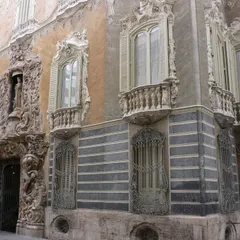
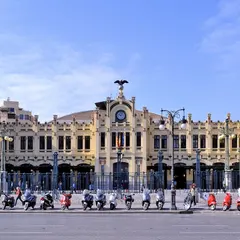
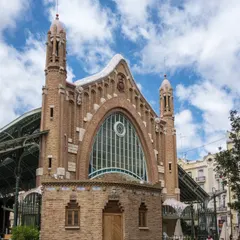
Directly opposite stands the Silk Exchange, and the city’s other great modernist market, the Colón Market, lies in the Ensanche.
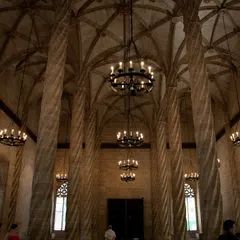
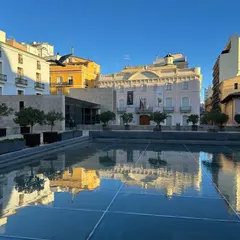
Facing La Lonja, two Valencias look at each other
Plaça del Mercat
Summary of this stop
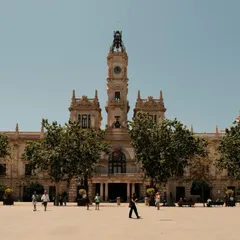
The city does not place its buildings randomly. By standing in the Plaça del Mercat, you have before you a very calculated duel of architectural egos. Behind you, La Lonja de la Seda represents the commercial power of 15th-century Gothic Valencia. In front, the Central Market answers with the aggressiveness of the 20th-century modernist bourgeoisie. It is a tense dialogue between two ways of understanding money and ostentation.
But the commercial custom here is much older than the iron you are seeing. Since the Middle Ages, this exact piece of land already housed an open-air market, and in 1839 the Mercat Nou was inaugurated here, germ of the current one. Those are centuries of transactions, shouting, and mud in the same spot on the map. In the audio I will tell you how it was decided to erase the medieval chaos to plant this monumental facade.
The beautiful square that hides a wound
Valencia Central Market
Summary of this stop
Look up. The exterior ceramic panels and stained glass windows are not there out of love for art. They directly represent the physical inventory of the Valencian orchard: oranges, vegetables, local products. It is an aesthetic justification for a utilitarian building. However, all that colorful beauty camouflages a dark past that is rarely mentioned.
Before these tiles existed, this ground was the city’s main scaffold. For centuries, this space was the scene of public executions, including the tragic death of Margarida Borràs in 1460. There is a secret history of violence beneath the ground you step on. In the audio guide I will reveal how the city has transformed its most macabre space into its brightest postcard.
The dome that turned the market into a monument
Central Dome and Parrot Weather Vane
Summary of this stop
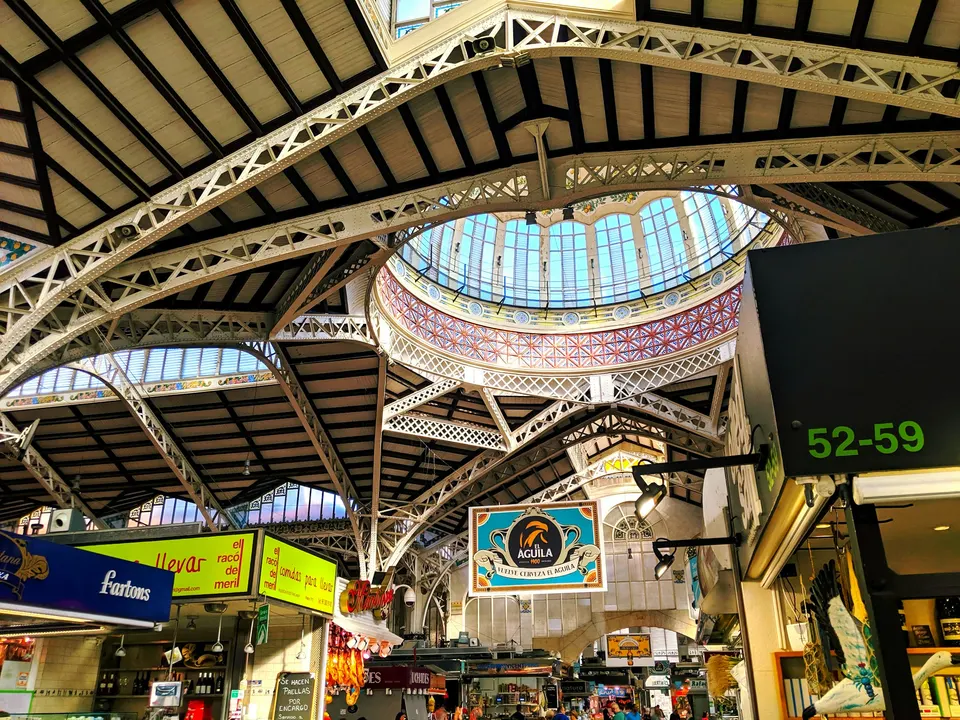
Entering and looking at the main nave is understanding that this was not a simple project. Designed in 1910 by Alexandre Soler i March and Francesc Guàrdia i Vial, disciples of the great Lluís Domènech i Montaner, the market was a logistical disaster. It suffered continuous stoppages and delays. It was necessary to pass it into the hands of the local architect Enric Viedma i Vidal to finish and inaugurate it in 1928.
The result justifies the wait: 8,160 square meters almost without columns. It is not a visual trick, it is pure iron and glass engineering to support a 30-meter high dome without obstructing the view of the buyers. A structure crowned by the famous parrot weather vane, a symbol of incessant chatter. Hit play on site; I will guide you to understand the exact physics that keeps this colossus standing.
The fish market where design smells of the sea
Fish Market Pavilion
Summary of this stop
Smell is the enemy of any market. Therefore, in 1914 they decided that the fish market could not share space with fruit. They designed it as a semi-independent circular pavilion, with its own dome and a swordfish-shaped weather vane. It is acoustic and olfactory isolation resolved with pure geometry.
Today the basement is an aseptic parking lot built in a later rehabilitation, but originally that basement was used to auction live animals and store ice. The true survival of the market is not in its foundations, but at the counters of its bars. The “esmorzaret” (mid-morning snack) rules here every morning. Walking with me through the fish market, you will understand why this gastronomic ritual remains the only religion that everyone respects in this enclosure.