Living History
Valencia Cathedral Audio Guide (Catedral de Valencia)
A palimpsest of a mosque, a Gothic cathedral, and Baroque touch-ups that guards the alleged Holy Grail. Discover the real layers beneath the official stone.
- 75 min of audio
- Eclectic Architecture
At first glance, this building seems like a head-on collision of disjointed styles. A very scenic Baroque portal here, a purely Gothic tower there. But this monument is not an inert block; it is the result of centuries of superimpositions, fires, whims, and calculated destructions. It began to be built in 1262 directly on the site of the main mosque —which in turn stood on an old Visigothic cathedral— and, since then, it has not stopped mutating.
What is truly fascinating here is not only what is visible, but what was deliberately hidden. From Renaissance angels walled up for centuries due to a matter of fashion, to relics that survived wars hidden in village closets. If you wonder what to see in Valencia Cathedral, the answer is not in looking passively, but in understanding the cracks in its story.
Highlights
- El Miguelete — 203 steps of freestanding history
- Holy Chalice — Between the 1st century and the legend
- Altar Frescoes — Hidden for more than 300 years
- Apostles' Gate — The court that distributes the water
When you plan what to see in Valencia Cathedral, traditional guides will sell you the image of a cohesive and majestic temple. The reality is much starker. The architecture of Valencia Cathedral is, deep down, a battlefield where different eras have fought to impose their criteria, covering up, demolishing, or recycling what was there before. Since its Gothic foundation in 1262, this place has been shaped by faith, the ego of architects, and the pure chance of history.
Forget the classic complacent postcard. Here is a secret history of neoclassical marbles that suffocated medieval vaults, venerated relics whose archaeological certainty mixes with myth, and bell towers that were born orphans. To understand this colossus, it is not enough to read the brief information on the tourist signs; you need the narration of what happened when no one was looking. And that is exactly what the audio guide will put in your ears when you are in front of its walls.
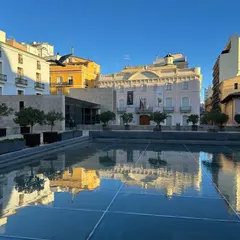
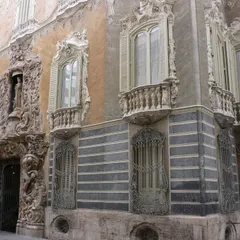
Right beside the cathedral, the Almoina Archaeological Center reveals Roman Valentia beneath the square, and a short walk away stands the Palace of the Marqués de Dos Aguas, with its Rococo portal.
The baroque facade that changed the face of the temple
Iron Gate
Summary of this stop
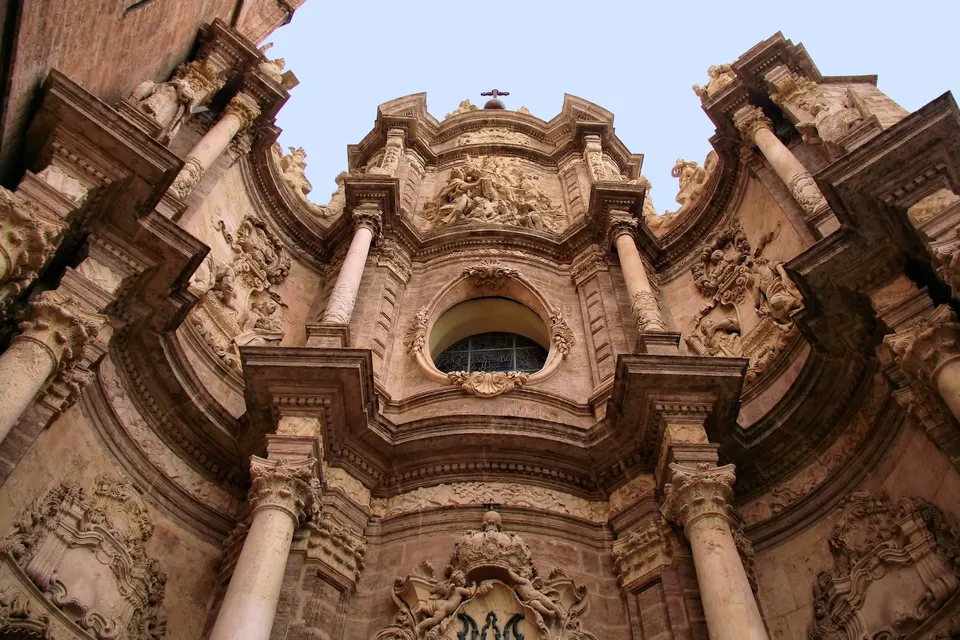
If you stand in the Plaza de la Reina, the first thing that hits you is the Puerta de los Hierros (Iron Gate). Begun in 1703 by the German Konrad Rudolf and finished decades later by his disciples, this baroque entrance is pure scenic theater of concave shapes. Do not look for medieval sobriety here; it was designed as a monumental facelift for a temple that the elite of the time already considered outdated.
A few meters away, marking its own territory, stands the bell tower of El Miguelete. Interestingly, although today it is the symbol of the cathedral, it began to be built in 1381 as a freestanding tower, completely isolated. Decades had to pass until, at the end of the 15th century, someone came up with a way to architecturally unite both volumes. Two pieces forced to fit in the same space.
When contemplating this aesthetic clash from the square, it is inevitable to be skeptical about the supposed harmony of the monument. What else have they patched or concealed over the centuries? The complete answer awaits you when activating the audio on site.
The door where justice sits in the open air
Apostles' Gate
Summary of this stop
Bordering the building towards the Plaza de la Virgen you will come across the Puerta de los Apóstoles (Apostles’ Gate), a 14th-century facade that serves as a backdrop for a historical anomaly. Every Thursday at 12:00, this place stops being a Gothic ornament to become a courthouse. The Water Tribunal has been settling the conflicts of the Valencian orchard right here, according to tradition, for more than a thousand years. Without papers, by word of mouth and with a pragmatic authority that has survived kings and republics.
But while earthly justice operates at street level, something much murkier watches you from above. If you look at the grotesque gargoyles on the wall, popular legend assures that they are not simple drains carved in stone, but the petrified faces of young men condemned for mocking a Corpus Christi procession.
A millennial assembly on the ground and an eternal condemnation on the roof. When you physically find yourself in this square, the audio guide will reveal the harsh reality of these stones. Do you dare to hold their gaze?
The nave that re-emerged from under the stucco
Gothic Central Nave
Summary of this stop
The interior of the central nave welcomes you with the forcefulness of its pillars and arches. What you are stepping on is a sandwich of conquests: the Gothic cathedral devoured the mosque, which had previously buried the Visigothic church. However, the greatest irony of the building is not in its foundations, but in the walls surrounding you.
In 1774, the prevailing taste dictated that Gothic was rude and barbaric. Architect Antoni Gilabert executed an aggressive reform that buried the original structure under heavy layers of stucco and neoclassical marble. The temple remained disguised for almost two centuries. It was not until 1972 that a tense process of “repristination” began to tear off that false skin and return the Gothic appearance you see today.
A legitimate historical layer was removed to recreate an idealized purity. Walking around here is crossing a stage that has been forcibly made up and unmade. With the app in hand, you will understand why this controversial architectural decision continues to generate debate.
The famous chalice among faith, politics, and escape
Chapel of the Holy Chalice
Summary of this stop
In the old Chapter House with a star-ribbed vault rests the most media-friendly piece of the enclosure: the Holy Chalice. Delivered to the cathedral in 1437 by King Alfonso V, tradition points to it as the Grail of the Last Supper. Realistically, although archaeological dating places the agate cup in the 1st century, its leap to the table in Jerusalem requires an act of faith that science cannot sign.
However, its true verifiable odyssey is much more recent. During the Civil War, faced with the imminence of looting, the chalice was clandestinely evacuated. Its hiding place was not a high-security bunker, but a house in the municipality of Carlet, vulgarly camouflaged inside a closet to bypass history.
The relic saved by the silence of a few and the discretion of old clothes. The survival story of this cup surpasses any Arthurian myth. When you are in front of the showcase, we will tell you the precise details of this movie-like escape.
The angels that reappeared over the altar
High Altar Vault
Summary of this stop
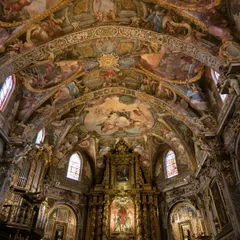
The last great deception of the cathedral requires you to look up, straight at the vault of the main altar. In the year 1469, a catastrophic fire devastated the old altarpiece. That disaster forced the commissioning of spectacular Renaissance frescoes to the Italians Paolo de San Leocadio and Francesco Pagano in 1472.
True to its habit of hiding the past, the cathedral decided in the 17th century that those frescoes were no longer useful, covered them with a new baroque vault, and erased them from collective memory. For more than 300 years no one knew of their existence, until in 2004, purely by chance during a restoration, the tools scraped where they shouldn’t and revealed the intact musician angels.
Standing under this vault proves that, in Valencia, not even what seems definitive really is. Download the audio guide and let us accompany you to discover how, sometimes, the best treasures just need someone to scratch the surface a little.