UNESCO Heritage
Silk Exchange Audio Guide (La Lonja de la Seda)
Discover the temple of medieval commerce in Valencia, an architectural marvel where wealth, power, and satire were carved in stone.
- 45 min of audio
- Civil Gothic
La Lonja de la Seda (The Silk Exchange) stands in the heart of Valencia as the most imposing civil testament of European late Gothic. Built to make the city's economic muscle visible during its Golden Age, this complex was not born for religious prayer, but for the worship of money, contracts, and the silk trade. Its monumentality transcends mere mercantile utility, becoming a public declaration of urban sovereignty that continues to amaze today with its audacity.
Crossing its doors means entering a game of calculated contrasts: from the almost sacred solemnity of its vaults to the biting humor of its gargoyles, to the severity of an internal prison for those whose word lost its value. A space where the laws of the Mediterranean were dictated under golden ceilings and where every construction detail hides a warning or a demonstration of civic pride.
Highlights
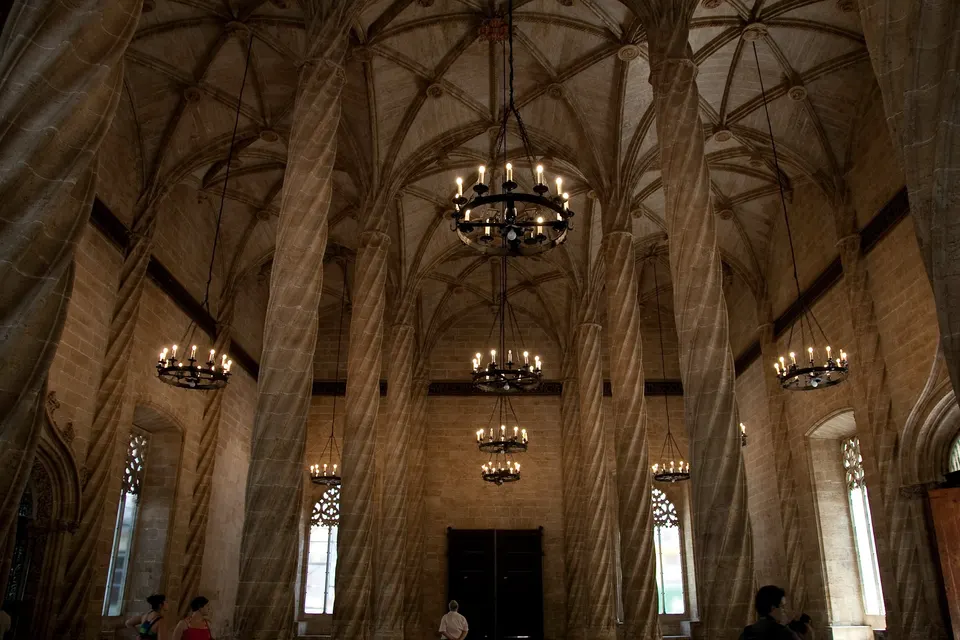
- Trading Hall — 17-meter helical columns
- Central Tower — The old merchants' prison
- Consulate of the Sea — Spectacular Renaissance coffered ceiling
Planning what to see in La Lonja de la Seda is to look into the era when Valencia dominated the trade routes of Europe. This building is not just a photo stop; it is a living structure that narrates the transition from the Middle Ages to the Renaissance. In 1996, UNESCO declared La Lonja a World Heritage Site, recognizing that this is not a common monument, but an exceptional and perfectly preserved testimony to a great medieval commodity exchange. Its design reflects the ambition of a society of merchants who needed a setting to match their ambitions. To understand the intrigues, fortunes, and moral codes that were sealed within these walls, the true experience begins when you walk through its rooms listening to the details that the stone keeps quiet at first glance, guided by an author’s narration designed for the real environment.
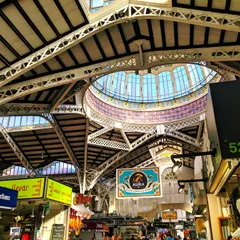
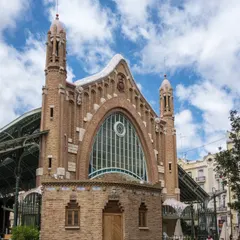
Back outside, the Central Market stands directly opposite, and a few minutes’ walk away the Church of San Nicolás holds what is known as Valencia’s Sistine Chapel.
The facade that was not just a facade
La Lonja de la Seda
Summary of this stop
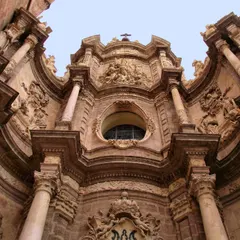
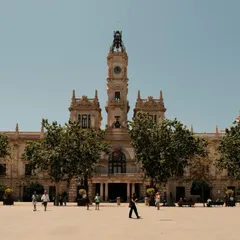
In front of the main facade of the building, the architecture of La Lonja de la Seda presents itself to the visitor as a resounding declaration of intentions commissioned by the Consell General de la Ciutat. Discretion was not sought, but to project an unbreakable image of trust, wealth, and urban authority to the outside. The exterior design immediately catches the eye, revealing that the civil power of the time was not afraid of opulence or monumentality to consolidate its status in the Mediterranean.
However, you only have to look up a little at the gargoyles and small sculptures of the building to discover that official solemnity coexists with a surprisingly subversive spirit. These figures do not fulfill a merely decorative or exclusively technical function for drainage; many of them represent satirical, erotic, or grotesque scenes. It was an avenue of popular expression and moral criticism allowed right in the official building, a Gothic code loaded with irony that challenged puritanical gazes.
Why did the city’s rulers allow this visual insolence on the walls of their greatest architectural pride? The facade hides a dialogue between the sacred and the profane that only makes sense when you know the mentality of the men who built it, a mystery that is revealed step by step in the audio guide tour.
A stone forest for doing business
Trading Hall
Summary of this stop
Upon crossing the threshold and standing in the center of the Sala de Contratación (Trading Hall), the perception of space completely changes. The monumental scale of this main hall is coldly designed to dwarf the individual and magnify the institution, immersing the visitor in an atmosphere where the reverberation of sound and the echo under the high vaults command almost religious respect. The construction of this imposing room was completed in a record time of 15 years, between 1483 and 1498, under the direction of the masters Pere Compte and Joan Ivarra, who managed to architecturally capture the splendor of the Valencian Golden Age.
The true marvel of the space lies in its eight free-standing helical columns almost 17 meters high. These structures not only support the weight of the building, but were designed to imitate a stone palm grove, creating a symbolic “paradise” for the merchants who gathered there. If you look down at the floor, you will notice that it partly preserves the original design of colored marbles (white, blue, and black) that precisely replicate the six-pointed star of the coat of arms of the master builder himself, Pere Compte, signing his masterpiece under your feet.
Money and business needed a neat setting, but also a constant reminder of the rules of the game. If you look up at the upper part of the room, you will see a Latin inscription with gold letters that runs around the perimeter, firmly warning about the need for fair trade and promising eternal life to the honest merchant. The stone dictated the moral sentence, but the real deals hid sophisticated traps that the architecture tried to contain. By touching the solidity and coolness of the stone of these columns, the echo of the past invites you to discover the stories of usury and fortune that the audio guide unravels at this very point.
The tower where bankruptcy cost you your honor
Central Tower
Summary of this stop
Right next to the magnificence of the main hall stands the central tower, an architectural element that drastically changes the tone of the visit. Although on the outside its robust physiognomy might resemble that of a fortified bell tower or a lookout point to watch over the city, the internal reality of the building was much darker. This central tower did not have a spiritual or military function: it was a prison meant exclusively for merchants declared bankrupt and debtors who could not meet their economic commitments.
The same financial system that celebrated commercial success and built stone palaces punished with relentless harshness those who broke market trust. Honor in the Valencian Golden Age was measured in transactions, and losing solvency meant losing freedom. Interestingly, the city’s financial activity was so advanced that, since 1407 —long before the construction of the structure we see today—, the “Taula de Canvis i Depòsits” operated in La Lonja, considered one of the first municipal banks in Europe, responsible for regulating exchange and deposit operations.
This contrast between the birth of modern banking and the immediate confinement of debtors shows the rawest face of the medieval mercantile system. Behind the facade of prestige and silk deals, the fear of ending up within the walls of this tower was the engine that maintained discipline in the city. The details about how this prison worked and the fate of disgraced merchants hold secrets that only acquire their true dimension when you stop before its base with the on-site audio.
From local deal to Mediterranean rules
Consulate of the Sea
Summary of this stop
The tour moves towards the annexed complex finished in the 16th century: the Consulate of the Sea. Upon entering its main hall, the environment transforms again, offering a strong aesthetic contrast with the austere Gothic that dominates the Trading Hall. Here, absolute prominence is claimed by a spectacular Renaissance-style gilded and polychromed wooden coffered ceiling, a meticulously carved roof that transports the visitor from medieval mystical verticality to Renaissance human and artistic horizontality.
This space was not just a decorative meeting place. The Consulate of the Sea housed the oldest mercantile court in Spain, a crucial legal institution whose maritime laws and interpretations of commercial law decisively influenced the entire Mediterranean Sea. In this room, the price of silk was not negotiated out loud; here litigation was judged, collisions were resolved, shipwrecks were managed, and the rules that made the flow of international wealth possible were dictated.
The Consulate of the Sea represents the definitive expansion of the scale of the monument: the transformation of verbal and daily pacts taken between columns into written laws and historical legacies that transcended borders. As you go out to the sunny Courtyard of the Orange Trees to rest from the visit, the contrast of temperature and light invites you to process the magnitude of what you have just toured. But what were the most scandalous trials that were deliberated under that gilded wooden roof? Download the full audio guide to hear the secret history that turned this building into the legislative heart of maritime trade.