Coastal History
Malvarrosa Beach Audio Guide (Playa de la Malvarrosa)
The beach that was born from a French botanist over an unhealthy marsh and ended up being Sorolla's canvas. Discover what to see on Malvarrosa Beach beyond the sand.
- 60 min of audio
- Urban Transformation
We are usually naive when we look at the sea and assume that the sand was always there. The secret history of this coastal strip destroys that idea: what you step on today was a swampy terrain that had to be dried out and tamed with geraniums. It was not always the city's great maritime lounge.
From the slave labor of the fishermen, to a catwalk for the bourgeoisie and an improvised landing strip. Understanding the architecture of Malvarrosa Beach and its evolution requires a skeptical look at its apparent calm.
Highlights
- The botanical origin — The planting of geraniums on the marsh (1856)
- Blasco Ibáñez House-Museum — Literary refuge on the front line (1902)
- Las Arenas Spa — Epicenter of bourgeois exhibitionism (1898)
- The first aerodrome — The historic takeoff of Julien Mamet (1910)
Any tourist guide will tell you that this is the ideal place to walk under the sun. And they are not lying, but they omit half of the story. If you wonder what to see at Malvarrosa Beach, the easy answer is sand, sea, and restaurants. The real answer requires scratching the surface. Behind the facade of modern spas and symmetrical palm trees hides a tale of engineering, floods, social ostentation, and brutal work. This land has been forcibly shaped by political decisions, economic interests, and natural disasters. To decipher the true character of this coastline, it is best to put on your headphones, walk on site, and let the audio guide dismantle the mirage.
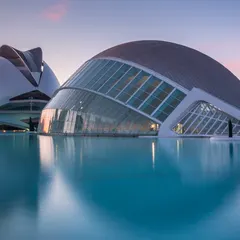
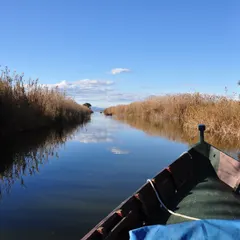
For more of Valencia by the water, the Albufera Natural Park lies to the south, and between the sea and the centre, the City of Arts and Sciences emerges at the end of the old riverbed.
The sand that was once a marsh
Malvarrosa Beach
Summary of this stop
It is tempting to believe that nature gave us this immense golden esplanade. The reality is much more earthly and calculated. Until the mid-19th century, breathing here was a risk. This was an unhealthy marsh until, around 1856, the French botanist Felix Robillard decided to dry it out. His solution? To massively plant scented geraniums, popularly known as malva-rosa. The name millions of tourists pronounce today is not ancient poetry, it is 19th-century botanical marketing.
But the sand hides darker secrets than the original mud. Long before the towels and umbrellas, in 1812, during the Napoleonic occupation, Valencia witnessed the execution of the guerrilla José Romeu y Parra, ‘El Romeu’, hanged as an exemplary punishment.
The secret history of the beach starts with blood and mud, not sunscreen. How do you erase such a past to sell a leisure paradise? In the audio guide we reveal the details of this strange collective amnesia.
The house from which the beach was written
House-Museum of Vicente Blasco Ibáñez
Summary of this stop
At the beginning of the 20th century, the beach had two very different faces that rarely crossed paths. On the one hand, around 1900, the shore was an open-air industrial estate. Fishermen beaching boats by sheer arm strength and women straining their eyes mending nets. Hard work, saltpeter, and survival.
On the other hand, that same brutal light that made the sailors squint attracted those who did not come to fish, but to look. In 1902, the writer Vicente Blasco Ibáñez planted his imposing chalet on the front line (today the only survivor of its kind). From that privileged vantage point he wrote about the miseries of those who sweated on the shore. Shortly after, in 1909, Joaquín Sorolla would turn that same labor harshness and evening light into the icon of luminist art with works like Walk on the Beach.
Two men bottled the essence of the beach and exported it to the world. But what did the fishermen really think of these artists who observed them from the sidelines? The answer awaits you in the audio while you contemplate the reddish facade of the House-Museum.
The spa where the sea cured and exhibited
Hotel Balneario Las Arenas
Summary of this stop
If we go back to 1880, going into the sea was not fun; it was a medical prescription. Doctors prescribed “wave baths” to cure ailments, and thus the perfect excuse to colonize the coast was born. The arrival of the steam tram in 1892, the famous ‘trenet’, opened the doors of the beach to the masses.
However, the Valencian bourgeoisie needed to keep their distance. In 1898 they inaugurated the Balneario Las Arenas. Quickly, the supposed health therapies took a back seat to the restaurants, dance halls, and social exhibitionism. The architecture of Malvarrosa Beach mutated: it was no longer enough to look at the sea, the important thing was to be seen in front of it.
The current 5-star hotel preserves the original pavilions of that social theater. As you walk along this stretch, the audio guide will reveal the extravagant rituals and strict etiquette that governed the most exclusive spa in the Mediterranean.
The new promenade on a changed beach
Maritime Promenade
Summary of this stop
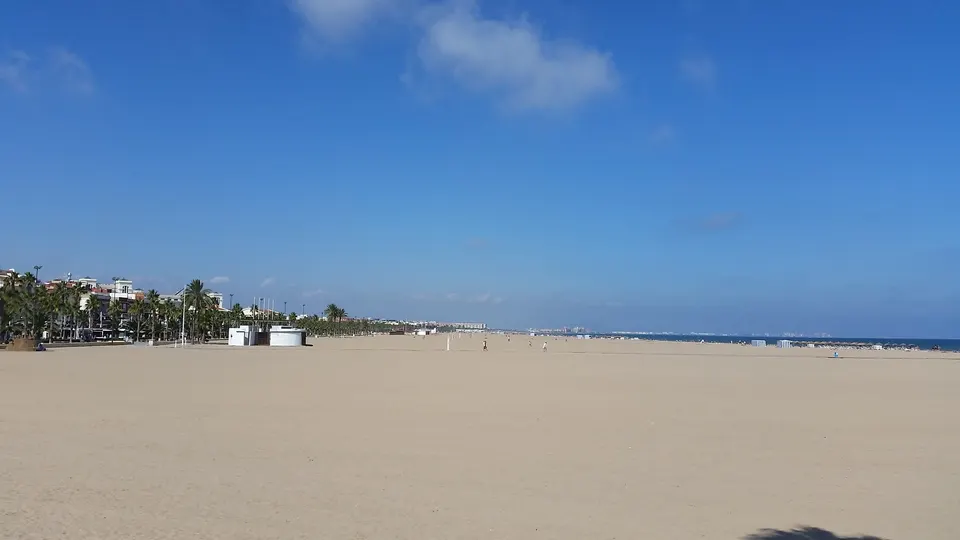
The current Maritime Promenade, with its perfect tiles and lined palm trees, projects an image of unreal permanence. Built in the 1990s, it is the child of destruction. To build it, it was necessary to wipe off the map the old picnic areas and the remains of a golden era that had been annihilated decades ago, specifically in 1957, when the devastating Turia flood swept away villas, spas, and tram tracks.
It is still hard to believe that this same peaceful esplanade was Valencia’s first aerodrome. In 1910, thousands of people crowded onto the sand to watch aviator Julien Mamet take off and make the first flight over the city. Today, the only flights are those of the seagulls and the sparks of the San Juan bonfires, when every June 23 the beach recovers its pagan pulse and fire purifies the sand.
The beach you see is an edited version, trimmed by disasters and redesigned by concrete. Download the app, stand in front of the sea, and listen to how the water continues to claim, wave after wave, what once belonged to it.