FeaturesHow it works Privacy Policy
Valladolid, Spain

Valladolid Audio Guide

Discover the history and soul of Valladolid with 30 walking audio guides narrated by experts. From the Plaza Mayor to Campo Grande, every corner has a story worth hearing.

+5h of audio
7 routes · +30 points of interest
Offline mode
English

What to see in Valladolid with the EarGuide audio tour

Valladolid gathers centuries of Castilian history in a walking tour: the Plaza Mayor rebuilt after the 1561 fire which served as a model for Madrid, the unfinished Herrerian cathedral, the Church of San Pablo where kings were baptized, the National Museum of Sculpture with Gregorio Fernández's imagery, the house where Cervantes lived when the first part of Don Quixote was published, the 1886 Pasaje Gutiérrez and Campo Grande with its peacocks. All within minutes of each other.

With EarGuide's Valladolid audio guide, every monument reveals its story through professional narration recorded by local historians. Unlike a free tour or a conventional guided visit, you set the pace, the order and the stops. No groups, no schedules, no internet needed.

No internet connection needed
Download the routes before you go and explore without using data.
Smart geolocation
Narration activates automatically when you arrive at a point of interest.
01
Urban Model

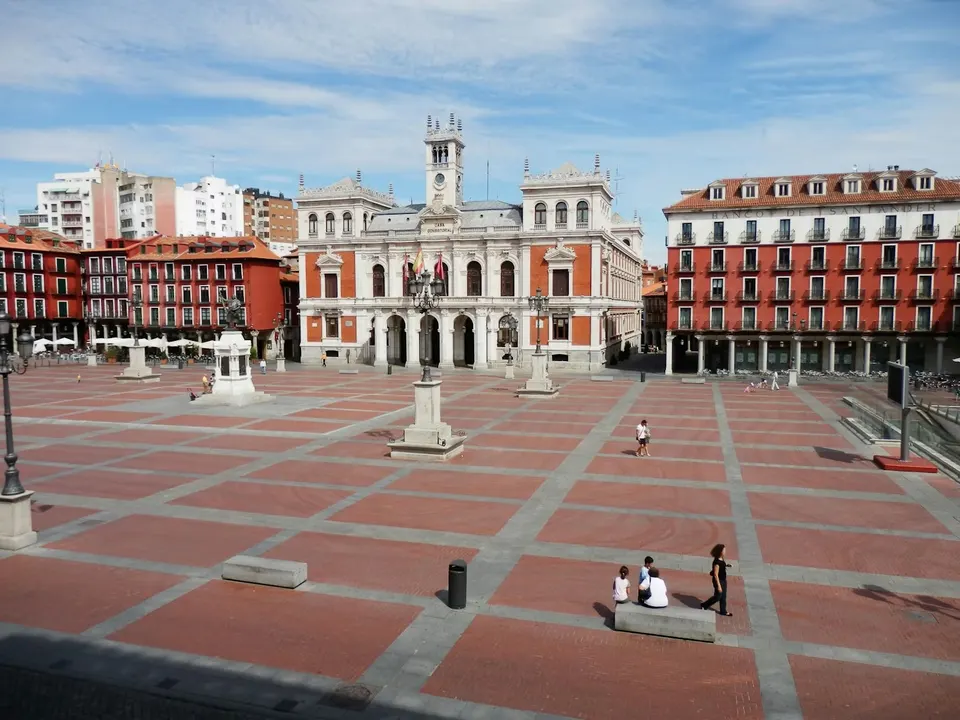
Plaza Mayor of Valladolid

The regular arcaded square that turned the great fire of 1561 into an urban model imitated across half of Spain, beginning with Madrid. An overview of what to see at the Plaza Mayor of Valladolid.

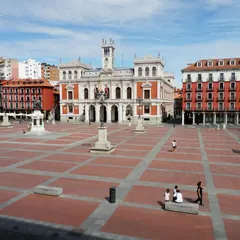
The Plaza Mayor of Valladolid constitutes the undisputed heart of the city, characterized by its wide, open rectangle, continuous arcades, and the City Hall presiding over the main front. This regular and geometric design was not born from leisurely planning, but from a catastrophe: the devastating fire of September 21, 1561, which destroyed a large part of the area around the town's main market, documented since the 13th century.

Philip II commissioned the reconstruction to Francisco de Salamanca, who ordered the space by creating a rectangular arcaded square with homogeneous facade heights. Considered the first regular Plaza Mayor in Spain, its layout served as a direct reference for the subsequent Plaza Mayor of Madrid in 1617. Visiting this point allows for an understanding of the close relationship between medieval trade, the ceremonial of the court of Valladolid of 1601-1606, and the theater of large civic demonstrations and punishments.

Fire of 1561 — The great urban disaster that prompted the regular design of the square
Francisco de Salamanca — The royal architect who designed the uniform arcades
Model for Madrid — The antecedent that served as a reference for the Madrid square in 1617
Statue of Count Ansúrez — The central landmark from 1903 dedicated to the medieval founder of the resettlement
City Hall — The historicist town hall inaugurated in 1908 to replace the 16th-century work
25 min of audioUrban History
01
Plaza Mayor of Valladolid
02
Herrerian Architecture

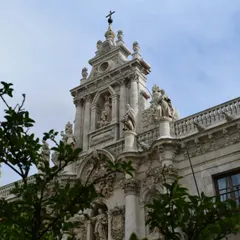
Cathedral of Nuestra Señora de la Asunción

The great Herrerian promise of the court of Valladolid that remained half-built. A detailed analysis of what to see at the Cathedral of Valladolid and the secrets of an asymmetric work that testifies to its own history.

Faced with the Cathedral of Valladolid, the first impression is not that of a traditional gothic temple loaded with ornaments, but that of a severe, clean stone mass of almost military order. Designed by Juan de Herrera in 1585, this temple was conceived on a colossal scale, intended to reflect the enormous ambition of a city that aspired to permanently house the court of the Spanish monarchy. However, the current building constitutes a monumental unfinished architectural puzzle.

Only half of Herrera's initial plans were actually built. The rest of the original project was suspended due to the transfer of the court to Madrid and the lack of funds, leaving a truncated and asymmetric silhouette. Stepping into this construction is not a visit to a conventional temple, but a great lesson in architecture and survival, where emptiness and absences take on as much importance as the stone walls that remain standing.

Project by Juan de Herrera — A 1585 design that sought to impress the imperial court
The unfinished volume — Only half of the original layout was actually built
Collapse of 1730 — The tragic collapse of the original Epistle tower
Baroque high altarpiece — A colossal 17th-century piece moved from the Antigua church
Capilla de San Blas — The visible remains of the Romanesque collegiate church of 1095
45 min of audioSevere Classicism
02
Cathedral of Nuestra Señora de la Asunción
03
Isabelline Gothic

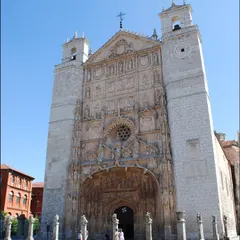
Church of San Pablo

The great Dominican church of Valladolid famous for its altarpiece-facade and its close relationship with the Spanish crown. A tour of the history of the Church of San Pablo of Valladolid and its legacy linked to the court.

The Church of San Pablo of Valladolid stands in the square of the same name as one of the peak works of Late Gothic in Spain. Its impressive carved stone facade, sculpted at the end of the 15th century under the patronage of Bishop Alonso de Burgos, functions as a gigantic open-air altarpiece. However, this temple was not conceived solely for the contemplation of the Dominican friars: it was designed as a monument of enormous courtly symbolic load, prepared to project power and prestige.

Due to its location adjacent to the royal palace and the institutional center of the era, San Pablo was the scene of key milestones of the Spanish monarchy, hosting ceremonies as significant as the baptisms of kings Philip II and Philip IV. After the 19th-century reforms and the loss of most of the original convent complex due to the confiscation, the temple stands today detached on a deeply redefined square, inviting the exploration of the secrets that its dense stone continues to guard.

Isabelline altarpiece-facade — The dense labyrinth of sculpted stone linked to the circle of Simón de Colonia
Royal baptisms — The liturgical and dynastic stage of Philip II and Philip IV
Patronage of Alonso de Burgos — The confessor of the Catholic Monarchs who rebuilt the temple
Convent of 1276 — The Dominican dependencies lost after the confiscation of 1835
35 min of audioLate Gothic
03
Church of San Pablo
04
Polychrome Sculpture

National Sculpture Museum

The most important collection of polychrome sculpture in Spain in an extraordinary Gothic college. An analysis of what to see at the National Sculpture Museum of Valladolid and its secret history of art and rescue.

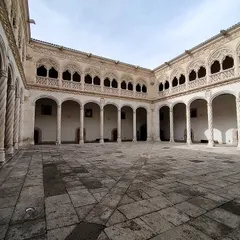
The National Sculpture Museum of Valladolid represents a perfect marriage between Castilian architecture and sacred art. Its main headquarters, the College of San Gregorio, is one of the peak works of Isabelline Gothic from the late 15th century. Founded by Bishop Alonso de Burgos, the building does not act as a simple cold museum container; on the contrary, its stone, its tracery, and its historical courtyards constantly dialogue with the religious carvings it houses inside, providing the visit with a unique atmosphere.

The collection stands out exceptionally for its specialization in polychrome wood sculpture from the 16th and 17th centuries, gathering masterpieces by Baroque geniuses such as Gregorio Fernández. The majority of these highly realistic images come from monasteries and convents confiscated in the 19th century, making this national museum a great archive of Spanish religious memory. Touring its rooms dispersed across several monumental palaces in the center of Valladolid, one discovers how painted wood transforms into a motionless theater.

College of San Gregorio — A late Gothic gem declared a National Monument in 1884
Gregorio Fernández — The Baroque sculptor who revolutionized the Holy Week in Valladolid
Confiscation rescue — Carvings rescued from convents by the State since 1842
Villena Palace and House of the Sun — Annexed locations that expand the monumental route
San Gregorio Courtyard — The Isabelline cloister that heralds the early Renaissance
90 min of audioSacred Imagery
04
National Sculpture Museum
05
Literary Museum

Cervantes House Museum

The only real home inhabited by Miguel de Cervantes preserved in Spain, where the first edition of Don Quixote saw the light of day. A tour of the Cervantes House Museum of Valladolid and its secret history.

The Cervantes House Museum of Valladolid is a corner of enormous literary and biographical significance. The author of the Exemplary Novels settled in this address in 1604, in a neighborhood on the urban periphery of Valladolid that was experiencing a high demand for rentals due to the transfer of the royal court of Philip III in 1601. Cervantes resided in these rooms of low ceilings and modest scale when the first edition of Don Quixote appeared from the presses of Juan de la Cuesta in 1605.

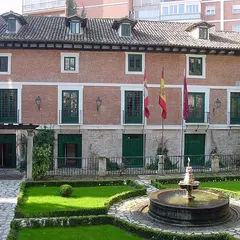
The building, a typical Castilian tenement house structured around a courtyard with a well, was identified as the Cervantes residence in the 19th century, which led to its subsequent purchase by the State in 1942 and its opening as a house museum in 1948. Through a careful historical recreation with period furniture and utensils, the museum recovers the daily domestic atmosphere of the Golden Age. However, beneath this peaceful atmosphere of garden and brick hide the traces of a homicide at its doors that dragged the writer and his family to the courts.

The Don Quixote of 1605 — The great universal masterpiece conceived and corrected in these rooms
Ezpeleta homicide — The violent dawn of 1605 that led Cervantes to jail
Castilian tenement — The original entrance hall, courtyard, and well that organized the neighborhood
House museum of 1948 — The recreation of daily life in the Golden Age
The 20th-century garden — The green corner created to evoke the writer's literary retirement
50 min of audioTenement House
05
Cervantes House Museum
06
Iron Architecture

Gutiérrez Passage

The elegant commercial gallery of 1886 that imported to Valladolid the dream of Parisian covered passages. An analysis of what to see at the Gutiérrez Passage of Valladolid and its secret history of splendor and rescue.

The Gutiérrez Passage of Valladolid was inaugurated in 1886 as a luxurious covered commercial gallery, promoted by the initiative of merchant Eusebio Gutiérrez. Projected by architect Jerónimo Ortiz de Urbina, the work represented an original urban surgery operation in the middle of the historical center, puncturing the interior of the pedestrian block to connect Fray Luis de León and Castelar streets directly. With this, a concept of bourgeois commercial promenade, very uncommon in late 19th-century Spain, was introduced to the city.

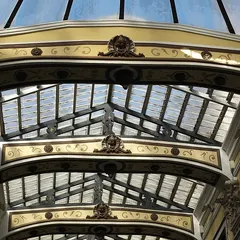
Its slender glazed roof with iron supports follows the direct influence of the passages of Paris and other European capitals of the industrial era. In the interior crossing of its two sections stands out an octagonal widening crowned by a glass dome that concentrates the zenithal light, illuminating a profuse eclectic decoration of plasterwork, caryatids, and pilasters. After overcoming a phase of severe decay during the 20th century, the passage was thoroughly rehabilitated, managing to remain today as one of the few and most alive historical passages preserved in Spain.

Iron and glass structure — The industrial roof of 1886 that filters the light from the sky
Octagonal rotunda — The central widening crowned by the large glazed dome
Statue of Mercury — The effigy of the Roman god of commerce in the center of the rotunda
Eclectic plasterwork — Caryatids and classical reliefs that stage the bourgeois shopping
Late 20th-century restoration — The heritage rescue that prevented the degradation of the corridor
20 min of audioCovered Passage
06
Gutiérrez Passage
07
Historical Garden

Campo Grande

The great romantic and historical green lung of Valladolid and a unique urban zoo populated by peacocks. A tour of what to see at the Campo Grande of Valladolid and its history as a fairground and military wasteland.

The Campo Grande of Valladolid represents the great green and sentimental parlor of the city. Listed today as a Historical Garden, this space of winding paths and cool shade was not born with its current design: for centuries it was a rough wasteland located outside the walls of the medieval town, useful precisely for its size for holding fairs, markets, and exercises of military discipline and parades, already documented under this name by the council in the Late Middle Ages.

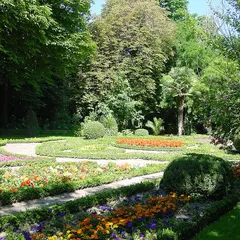
In 1787, under the enlightened impulse in the times of Charles III, its layout as a regular tree-lined walk was approved, a physiognomy that would evolve in the 19th century towards the current romantic aesthetic, with curved paths, century-old trees, waterfalls, and a pond. Bordered by the elegant Acera de Recoletos and a few meters from the North railway station of 1860, the park acts as the first botanical welcome for travelers and as a daily refuge where the bourgeois walk, literature, and the presence of its famous free-roaming peacocks coexist.

Romantic paths — Curved ways and mature trees that break the straight urban layout
Peacocks — Exotic birds in semi-freedom turned into the sentimental emblem of the park
Pond and waterfall — The water corner designed for contemplation and bourgeois leisure
Monument to Zorrilla — The great sculptural group from 1900 that pays tribute to the local poet
Fountain of Fame — Monumental 19th-century sculpture moved to the interior of the park
45 min of audioHistorical Garden
07
Campo Grande

Questions about the Valladolid audio guide

How much does the Valladolid audio guide cost?

The EarGuide app is free. The Valladolid audio guide includes 7 walking routes with over 5 hours of professional narration across 7 monuments and more than 30 points of interest. Download it free on the App Store and Google Play.

Do I need internet to use the audio guide?

No. EarGuide works completely offline. Download the routes over WiFi before you head out and you can use the audio guide without internet or mobile data throughout your entire tour of Valladolid.

What languages is the Valladolid audio guide available in?

The Valladolid audio guide is available in Spanish and English, with professional narration recorded by historians and experts in Castilian culture.

How long does the full tour take?

The audio guide includes 7 independent routes with over 5 hours of narrated content in total. Each route takes between 20 and 90 minutes on foot. You can do each route separately or combine several in a single day, at your own pace.

Is an audio guide better than a free tour or guided visit?

They are different experiences. EarGuide's audio guide lets you explore Valladolid with no schedules or groups, pause and resume whenever you like, and replay any explanation as many times as you need. It's ideal for independent travellers, families and anyone who prefers a more flexible and in-depth tour than a conventional free tour.

Which monuments and points of interest are included?

The Valladolid audio guide covers 7 major monuments: Plaza Mayor, Catedral de Nuestra Señora de la Asunción, Iglesia de San Pablo, Museo Nacional de Escultura, Casa de Cervantes, Pasaje Gutiérrez and Campo Grande.

Download the Valladolid audio guide for free

Download EarGuide free and carry all Valladolid audio guides in your pocket. Offline, at your own pace.

More audio tours across Spanish cities

Valencia
Valencia

From the City of Arts and Sciences to the Carmen neighbourhood. Discover 2,000 years of Valencian history with audio guides.

Explore Valencia
Coming soon
Your city?

We are working to bring EarGuide to more cities in Spain and Europe. Where do you want to discover culture?

Notify me