Underground City
Almoina Archaeological Center Audio Guide (Centro Arqueológico de la Almoina)
Forget intact monuments. Here you go underground to see the exact scar of how a city was founded, burned down, and rebuilt.
- 60 min of audio
- Underground Site
Do not expect romantic ruins set there for a photo. What defines the architecture of the Almoina Archaeological Center is a forensic cut in the subsoil. Discovered by pure chance in 1985 while laying the foundations for an expansion of the Cathedral, this site is an archive of earth and stone that stacks more than two thousand years of history without filters.
From the first Roman stone to the foundations of the Islamic alcazar, all the power and tragedy of Valencia are concentrated in these very square meters. At first glance, stones and walkways. But when you understand what you are looking at, it is the rawest place in the city.
Highlights
- Crossroads of the Cardo and Decumanus — The ground zero of the Roman foundation.
- Ash layer from 75 BC — The stratified proof of total destruction.
- Skeleton with pilum — Forensic evidence of a massacre in the Sertorian Wars.
- Visigothic baptistery — Cruciform plan font from the 6th century.
- Islamic engineering — Islamic waterwheel and pool built on the ruins.
Let’s be honest: most people step on the upper square ignoring the historical void under their shoes. This site is not a museum of pristine sculptures; it is physical proof that the history of Valencia is a violent accumulation of debris, reconstructions, and survival. There are no assumptions here. You have the original pavements, the tombs, the Islamic water systems, and the ashes of the fires in plain sight. With the audio guide, as you walk along the metal walkways, those stones cease to be an incomprehensible puzzle and become the city’s dossier.
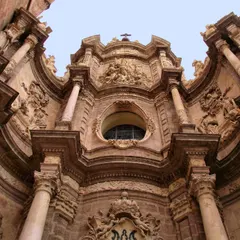
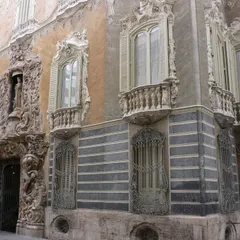
Right next door rises Valencia Cathedral, and a few minutes’ walk away the Palace of the Marqués de Dos Aguas swaps Roman ruins for Rococo.
The square that is actually a roof
Almoina Archaeological Center
Summary of this stop
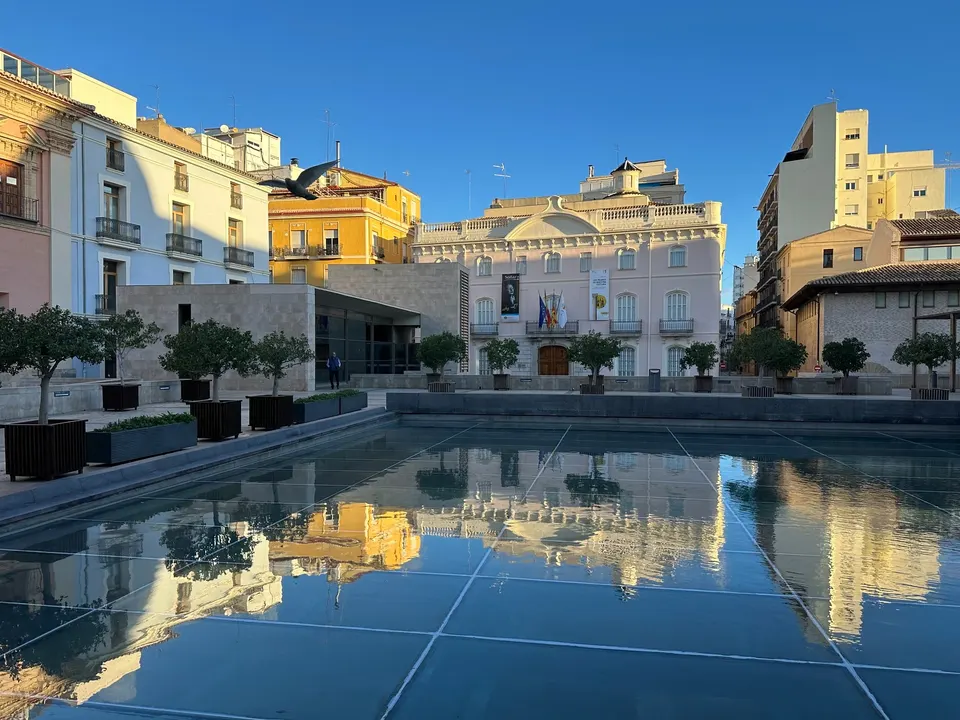
The deception begins before entering. The large sheet of glass and water in the outer square, inaugurated in 2007, seems like a simple urban design decision. In reality, it is a skylight that sheds light on a hole discovered unexpectedly in 1985.
They were going to expand the Cathedral and unexpectedly stumbled upon the bowels of the original city. When descending below the current street level and looking up, the reflection of the water on the roof casts patterns over the ruins. It is the first warning: down here, the perspective of what you thought you knew about Valencia changes completely. What else is hidden exactly beneath the asphalt we walk on daily? The audio guide will detail how that fortuitous discovery paralyzed the works.
The crossroads where Valentia began
Crossroads of Cardo and Decumanus
Summary of this stop
Roman cities were not born by spontaneous generation. Year 138 BC: Consul Decimus Junius Brutus Callaicus needed to settle the veterans of the Lusitanian wars. What you have in front of you is the pavement of the Cardo and Decumanus, the main arteries that dictate the exact center of power.
But the foundation of Valentia was not a bureaucratic formality; it was a sacred ritual. Documented tradition speaks of the sulcus primigenius, a perimeter traced with a bronze plow and white oxen to separate the divine from the wild. You are looking at the mathematical and spiritual epicenter of that act. In the audio we will reconstruct step by step how that inauguration was executed, sealing the fate of this plot forever.
The ash that reveals a massacre
Sertorian ash layer
Summary of this stop
If you are looking for what to see in the Almoina Archaeological Center and expect only imperial greatness, stop at the thick dark strip of the archaeological stratum. It is ash. Around the year 75 BC, during the Sertorian Wars, Gnaeus Pompeius Magnus devastated the city.
It wasn’t just a fire. A few meters from the ash lies the replica of a human skeleton with a pilum (javelin) next to it. Excavations revealed dismembered bodies and decapitated families. These are not combat casualties, it is forensic evidence of a mass execution of civilians. Archaeology rarely allows us to see the faces of the victims so vividly. The complete account of the siege and brutal repression awaits you in our on-site narration, where bones speak louder than textbooks.
From the forum to the baptistery and the water
Visigothic Apse and Baptismal Font
Summary of this stop
Power is parasitic, and this land never lost its magnetism. Over the Roman ashes, in the 6th century AD, the Visigoths installed their machinery of authority. Here you will see the remains of a monumental tomb from the mid-6th century, attributed to Bishop Justinian, and a unique cruciform baptismal font.
But history did not stop at the cross. Then came 711, the Muslim conquest erased the baptistery and the space was engulfed by the alcazar. They built a pool and a waterwheel —whose circular foundations are still here— using the rubble of the past to water their gardens in the Islamic era. Three different civilizations parasitizing the same nerve center. What secrets are really hidden in the link between this place and the martyr Saint Vincent? In the audio guide we will break down the academic controversy versus the legend.
Why this place is called Almoina
Almoina Archaeological Center
Summary of this stop
To understand the secret history of this museum, you have to look at its name. “Almoina” means alms. It does not refer to emperors, or bishops, or caliphs.
In 1303, the bishop of Valencia Ramón Despont founded a Gothic charity building on this exact spot. For five centuries, over the ruins of forums and alcazars that you have just toured, hundreds of Valencians queued every day to receive a piece of bread and broth. This place is not just a repository of ancient architecture; it was the lifeline of the poorest until the 19th century. Download the app and join us to hear the echo of the everyday stories that stepped on the same stones you are going to step on today.