Baroque Manifesto
Palace of the Marqués de Dos Aguas Audio Guide (Palacio del Marqués de Dos Aguas)
Discover how a Valencian nobleman tore down his medieval castle to build the wildest exercise in Baroque vanity in the city. Today, paradoxically, it guards everyone's ceramic memory.
- 60 min of audio
- Aristocratic Vanity
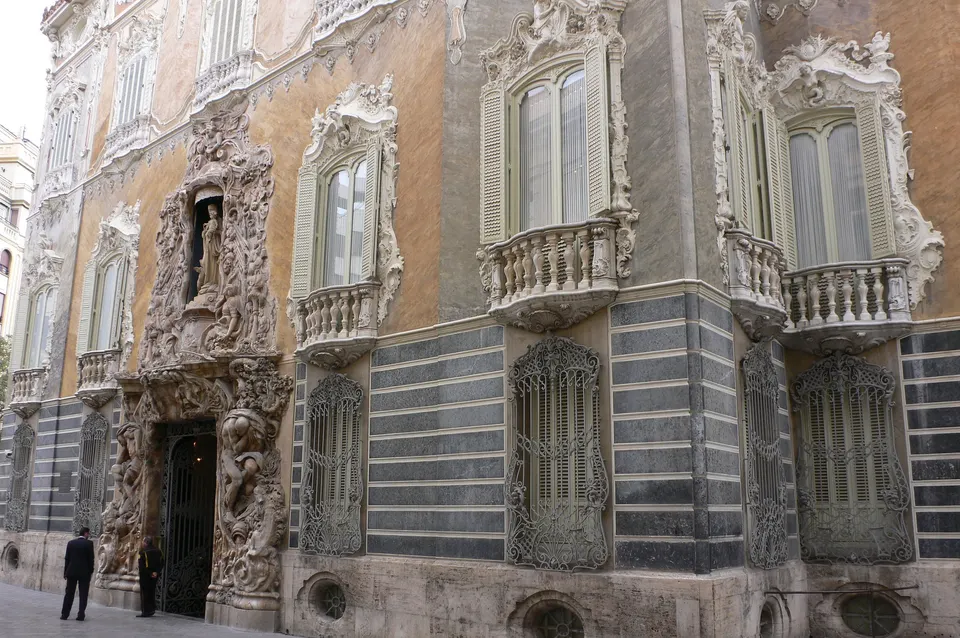
When planning what to see in the Palace of the Marqués de Dos Aguas, you should park your naivety. What you are going to find is not a peaceful home, but a calculated exercise in power propaganda. Between 1740 and 1744, the 3rd Marquis, Giner Rabassa de Perellós, decided that his palace did not command enough respect. Without his pulse trembling, he ordered the demolition of the severe Gothic crenellated towers that gave character to his lineage to commission a radical Baroque reform. The goal was not beauty, it was the visual submission of the passerby. Walking through these rooms today with our audio guide is learning to read between the lines of unbridled ambition.
That architectural excess today encloses formidable paradoxes. Behind a facade that shouts noble exclusivity, now beats the fragile history of the artisan tradition. And although the current building imposes reverence, its walls have endured aggressive redecorations, art exiles, and deceptive reconstructions that have altered its original essence. Nothing is exactly what it seems.
Highlights
- Alabaster Portal — Ignacio Vergara's sculpture that defies restraint.
- Inner Courtyard — Showcase of Rococo luxury and home to the immense Carriage of the Nymphs.
- Traditional Kitchen — More than 1,500 historical tiles that hide a curatorial trick.
- 19th Century Halls — The profound Elizabethan and neo-empire alteration of 1853.
Planning a visit to this point in the city requires looking beyond traditional tourist guides. The architecture of the Palace of the Marqués de Dos Aguas is not designed to please, but to overwhelm. What began as the Gothic abode of the Rabassa de Perellós family mutated, out of pure whim and demonstration of status, into an unprecedented ornamental extravagance. Throughout the tour, we will give you the audio clues so you do not let yourself be blinded by the gold leaf and understand how this building has survived its own owners, reinventing itself from an elitist palace to a container of popular Valencian art.
A few minutes’ walk away lie Valencia Cathedral and the Almoina Archaeological Center, and in the opposite direction, the Town Hall Square.
The narrow street and the Baroque strike
Palace of the Marqués de Dos Aguas
Summary of this stop
The first impact assaults you on the street itself. The surrounding urban space is surprisingly narrow, and suddenly, the monumentality of the building falls upon you. This spatial asphyxiation is intentional. In 1740, the 3rd Marquis of Dos Aguas, driven by an undisguisable ego, ordered the demolition of the old medieval crenellated towers that protected his original house.
His mandate was clear: execute a Baroque reform so radical that it would erase any trace of the defensive past to establish a present of absolute ostentation. Everything had to be finished in 1744. The scale of what they built dwarfs the pedestrian and raises a reasonable doubt. What level of arrogance is required to demolish the history of your own lineage just to silence your contemporary rivals? The answer awaits you just a few steps from the entrance.
Two rivers, a title, and a provocation
Alabaster portal
Summary of this stop
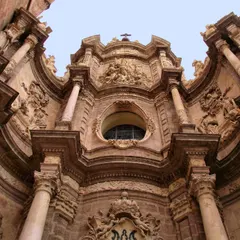
Approach the main door and adopt a critical stance. This mass spilled in alabaster from the Niñerola quarries is the work of the sculptor Ignacio Vergara. Originally, the painter Hipólito Rovira designed this whole set, including some frescoes of a triumphal chariot that covered the facade and that the weather —and subsequent neglect— took care of erasing.
Pay attention to the two muscular and naked giants flanking the entrance. They are not there out of love for classical anatomy. They are allegories of the Turia and Júcar rivers, a direct, insistent, and colossal allusion to the title of “Dos Aguas” (Two Waters). However, the street always has the last word against the nobility. These statues caught on so well in Valencian popular sarcasm that today they are still alive in the expression “to be more naked than the Turia and the Júcar” to refer to total ruin. But the facade holds a coded message about who really ruled in the city. In the audio guide, we will point out the exact spot where you should fix your eyes to discover it.
The carriage and life turned into a spectacle
Carriage of the Nymphs
Summary of this stop
Crossing the threshold and entering the courtyard, silence replaces the outside roar, but the vanity remains. Here the ‘Carriage of the Nymphs’ is exhibited, an 18th-century French Rococo vehicle. It was not a means of transport, it was a mobile stage used exclusively in high solemnity events so that the 3rd Marquis could be idolized by the masses.
If you look up at the wrought-iron French balconies, you must know that you are being deceived. They do not belong to Rovira’s original design. Between 1853 and 1867, with Vicente Dasí y Lluesma as owner, the palace underwent a second major reform directed by the architect Ramón María Ximénez Cros, who mercilessly tore out the remains of the Baroque frescoes and redecorated the halls to the Elizabethan and neo-empire taste of the time. Pure rotation of aristocratic fashions. However, the true secret history of this place is much denser. What other transformations and whims do these halls hide beneath the gold leaf? We will relate it step by step as you climb the stairs.
The kitchen that was not born here
Traditional Valencian kitchen
Summary of this stop
The closing of this palace is a magnificent exercise in historical irony. The building, built to glorify an exclusive blood, was declared a Historic-Artistic Monument in 1941 and bought by the Spanish State in 1949. Already in 1947, thanks to the cunning and tenacity of the scholar Manuel González Martí, the National Museum of Ceramics had been created, which ended up housed within its walls.
Observe now the recreation of the traditional Valencian kitchen. It is dazzling, covered by more than 1,500 tiles from the 18th and 19th centuries. But this is where skepticism comes into play: this room is a curatorial mirage. The kitchen does not belong to the real history of the palace. It was assembled in 1954 by González Martí himself using tiles torn and recovered from other humble or demolished homes. The great totem of the nobility ended up serving as an architectural patch to save popular memory. To discover which tiles hide the signatures of the true artisans of Manises and disarm the rest of the tricks of this museum, put on your headphones and join us.