Industrial Modernism
North Station Audio Guide (Estación del Norte)
A terminal designed to impress and dominate. Discover how a private company disguised its corporate propaganda as a tribute to the city.
- 30 min of audio
- Sezession Architecture
At first glance, it's easy to be fooled by the avalanche of ceramics and floral motifs. But if you are considering what to see at Estación del Norte (North Station), you should know that this building was not born from a burst of local romanticism, but from cold corporate calculation.
To cut to the chase, the architecture of Estación del Norte hides much more than just century-old ticket offices. Behind its careful aesthetics there are strikes, bombings, and ghost projects that no one bothers to look at.
Highlights
- Sezession Facade — Corporate propaganda disguised as local ceramics.
- Historical Lobby — Wooden ticket offices intact since 1917.
- Mongrell Mosaics — The 'Bon Voyage' greeting in pure trencadís.
- Iron Canopy — 45 meters of span and pure foundry engineering.
Do not expect a peaceful or complacent monument. Estación del Norte is, above all, a declaration of intent financed with private capital at the beginning of the 20th century. Today, travelers rush by dragging suitcases, ignoring that they are walking on one of the most ambitious and turbulent engineering works in the city. Join me on this route, because the secret history hidden in this place requires stopping in your tracks, looking up, and doubting your first impressions. I guarantee that, with the audio guide running, the noise of the trains will fade into the background.
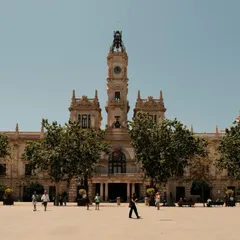
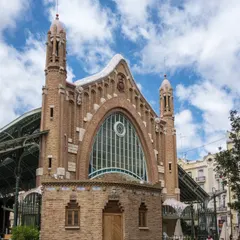
Valencian modernism continues at the Colón Market, and a couple of streets away the Town Hall Square opens out.
The name deceives and the facade explains
Main facade
Summary of this stop
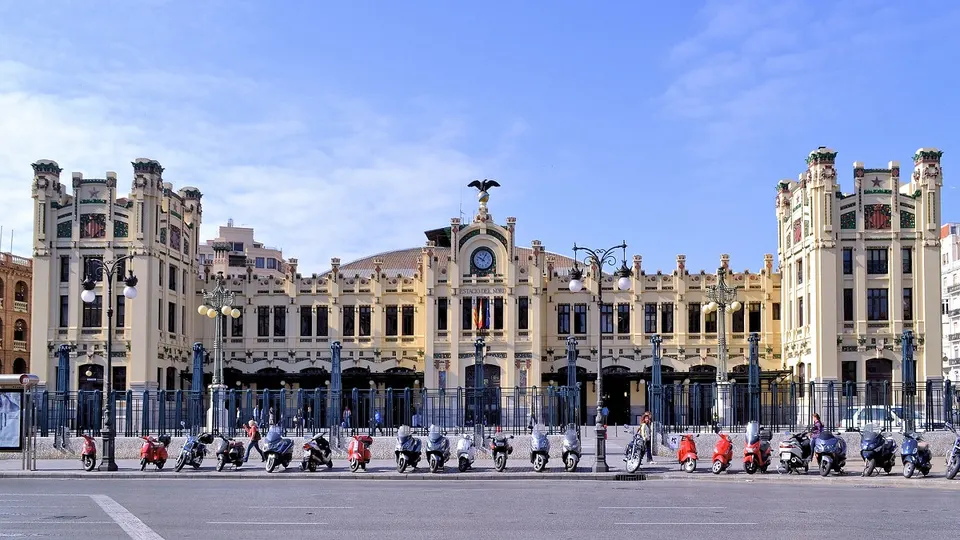
You are standing on the southern esplanade of the historic center of Valencia, but the building in front of you is called “Estación del Norte” (North Station). A geographical error? Not at all. It’s pure 1917 marketing. The name belongs to the Compañía de los Caminos de Hierro del Norte de España, owner of the line, which connected Madrid with the northern half of the country.
If you look at the huge eagle crowning the building on a globe, do not look for Valencian symbolism; it is the emblem of the company, a visual representation of the speed of the railway. To soften the corporate tone, they commissioned the local factory ‘La Ceramo’ to flood the facade with oranges, roses, and orange blossoms. A full-blown public relations strategy. Do you want to know what else this facade is lying to you about? In the audio I will debunk a couple more myths before crossing the door.
Bon Voyage: Valencia bids you farewell
Lobby and ticket offices
Summary of this stop
Cross the threshold and let the scale of the lobby do its job. Designed in 1906 and built between 1907 and 1917 by the architect Demetrio Ribes, this room still preserves the original wooden ticket offices. It is one of the few places where the past does not look like a cardboard replica.
Here the great attraction are the trencadís mosaics by the painter José Mongrell and the wooden wainscoting that wish you a “Buen Viaje” (Bon Voyage) in several languages. But the mosaics are not just decorative panels. They represent two very different women. Popular culture is very clear about who the traditional woman dressed as a huertana is and who the cosmopolitan woman is. It is a silent tug-of-war between local identity and the outside world to which the train opened its doors. Who wins that arm wrestling I will reveal as soon as you put on your headphones under these very lamps.
The great canopy and what it had to endure
Platform canopy
Summary of this stop
Let’s go out to the platforms. The architecture of Estación del Norte changes drastically. Ribes had contacts with Otto Wagner, so he applied the modernism of the Viennese Sezession, much more geometric and rigorous than the Catalan style, to erect this monstrosity of iron and glass. It is 45 meters wide and 24 meters high. Pure engineering, functional and skeptical of any unnecessary ornament.
But this technical vault was not immune to reality. On the afternoon of May 28, 1937, the Italian aviation bombed this very station, leaving a trail of destruction and death among the waiting civilians. The industrial beauty you see today has very real scars. Walking around here without knowing what fell from the sky is seeing only half the picture. Get ready, because the on-site narration will make your hair stand on end.
The station that is still alive, even incomplete
Estación del Norte Platforms
Summary of this stop
Despite everything, it has been a National Historic-Artistic Monument since 1961 and has never interrupted its service. However, its official history is full of stumbling blocks. Did you know that it was inaugurated on August 8, 1917, without authorities or official speeches? It opened in a surprisingly discreet way, amid enormous social tension: a few days later the revolutionary general strike of August 1917 would break out.
And to top it off, its history is full of projects that never got off the ground. According to some accounts, Ribes’s original plan even contemplated a metal tower that was never built. If you want to know exactly which plans never materialized and how this station served as a refuge in the worst natural disaster of the city, download the app. I’ll wait for you at the end of the platform.