Political and Fallas Center
Town Hall Square Audio Guide (Plaza del Ayuntamiento)
Neither its shape was planned, nor is its history peaceful. Discover how a neighborhood wiped off the map became the great civic stage of Valencia.
- 25 min of audio
- Contemporary Urban History
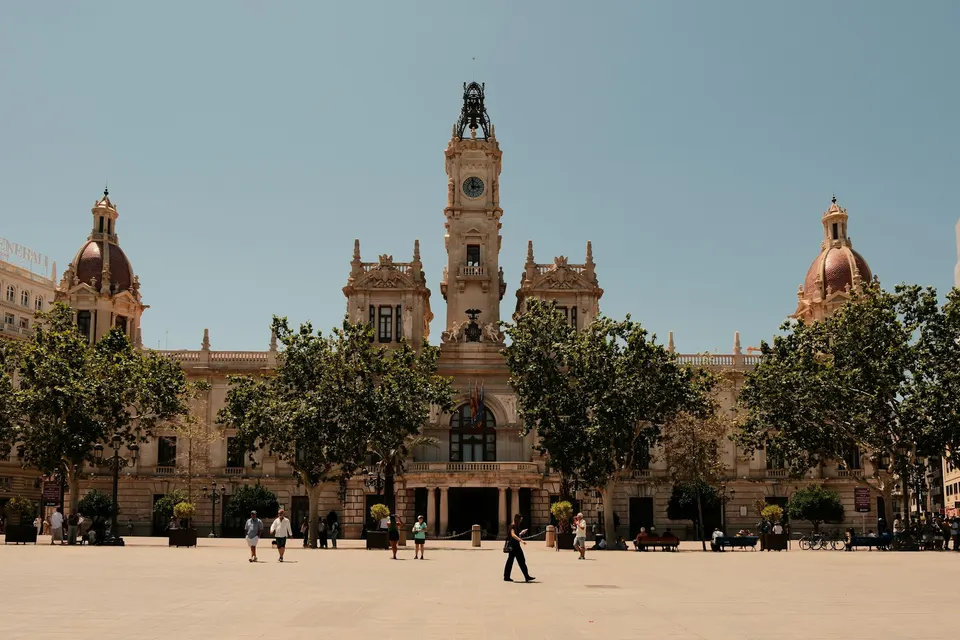
If you are looking for what to see in the Town Hall Square, be prepared to question what is in front of you. The official narrative sells this space as the natural heart of the city, but the reality is the result of a brutal demolition. This huge esplanade did not exist before the 20th century; it was born by completely razing the Convent of San Francisco and the attached fishermen's neighborhood. Behind its imposing facades, the secret history of this place hides constant political changes, names crossed out on plaques, and war scars that tourist postcards prefer to omit.
Far from being a peaceful relic, the architecture of the Town Hall Square is a theater of operations. It was flooded by more than two meters of water in the Great Flood of 1957, used as a testing ground for architectural modernity, and, finally, converted into a pedestrian zone. A canvas where municipal power tries to impose order, while tradition demands making the ground shake with tons of gunpowder.
Highlights
- The great void — A 1928 urban triangle born on the rubble of a neighborhood.
- Palace of Communications — A 1923 colossus crowned by an aerial lighthouse.
- City Hall — False unitary building that hid an air raid shelter.
- The Altar of Gunpowder — Official stage of the mascletàs since 1945.
If you are planning what to see in the Town Hall Square, the first thing you will notice is that the scale of the space is disproportionate for an old-layout city. Do not trust the apparent perfection of the whole. This square is an exercise in urban amnesia. What you are stepping on today was, until the first third of the 20th century, a dense fishermen’s neighborhood and a huge convent. The “tabula rasa” policy was applied here to build the identity of a Valencia that wanted, at all costs, to look like a modern European capital.
You will walk on a space that has changed its name as many times as the country has changed its political regime. From San Francisco to the Second Republic, going through the dictatorship until its current name. The stones of the square are a silent record of the recent history of Spain. But to read those scars, you need to know where to look. By putting on your headphones, we will put the postcards aside to understand the real cost of building a symbol.
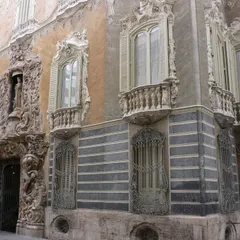
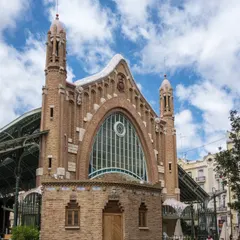
From the square, it is a few minutes’ walk to the Palace of the Marqués de Dos Aguas and the Central Market, and a couple of streets to the North Station, a modernist gem.
The triangle that swallowed a neighborhood
Town Hall Square
Summary of this stop
They sell us a logical and structured esplanade, but this large triangular plan is almost an accident. Its definitive shape, consolidated between 1927 and 1933, was not the product of a brilliant master plan, but the inevitable geometric consequence of joining the irregular plot left by the demolished convent with the new rectilinear axis of Marqués de Sotelo street.
Basically, the city ate a whole neighborhood to breathe. They eliminated narrow streets and old ways of life to establish asphalt and visual control. As you walk through the center of the esplanade, it is fair to wonder: what was left of those who lived here before the cranes arrived? In the audio guide we unearth exactly what the concrete tried to bury definitively.
The post office and the city that wanted to look modern
Palace of Communications
Summary of this stop
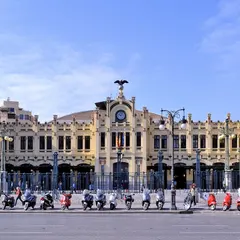
Facing the City Hall stands the Palace of Communications, inaugurated in 1923. Its metallic structure and imposing dome did not only respond to postal needs, but to pure technical propaganda. Valencia wanted to flex its muscles. Its tower literally functioned as an aerial lighthouse for navigation, a visual claim that shouted technological progress to the four winds.
Fast-forwarding a century, the desire for transformation remains intact. In May 2020, the square underwent its last great mutation when it was pedestrianized, erasing the iconic and chaotic traffic roundabout that defined it for decades. A decision that returned the space to citizens, not without generating heated debates about mobility. We will guide you through this reconquered asphalt so you can judge for yourself if the result lives up to the original ambition of the building in front of you.
The balcony, the clock, and the years of fear
City Hall
Summary of this stop
The architecture of the Town Hall Square lies, and the best example is the town hall building itself. That large monumental facade you see (added between 1906 and 1930) is an aesthetic patch designed to cover and unify the old 18th-century Casa de Enseñanza. Everything in this square seeks to project stability, but this building knows panic firsthand.
During the Civil War, with Valencia as the capital of the Republic, this esplanade stopped being a place of transit to become a target. Its historic carillon fell silent around 1971 and remained mute for almost half a century, until its restoration in 2017. Meanwhile, the basement of the City Hall served as an air raid shelter. If you download the on-site route, we will place you exactly at the point where the civilian population ran to hide when the sound of the bells was drowned out by the sirens.
Flowers, gunpowder, and a recovered square
Flower Stalls
Summary of this stop
The last stretch of the tour is marked by two volatile elements: water and fire. The current central fountain dates from 1963 and its construction required, true to the destructive tradition of the place, demolishing an earlier platform known as “la torta”, which housed the flower market. Today, the stalls survive aligned on one side, bringing color to a square dominated by gray and white.
But the true owner of this space is the noise. Since 1945, the square has been the official venue for the mascletàs. Up to 120 kg of gunpowder are detonated here daily during the Fallas. There are no automatic switches; the firing order is given by a human voice from the balcony, an almost totemic ritual that unleashes coordinated chaos. In front of the flower kiosks, we will tell you the secret of the roar that makes the foundations of the square tremble and how the echo of gunpowder defines Valencia much better than any of its buildings.