Futuristic Architecture
City of Arts and Sciences Audio Guide (Ciudad de las Artes y las Ciencias)
A complex that transformed the dry bed of a river into a sci-fi set, marked equally by architectural genius and millionaire controversies.
- 90 min of audio
- Secret History
Beyond the impeccable postcards, the architecture of the City of Arts and Sciences holds a history of political ambition and cost overruns. Built on the old bed of the Turia River, this immense white and blue ensemble defies gravity and, sometimes, the financial logic of a city that wanted to rewrite its skyline.
Walking among these immense biomorphic structures requires a critical eye. Discovering what to see in the City of Arts and Sciences implies scratching under its brilliant trencadís surface to find exiled geniuses, ironic floods, and a sharp popular humor that demystifies the solemnity of the work.
Highlights
- L'Hemisfèric — The immense eye of wisdom inaugurated in 1998.
- Museu de les Ciències — A whale skeleton under the scorching sun.
- L'Oceanogràfic — The posthumous legacy in concrete of the master Félix Candela.
- Pont de l'Assut de l'Or — The highest structural point in Valencia.
Planning what to see in the City of Arts and Sciences is usually limited to admiring its immense scale against the deep blue sky. But this place demands more skepticism. Born in the dry bed of the Turia River after the tragic flood of 1957, the complex is a monument to the overflowing ambition of the late 20th century. Here, the secret history weighs as much as the tons of steel. Between the blinding reflections of the ponds and the echo on the walkways, the audio guide will reveal not only the visual achievements but the chiaroscuros and cracks of a futuristic dream that forever altered the accounts and landscape of the city.
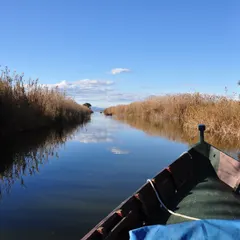
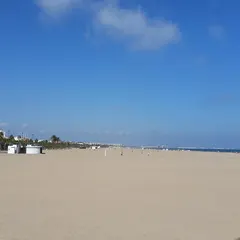
From here, the Turia Garden leads back to the centre along the old riverbed; towards the sea lies Malvarrosa Beach and, to the south, the Albufera Natural Park.
The future built on a river
L'Hemisfèric
Summary of this stop
The initial impact of this complex is not understood by looking at the sky, but by looking down. You are stepping on the bed of a river that the Spanish Government forcefully diverted after the devastating flood of 1957. Nature was suppressed so that, decades later, this aseptic esplanade could be planted in its place.
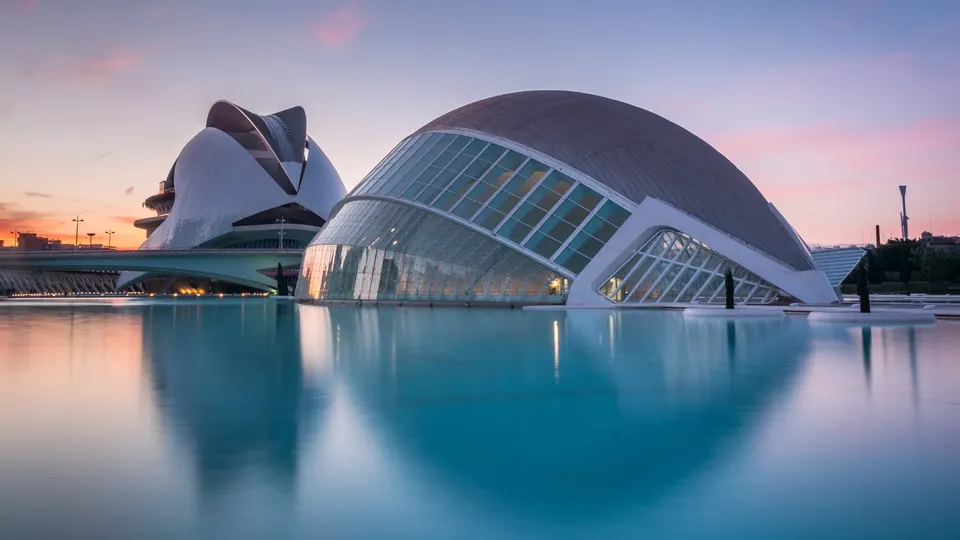
The first giant to open its doors was L’Hemisfèric, inaugurated on April 16, 1998, by the architect Santiago Calatrava. It was designed with the literal shape of a human eye, projected as a symbol of wisdom emerging from the water. But what exactly did this huge eye witness during its early years while the rest of the work suffered constant alterations? The answers await you in the on-site narration.
An eye and a skeleton to look at
Museu de les Ciències Príncipe Felipe
Summary of this stop
The architecture of the City of Arts and Sciences completely ignores subtlety. The buildings imitate bodies. In front of you, the Museu de les Ciències extends like the calcareous skeleton of a stranded whale, while the nearby Palau de les Arts simulates a large fish or a Spartan helmet.
To protect these creatures from the sun and visually unify the complex, they used ‘trencadís’, the mosaic of tile fragments popularized by Gaudí. These thousands of pieces reflect the blinding light, duplicating the complex in the reflecting pools. However, this pristine white skin hides serious design frailties that the official version usually omits. Walking with us, you will understand why architectural beauty sometimes clashes with physics.
The brilliant opera with cracks
Palau de les Arts Reina Sofía
Summary of this stop
The original design commissioned in 1989 by Joan Lerma did not contemplate an opera house. Instead, Calatrava projected a 370-meter communication tower. It was in 1996 when Eduardo Zaplana canceled the tower and rewrote the project to include the Palau de les Arts Reina Sofía, reformulating the purpose of the work and significantly inflating the costs.
But irony does not forgive. In November 2007, this monumental fish-shaped building, erected in a dry riverbed, suffered a catastrophic flood that destroyed its advanced stage machinery. Building in the Turia riverbed had predictable risks. On our guided tour, you will discover how the water returned with fury to take its toll for this geographical alteration.
Candela’s farewell in concrete
L'Oceanogràfic
Summary of this stop
Not all the design of this immense complex bears Calatrava’s signature. Upon reaching L’Oceanogràfic, you will notice that the forms become lighter. Its unmistakable parabolic roofs are the final work of Félix Candela, an exiled genius of concrete structures.
Candela conceived these elegant domes as his triumphant return to Spain when he was over 80 years old, but he died in 1997 before seeing them finished. It is the most honest corner of the enclosure: the vital testament of an indisputable master that our audio guide will help you decipher without grandiloquent distractions.
The highest bridge and Valencian humor
Pont de l'Assut de l'Or
Summary of this stop
The route culminates among profiles that have served as sets for science fiction productions such as Tomorrowland (2015) and Westworld (2020). Here dominates the Pont de l’Assut de l’Or, inaugurated in 2008, whose 125-meter pylon marks the ceiling of the city. At its feet lies L’Àgora (2009), a space conceived with such vagueness that it remained underutilized and damaged until the “la Caixa” Foundation rescued it to install its CaixaForum.
Faced with cold monumentality, street skepticism did not take long to act. Locals almost immediately christened this cable-stayed bridge ‘El Jamonero’ (the ham holder), seeing it as a disproportionate support for cutting cold cuts. Download the audio guide, stand in front of the white giant, and discover how a city manages to digest its own mirage with humor and perspective.