Valencian Modernism
Colón Market Audio Guide (Mercado de Colón)
From the stench of gas to gastronomic luxury. Discover how the Valencian bourgeoisie transformed its neighborhood by building a market that today no longer sells fresh food, but exclusivity.
- 30 min of audio
- Modernist Architecture
At first glance, it seems like the perfect excuse for the city to overcharge for a coffee. But the history of the Colón Market hides a much less innocent agenda. Built in 1914 by Francisco Mora Berenguer, this magnum opus of the Ensanche was not erected out of pure love for art, but as a prestige tool to isolate the local elite from the rest of Valencia.
Architecture always hides double intentions. What today is a placid diaphanous space of iron and glass, was actually born as a hygienist exorcism to wipe a toxic industrial factory off the map. And that is only the first of its contradictions.
Highlights
- Great monumental arch — Brick, stone and trencadís mosaic
- Diaphanous nave — 3,500 m² supported by wrought iron arches
- Urban asymmetry — Two facades designed to reflect social classes
At first glance, the building looks like a harmless postcard. But if you are planning what to see in the Colón Market, forget the usual tourist brochures. The architecture of the Colón Market was designed as a statement of power, an aesthetic and social border for the new bourgeoisie of the Ensanche. If you want to discover its secret history, we warn you that the truth behind these colorful mosaics is as fascinating as it is calculated. Download the audio guide, walk towards its portico, and join us to uncover the hidden motives that traditional guides usually overlook.
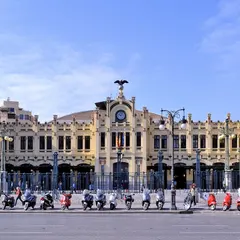
Its modernist counterpart in the historic centre is the Central Market, and the North Station, decorated with oranges and orange blossom, dates from the same period.
The arch that covered a toxic past
Colón Market
Summary of this stop
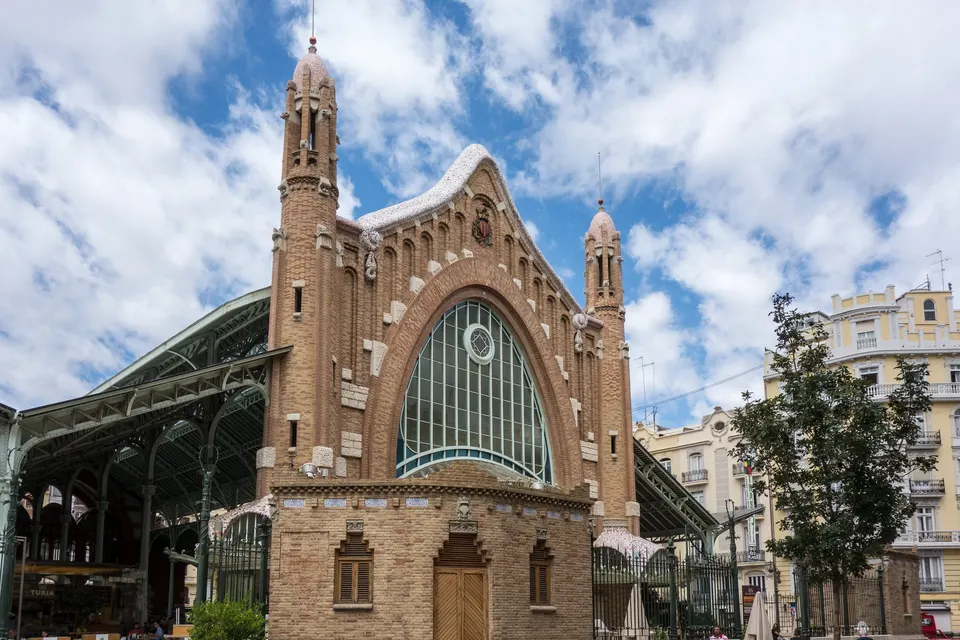
The air that today smells of artisanal horchata and expensive pastries was tainted for decades. Until the late 19th century, the ground you are going to step on housed the Gas Factory of the Marqués de Campo. It was a constant source of pollution and risk of explosion that embittered the wealthy residents of the Ensanche. The construction of the market was, above all, an industrial exorcism.
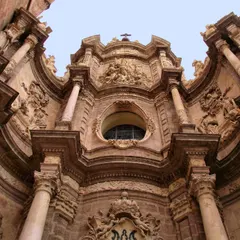
To clean the area, they brought in Francisco Mora Berenguer, an architect shaped under the immense influence of the Catalan master Lluís Domènech i Montaner. The majestic brick arch is not just a work of art; it is an aesthetic Band-Aid over an urban scar. What dark meaning do the details of its main facade really hide? In the audio guide we reveal the visual trick.
Two facades, two city ranks
Rear facade of the Colón Market
Summary of this stop
If you think the marked asymmetry of the building is an artistic whim, you are wrong. The two faces of this market exactly reflect the classist obsession of the Ensanche of 1916. The triumphal and monumental arch of Jorge Juan street deliberately contrasts with the modesty of the entrance on Conde de Salvatierra. Architecture served to classify the importance of the streets.
The ‘trencadís’ ceramics, illustrating oranges and flowers, celebrated agricultural wealth, but this was never the market of the common people. Unlike the immense Central Market, this was born as a private pantry for the wealthiest neighborhood. Tradition has it that the sculptural figures had a very cynical relationship with daily sales. We keep its secret for the on-site audio.
An open nave of iron and glass
Main nave of the Colón Market
Summary of this stop
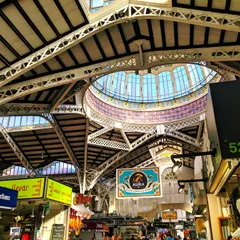
Erecting this giant of iron and glass took barely two years. It was an engineering display that, using wrought iron arches resting on cast-iron pillars, managed to cover a total surface of 3,500 square meters with a wide, open nave. It was a perfect machine, designed to the millimeter to house dozens of fresh food stalls without the space feeling oppressive.
But haste has a price. They inaugurated it strategically on Christmas Eve 1916. They threw the market and its sellers right into the epicenter of stress: the most frantic shopping morning of the year. What was it like to survive that baptism of fire under this resounding vault? We invite you to stand in the center of the nave and listen to the chronicle of that day.
The saved market that shed its skin
Accesses to the lower level of the Colón Market
Summary of this stop
The status of National Monument in 1962 did not prevent the building from falling into almost absolute abandonment during the 70s and 80s. To avoid its total ruin, an aggressive rehabilitation was executed in 2003. A new underground level for parking was excavated and the structure was restored, but the cost was the eradication of its traditional soul.
The fresh vegetable and meat stalls disappeared, replaced by a leisure and hospitality ecosystem. It is a textbook case study on gentrification: the historical shell survived, but its public function was devoured. Architectural rescue or forced eviction? Stand in front of the modern escalators, hit play, and draw your own conclusions.