Gothic Architecture
Serranos Towers Audio Guide (Torres de Serranos)
The gate that was designed to flatter power, survived because it was a prison, and ended up hiding works of the Prado Museum.
- 35 min of audio
- Medieval Fortress
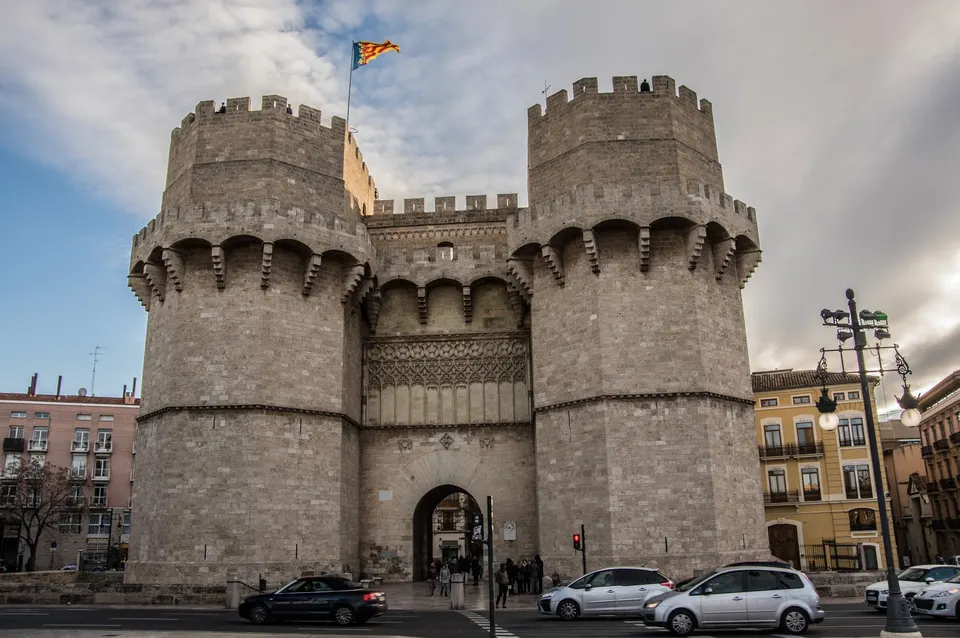
If you are looking for what to see at the Serranos Towers, forget the romanticism of the classic medieval postcard. Built between 1392 and 1398 by Pere Balaguer, they were born as a double-edged urban machine: a colossal access to intimidate and, at the same time, a gigantic triumphal arch for the pomp of kings. At first glance it seems pure defensive engineering, but its history is full of pragmatic improvisations and ironic twists.
The architecture of the Serranos Towers deceives the modern spectator. What today is bare stone was once a polychrome festival. However, its true survival did not depend on its beauty, but on its ability to house human misery. The secret history it hides in its vaults requires more than a superficial reading; to understand how this block of stone avoided demolition and came to guard the greatest artistic treasure in the country, you need to listen to the audio guide while you walk it.
Highlights
- Exterior facade — Propaganda and medieval power
- Main passage — The secret bunker of the Prado Museum
- Interior facade — The rear military design
- Crenellated terraces — The living stage of the Crida
If you are planning what to see at the Serranos Towers, assume that the building is lying to you a little. This is not the typical heroic defense. Between 1392 and 1398, the Jurats of València commissioned Pere Balaguer with a structure that would function as a triumphal arch to receive the elites and as a fortress against attacks. An architectural bipolarity that defines its entire existence.
The secret history of this stone mass is riddled with raw decisions. Over the centuries, this natural pass for travelers from the Los Serranos region went from exhibiting colorful polychromy to becoming a prison hole. Its real biography cannot be understood looking at photos on a screen; you need to stand under its arches, feel the drop in temperature, and let us tell you, on site, how a wall designed to repel artillery ended up saving itself by accident.
The medieval wall’s other great surviving gate is the Quart Towers, and at the foot of Serranos stretches the Turia Garden, the old riverbed turned into a park.
The gate that wanted to impress
Serranos Towers
Summary of this stop
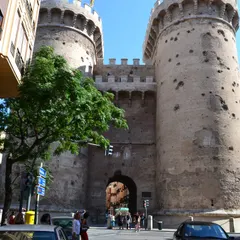
From the square, the immense scale intimidates. That was the exact objective. They wanted an access that shouted authority. However, do not be fooled by the current rawness of the monument. Originally, the royal coats of arms and the Gothic decoration of this facade were brilliantly polychromed. It was pure visual propaganda, designed to flatter ambassadors before crossing the wall.
The architecture of the Serranos Towers on this exterior front is public relations disguised as a military threat. To understand the true medieval pragmatism that governed its construction, you have to turn your back on the monumentality and prepare to go around the building. The key to its defense, interestingly, lies in what it lacks. In the app we will give you the exact coordinates to understand this visual trick.
The reverse that reveals its strategy
Serranos Towers
Summary of this stop
When you look at the Plaza de los Fueros, the greatness disappears. The back of the building is completely sectioned, leaving the rooms and the ribbed vaults exposed to the sight of the citizens. It was not a budget cut, but pure and simple paranoia.
The military manual of the time demanded that, if the enemies took the towers, they could not entrench themselves in them to attack Valencia from within. A brutal pragmatism that dismantles the myth of the impenetrable monument. What is arrogance in the front is an almost pessimistic distrust in the back. And speaking of gloomy scenarios, this same open design takes us head-on to the darkest function these walls housed.
The prison that prevented demolition
Main passage of the Serranos Towers
Summary of this stop
Under the semicircular arch, the shadow imposes another tone. Between 1586 and 1887, these noble rooms ended up functioning as a prison for knights. It sounds like preferential treatment, but the precariousness was such that, according to the chronicles, the prisoners came to riot, fed up with the warden’s miserable rations.
The irony is that this prison function was its lifesaver. When Governor Cirilo Amorós tore down the wall in 1865 to expand the city, he pardoned the towers above all because they still served as a prison. They survived to play an even more surreal role: in 1936, the government of the Second Republic built a concrete vault almost a meter thick here. The purpose? To create an air-conditioned bunker to safeguard works of the Prado Museum evacuated during the war. The details of how the great masterpieces entrenched themselves in a Gothic building will be whispered to you at the corresponding stop of the audio guide.
From the medieval balcony to the cry of Fallas
Terraces of the Serranos Towers
Summary of this stop
Up on the crenellated terraces, the constant wind and the panoramic view of the old Turia riverbed clear the claustrophobic atmosphere. After centuries of accumulating military, penitentiary, and bunker functions, the city decided to return it to public use, but in its own way.
Since 1954, every last Sunday in February, this old defensive parapet becomes the epicenter of the party. The Fallera Mayor appears here to give the ‘Crida’, announcing that Valencia is in Fallas. It is the perfect closure for a cynical building: a structure erected to keep intruders out, which now serves to summon the crowd. To understand the physical magnitude of that change and the real scale of the city at your feet, download the experience and climb the stairs with us.