Military Architecture
Quart Towers Audio Guide (Torres de Quart)
A defensive mass that refuses to erase its scars. Discover the medieval gate that survived artillery, urban demolitions, and its own past as a prison.
- 30 min of audio
- War survivor
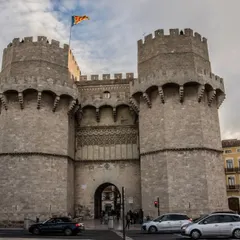
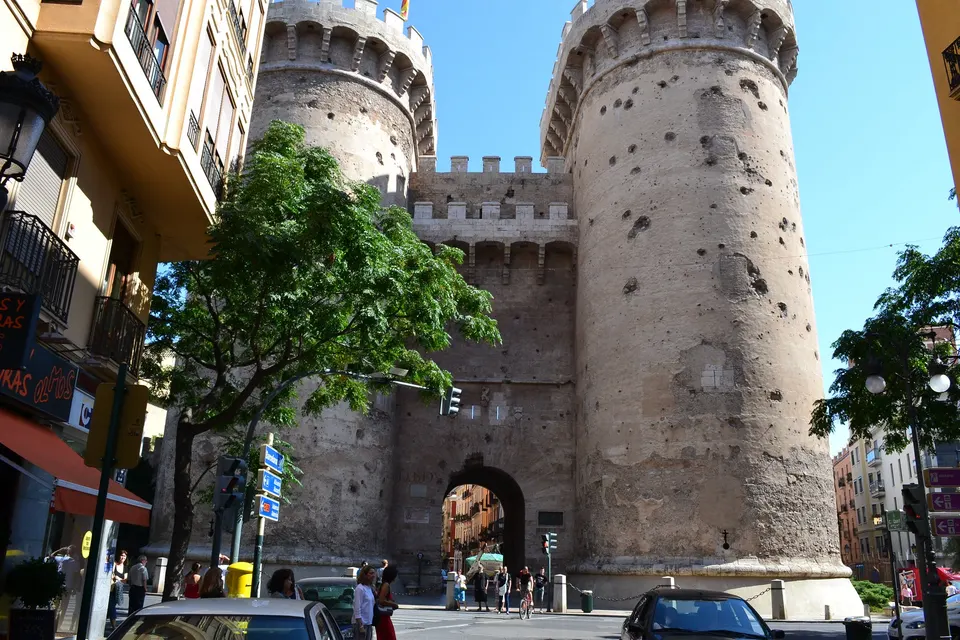
Cities usually apply makeup to their past; Valencia, on the other hand, left its wounds in plain sight in the middle of the expansion. Built between 1441 and 1460 under the direction of Francesc Baldomar and Pere Compte, the Quart Towers are not the typical postcard scenery. They were the robust western gate of the Christian wall and the physical barrier against the road to Castile. If you wonder what to see at the Quart Towers, forget princess tales: here you will find rough masonry, real cannonball impacts, and pure urban survival.
It is ironic that a structure designed to keep the enemy out spent centuries (from 1626 to 1868) dedicated to keeping women inside, functioning as an overcrowded female prison. Today, stripped of the walled enclosure that gave it meaning, this mass challenges you from the sidewalk. But looking at it from the outside is just scratching the surface. To unearth its secret history and understand the implacable logic of its design, you have to cross its shadow. Download our audio guide and join us in reading the stone.
Highlights
- Riddled exterior facade — Real marks from the 1808 bombardment
- Anti-artillery design — 15th-century curved towers
- Female prison — More than two centuries of dark captivity
- Perimeter viewpoint — The balcony to the vanished wall
The Serranos Towers are the medieval wall’s other great surviving gate, and following Calle de Quart towards the centre leads to the Church of San Nicolás.
The gate that looked towards Castile
Quart Towers
Summary of this stop
Do not trust its current monumentality. When you stand in front of the exterior facade on the sidewalk, the scale of the building comes down on you with a very clear intention: to intimidate. Financed by the city of Valencia between 1441 and 1460, these towers were not built to decorate the landscape, but to replace an older access and fiercely control the main exit to the west, towards Quart de Poblet and Castile.
It is easy to romanticize old stone, but this was a pure and hard customs office. Goods entered here and, with them, taxes. Do you want to know why they didn’t fall when the rest of the city crumbled under fire? The answer is not in luck, but in a geometry calculated to the millimeter that we will reveal when you put on your headphones.
Two curved towers against artillery
Image above the gate
Summary of this stop
Just look up a little to understand that the architecture of the Quart Towers did not seek aesthetic awards, but to survive gunpowder. The 15th century brought with it artillery warfare, and Francesc Baldomar and Pere Compte knew it. That is why they designed two massive semi-cylindrical masses. There are no corners because the curved front is designed exactly to deflect cannonball impacts, built not with elegant continuous ashlar stones, but with a tenacious factory of rammed earth and clad masonry, typical of Valencian late medieval defense.
Just above the entrance, guarding the passage, you will see a Marian image installed above the gate. A curious mixture: extreme military protection on one side and symbolic shelter on the other. However, under the watchful eye of that religious figure, the tunnel in front of you would hide miseries that no traditional tourism book usually mentions. Ready to step into the shadow?
Under the arch: control, prison, and violence
Passage arch
Summary of this stop
The change in light upon entering under the central arch marks the border between the monument you see and the harshness of what really happened here. For centuries, this funnel functioned as a strict health and fiscal checkpoint. But its darkest stage began in 1626, when the military enclosure was converted into a female prison. Until 1868, these walls muffled the screams of marginalized women and inmates overcrowded in a space conceived for soldiers.
And if prison history makes you uncomfortable, wait until you look back. The exterior facade exhibits, almost with forensic pride, the artillery holes from the Napoleonic attack of 1808. Right here, that same year, popular fury against the invader’s sympathizers took some lives in brutal lynchings. Violence did not always come from outside. Today guides lightly point out the holes, but in our audio guide you will immerse yourself in the exact panic of those days. Do you dare to hear what this arch sounded like under crossfire?
Up above, where almost the entire wall is missing
Crowning and battlements
Summary of this stop
The last act of the visit is a slap of urban reality. Climbing up the old walkway, the wind hits you, but what really impacts is what is no longer there. Starting in 1865, the City Council relentlessly demolished the Christian wall. The Quart Towers miraculously survived, left stranded like an anachronistic island surrounded by asphalt and modern traffic.
From this crowning, the reading of the building changes completely. You are no longer a watchman waiting for the troops of Castile, but a spectator of a city that devoured its own limits. Understanding the ghost layout of the wall is the only way to understand this place. Turn on the audio guide and let us tell you the details of the political and social miracle that prevented the pickaxe from turning this jewel into rubble.