Herrerian Architecture
Valladolid Cathedral Audio Guide (Catedral de Valladolid)
The great Herrerian promise of the court of Valladolid that remained half-built. A detailed analysis of what to see at the Cathedral of Valladolid and the secrets of an asymmetric work that testifies to its own history.
- 45 min of audio
- Severe Classicism
Faced with the Cathedral of Valladolid, the first impression is not that of a traditional gothic temple loaded with ornaments, but that of a severe, clean stone mass of almost military order. Designed by Juan de Herrera in 1585, this temple was conceived on a colossal scale, intended to reflect the enormous ambition of a city that aspired to permanently house the court of the Spanish monarchy. However, the current building constitutes a monumental unfinished architectural puzzle.
Only half of Herrera's initial plans were actually built. The rest of the original project was suspended due to the transfer of the court to Madrid and the lack of funds, leaving a truncated and asymmetric silhouette. Stepping into this construction is not a visit to a conventional temple, but a great lesson in architecture and survival, where emptiness and absences take on as much importance as the stone walls that remain standing.
Highlights
- Project by Juan de Herrera — A 1585 design that sought to impress the imperial court
- The unfinished volume — Only half of the original layout was actually built
- Collapse of 1730 — The tragic collapse of the original Epistle tower
- Baroque high altarpiece — A colossal 17th-century piece moved from the Antigua church
- Capilla de San Blas — The visible remains of the Romanesque collegiate church of 1095
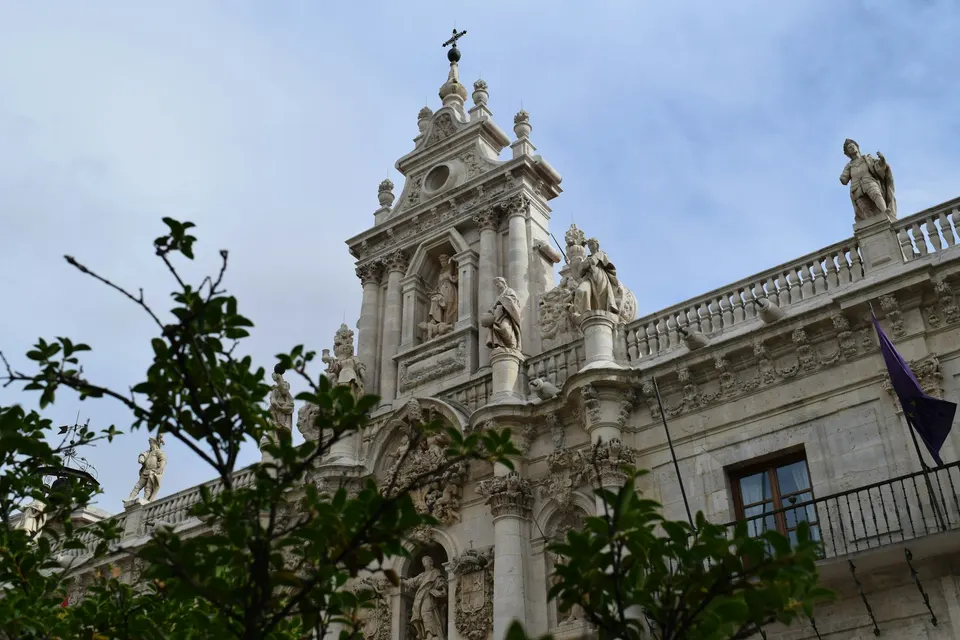
Few temples in Spain are as baffling at first glance as the Cathedral of Valladolid. Its main facade transmits a sense of discipline and absolute control: straight lines, solid stone, and bare pilasters that evoke the sobriety of a palace rather than the ornamentation of a traditional cathedral. This language devoid of adornment is the undisputed hallmark of the architecture of the Cathedral of Nuestra Señora de la Asunción, conceived by the celebrated royal architect Juan de Herrera. The chapter of Valladolid commissioned the work in 1585, seeking a grandiose building to serve as a letter of introduction for a city with ecclesiastical and political aspirations of capital status.
However, the monument’s destiny abruptly changed course. Surrounding its walls, one finds a silhouette cut in half and an asymmetry that immediately betrays a greatly interrupted project. To truly understand what to see at the Cathedral of Valladolid and decipher the secret history of its collapses and adaptations, it must be toured in detail. The audio guide proposes a route through its exterior and interior corners to analyze what the stone keeps silent.
The Gutiérrez Passage is very close by, and a few minutes to the north, the Church of San Pablo and the National Sculpture Museum bring together the great Isabelline Gothic façades.
A courtly ambition
Main facade
Summary of this stop
The analysis of the main facade reveals a severe character, far from storied portals or capricious gargoyles. Herrera imposed a language of mathematical proportions and classical order in 1585, which constituted the answer in stone to a Valladolid that aspired to the highest heights. The severity of this main portal, completed in the 17th century by continuing architects Diego and Francisco de Praves, departs from the Plateresque exuberance of other Castilian temples and asserts a noble and contained presence.
Contemplating these large pilasters makes it evident that the building was conceived as a royal stage. Valladolid needed to demonstrate its rank, and the chapter did not hesitate to commit gigantic resources. The fate of this facade after the departure of the court is linked to a subtle detail in the upper finish, the narrative outcome of which is explained in the on-site guide.
The missing half
Unfinished side volume
Summary of this stop
Circling the exterior towards the side of the cathedral, the classical regularity suddenly disappears. The stone masses are cut off abruptly, and the building’s profile reads like an interrupted sentence. What is observed is not the consequence of a subsequent demolition, but of a total halt to the works. Between 1596 and 1668, the work progressed under the direction of the Praves, but only approximately half of the structure projected by Herrera was executed.
This great physical truncation defines the singular character of the temple. Instead of mentally reconstructing the destruction of an ancient building, at this point the visitor contemplates what was never built: the two remaining aisles, the large transept, and the original head. The economic and dynastic details that caused this colossal construction halt are revealed when listening to the route on the ground.
The tower that was not meant to be this one
Current tower
Summary of this stop
Looking up at the single tower that today crowns the temple’s profile, one perceives an off-center position relative to the main facade. The explanation for this architectural rarity lies in a dramatic collapse: on May 31, 1730, the original tower that had been erected on the Epistle side (popularly known as the ‘Buena Moza’) collapsed, seriously damaging the cathedral’s structure and altering its appearance forever.
The current tower, located at the foot on the Gospel side, was completed much later, in 1880, following a design by the architect Antonio Iturralde. It is therefore not a Herrerian tower, but a 19th-century emergency solution that replaced the lost structure. This resulting asymmetry acts as a physical memory of a historical collapse, the details and aesthetic consequences of which are detailed in the on-site explanation.
Geometry, echo, and a magnificent intruder
Main nave
Summary of this stop
Crossing the threshold of the temple, the echo of footsteps lengthens in a nave of superb proportions. Inside, the Herrerian sobriety acquires a monumental and calm tone, reinforced by a filtered light that enters without drama and highlights the pure geometry of the pillars. There is a paradox in this space: in 1595, the bull of Pope Clement VIII had already raised the temple to the rank of cathedral and created the diocese of Valladolid, even before the stone could support the roof of the main nave.
At the end of the nave, however, a piece breaks the coldness of the stone: the colossal Baroque high altarpiece. This lavish work of gilded wood, originally designed by Juan de Juni for the church of Santa María la Antigua, was moved to the cathedral in the 20th century. This transfer hid a surprise: when dismantling the heavy timbers in 1923, the workers found in a lead box the uncorrupted body of the infant Don Alfonso of Castile, son of King Pedro I. The discovery of the princely body and its relevance in the gossip of the time are detailed in the on-site narration.
Before the cathedral, another church
Capilla de San Blas
Summary of this stop
The tour advances towards the most sheltered area of the interior, near the chapel of San Blas and the dependencies of the Diocesan and Cathedral Museum, founded in 1929. Here, among the Herrerian construction, remain walls of masonry and capitals belonging to an earlier era. In 1095, after the resettlement of the town led by Count Pedro Ansúrez, the medieval collegiate church of Santa María was founded, the primitive religious heart that occupied this site.
The modern cathedral did not completely erase the previous temple, but absorbed and buried it in its foundations, leaving the chapel of San Blas as a witness to that superposition of eras. Contemplating this corner allows for an understanding that the Cathedral of Valladolid is a living palimpsest where the ambition of the Golden Age, the Baroque collapse, and the trace of the old medieval Castile coexist, whose history of permanence is revealed when listening to the audio guide.