Polychrome Sculpture
National Sculpture Museum Audio Guide (Museo Nacional de Escultura)
The most important collection of polychrome sculpture in Spain in an extraordinary Gothic college. An analysis of what to see at the National Sculpture Museum of Valladolid and its secret history of art and rescue.
- 90 min of audio
- Sacred Imagery
The National Sculpture Museum of Valladolid represents a perfect marriage between Castilian architecture and sacred art. Its main headquarters, the College of San Gregorio, is one of the peak works of Isabelline Gothic from the late 15th century. Founded by Bishop Alonso de Burgos, the building does not act as a simple cold museum container; on the contrary, its stone, its tracery, and its historical courtyards constantly dialogue with the religious carvings it houses inside, providing the visit with a unique atmosphere.
The collection stands out exceptionally for its specialization in polychrome wood sculpture from the 16th and 17th centuries, gathering masterpieces by Baroque geniuses such as Gregorio Fernández. The majority of these highly realistic images come from monasteries and convents confiscated in the 19th century, making this national museum a great archive of Spanish religious memory. Touring its rooms dispersed across several monumental palaces in the center of Valladolid, one discovers how painted wood transforms into a motionless theater.
Highlights
- College of San Gregorio — A late Gothic gem declared a National Monument in 1884
- Gregorio Fernández — The Baroque sculptor who revolutionized the Holy Week in Valladolid
- Confiscation rescue — Carvings rescued from convents by the State since 1842
- Villena Palace and House of the Sun — Annexed locations that expand the monumental route
- San Gregorio Courtyard — The Isabelline cloister that heralds the early Renaissance
Few museums manage to have the exterior architecture and interior pieces explain each other as roundly as the National Sculpture Museum. Its main headquarters, the College of San Gregorio, presents itself to the traveler’s gaze with one of the most dazzling and dense portals of Late Gothic. But once the threshold is left behind and its historical rooms are entered, the tone changes immediately: stone gives way to polychrome wood, and decorative exuberance transforms into a dramatic collection of religious figures of extreme realism.
The institution, founded in the 19th century, was consolidated in 1933 with its current name and specialization, attracting scholars and visitors from all over the world. To truly understand what to see at the National Sculpture Museum of Valladolid and decipher the architecture of the National Sculpture Museum of Valladolid, it is necessary to tour its courtyards, rooms, and annexed locations, paying attention to the history behind its carvings. The EarGuide audio guide accompanies on the ground to reveal the memories and lore hidden in this unique corner of Valladolid.
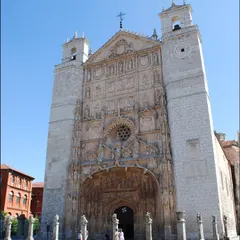
Next door, the façade of the Church of San Pablo completes the Isabelline Gothic ensemble, and a few minutes to the south awaits Valladolid Cathedral.
The portal that never ends
Portal of the College of San Gregorio
Summary of this stop
The tour invites the contemplation of the main portal from a few steps back, where the facade is taken in before entering into historiographical details. In front of the street stands the main facade of the College of San Gregorio, founded in 1490 by Fray Alonso de Burgos. This great portal of Isabelline stone functions as an authentic public manifesto of power, filled with shields, foliage, heraldic figures, and singular carved stone ‘savages’ that flank the main threshold.
The density of the reliefs forces the eyes to stop and traverse the complex in parts. It is not a simple devout ornament, but a facade-manifesto meticulously planned to proclaim the dignity of the college and its founder. Popular custom invites the search for hidden figures among the plant motifs: fabulous animals, embedded saints, and small beings that seem to challenge the observer. The mysteries of this stone bestiary and Alonso de Burgos’ reasons for choosing such an overwhelming portal are detailed in the audio guide as the access is approached.
A college turned into a national museum
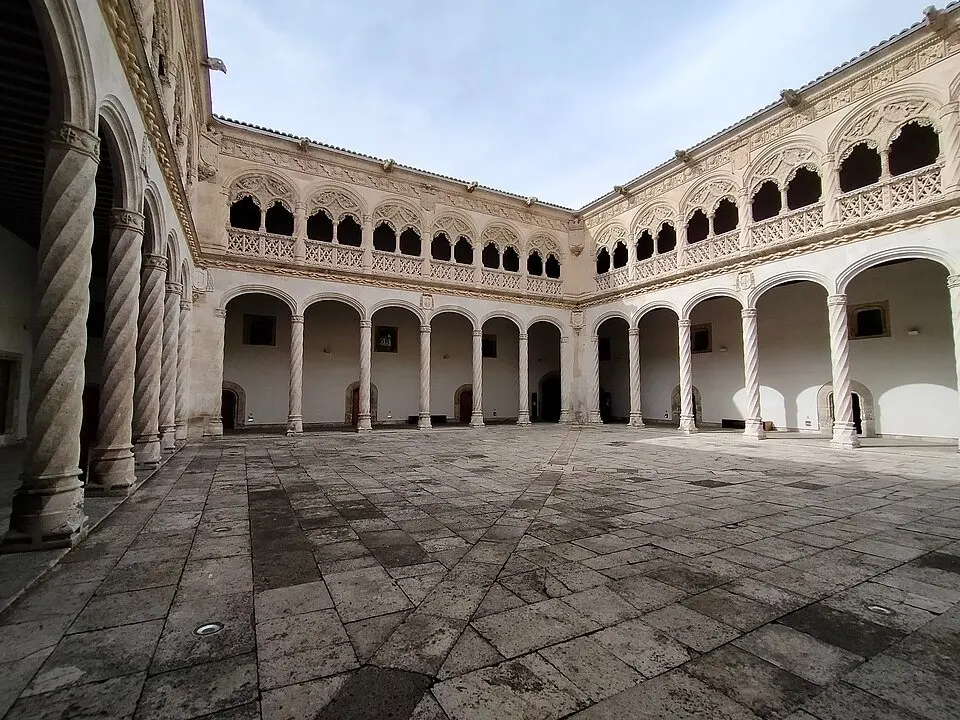
Courtyard of the College of San Gregorio
Summary of this stop
Crossing the entrance hall and entering the courtyard of the College of San Gregorio, the light from the street is filtered between columns and arches of openwork tracery. This cloister combining Late Gothic decoration from the late 15th century with proportions and pilasters that herald the arrival of the early Renaissance to Castile. Long before housing artistic collections, the building was already declared a National Monument in 1884 due to its indubitable heritage value.
In 1933 the State decided to move the headquarters of the sculpture collection here, converting the old college of theology into the permanent residence of the institution. Walking under the arcades of the courtyard, one perceives how the historical stone preserves a unique temperature and echo, far from the aseptic atmosphere of a contemporary gallery. The courtyard prepares the gaze for the contemplation and intensity of the sacred imagery rooms, whose narrative secrets are revealed by the audio on-site.
Sculptures saved from a shipwreck
Polychrome sculpture rooms
Summary of this stop
Upon entering the main rooms of the museum, the color and volume of the polychrome wood carvings concentrate the attention. But to understand these pieces, it is necessary to look at a great wound of the 19th century: the ecclesiastical confiscation of 1835. With the forced closure of monasteries and the exclaustration of religious orders, hundreds of exceptional works were left unprotected. To halt their loss, the State created the Provincial Museum of Fine Arts of Valladolid in 1842, gathering paintings and sculptures from the empty convents of the province.
Most of the carvings contemplated today were not born to be in an exhibition room: they belonged to immense altarpieces, dark chapels, or community altars. Their transfer saved them from destruction, but stripped them of their original context, transforming the museum into a great archive of displaced Castilian sacred geography. There is an inevitable melancholy in seeing these figures isolated on pedestals, separated from the original set for which they were carved, a historical drama whose details and anecdotes are explained when listening to the guide on the ground.
Gregorio Fernández and the motionless theater
Polychrome sculpture rooms
Summary of this stop
The peak of the tour places the visitor before the Baroque ensembles of Gregorio Fernández and his circle. Active in Valladolid in the 17th century, Fernández brought the realism of polychrome wood to outstanding levels: flesh tones that imitate human skin with astonishing fidelity, glass eyes, bone teeth, and resin tears that give the figures an almost breathable air.
These processional sculptures are not objects of simple passive contemplation: they were conceived as dramatic scenes to move the faithful and teach the Catholic doctrine of the Counter-Reformation. In Valladolid’s Holy Week, many of these images continue to go out in procession, leaving their exhibition lethargy to traverse the streets surrounded by dull drums and silence on the asphalt. Contemplating these carvings up close, one understands that they represent a stopped theater, where painted wood reaches a tragic force detailed in the narration of the audio guide.
A museum spread across the historical city
Villena Palace
Summary of this stop
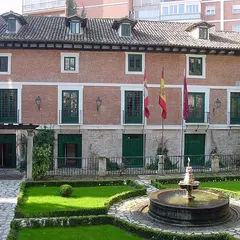
Upon leaving the San Gregorio headquarters, one can direct the gaze towards the adjacent buildings. In 1998, the museum incorporated annexed locations to house its growing collections, integrating the Villena Palace and the House of the Sun within the institutional circuit. This growth through the historical fabric culminated in an important architectural and museological rehabilitation between 2004 and 2009 to adapt the historical buildings to contemporary safety and accessibility requirements without neutralizing their original monumental character.
The visit to the museum thus spills across several noble architectures of Valladolid, avoiding the rigidity of a conventional exhibition box. Whether looking at the tracery of San Gregorio, the annexed palaces, or the Baroque imagery itself, everything ends up telling the same story: Valladolid has known how to preserve and adapt its historical heritage as a living matter that continues to dialogue with the present, a plot completely revealed when listening to the audio guide on-site.