Literary Museum
Cervantes House Museum Audio Guide (Casa de Cervantes)
The only real home inhabited by Miguel de Cervantes preserved in Spain, where the first edition of Don Quixote saw the light of day. A tour of the Cervantes House Museum of Valladolid and its secret history.
- 50 min of audio
- Tenement House
The Cervantes House Museum of Valladolid is a corner of enormous literary and biographical significance. The author of the Exemplary Novels settled in this address in 1604, in a neighborhood on the urban periphery of Valladolid that was experiencing a high demand for rentals due to the transfer of the royal court of Philip III in 1601. Cervantes resided in these rooms of low ceilings and modest scale when the first edition of Don Quixote appeared from the presses of Juan de la Cuesta in 1605.
The building, a typical Castilian tenement house structured around a courtyard with a well, was identified as the Cervantes residence in the 19th century, which led to its subsequent purchase by the State in 1942 and its opening as a house museum in 1948. Through a careful historical recreation with period furniture and utensils, the museum recovers the daily domestic atmosphere of the Golden Age. However, beneath this peaceful atmosphere of garden and brick hide the traces of a homicide at its doors that dragged the writer and his family to the courts.
Highlights
- The Don Quixote of 1605 — The great universal masterpiece conceived and corrected in these rooms
- Ezpeleta homicide — The violent dawn of 1605 that led Cervantes to jail
- Castilian tenement — The original entrance hall, courtyard, and well that organized the neighborhood
- House museum of 1948 — The recreation of daily life in the Golden Age
- The 20th-century garden — The green corner created to evoke the writer's literary retirement
Few places in Valladolid manage to connect us with the daily pulse of the Golden Age as intimately as the Cervantes House Museum. Unlike solemn monuments and official palaces, here one enters a domestic environment, crosses a rustic entrance hall, and steps on wooden floors that creak underfoot. In this brick building, Miguel de Cervantes resided for barely two years, between 1604 and 1606, sharing rooms with his wife Catalina de Salazar, his sisters Andrea and Magdalena, his daughter Isabel de Saavedra, and his niece Constanza de Ovando.
Although the exterior today evokes a peaceful reading corner separated from the street by a fence and a small garden, the reality of 1605 was very different. To understand what to see at the Cervantes House Museum of Valladolid and delve into the architecture of the Cervantes House Museum of Valladolid, it is necessary to shed decorative myths and observe how people lived, wrote, and litigated in this Castilian tenement. The audio guide provides the keys to reading step-by-step to reveal the author’s less known stories.
The house is very close to the Campo Grande, and a few minutes towards the centre lies the Gutiérrez Passage.
An authentic house, a remade scene
Cervantes House Museum
Summary of this stop
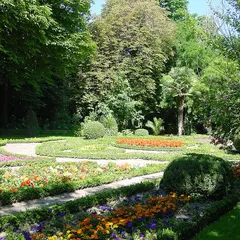
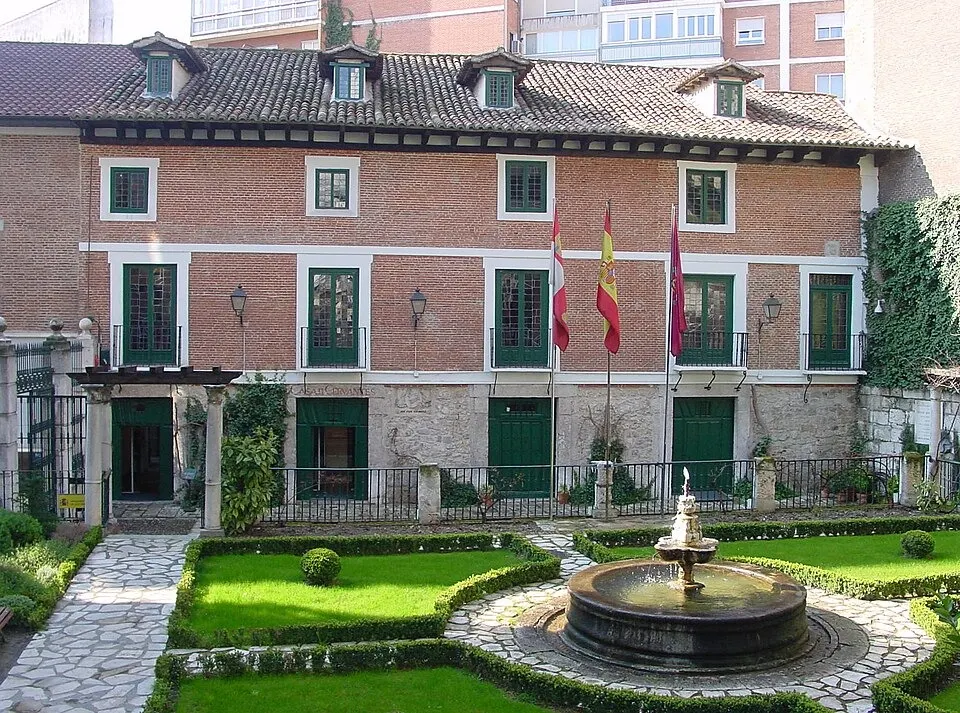
The tour stops initially in front of the gate and the facade before taking any historiographical details for granted. In front of the observer stands a brick building with a small front garden that today isolates the house from urban traffic. This garden, designed with plants characteristic of the Golden Age, and the iron gate are 20th-century creations to provide the place with the appearance of an idyllic literary sanctuary. In 1604, when Cervantes settled in this neighborhood outside the walls, the houses faced directly onto a noisy street in constant transformation due to the presence of the court of Philip III.
The historical identification of the property was consolidated in the 19th century, leading to its declaration as a National Monument and its subsequent purchase by the State in 1942. But the current museum opened in 1948 after a major renovation aimed at recreating the atmosphere of a well-off 17th-century home, rather than keeping intact the writer’s austere and precarious rooms. Standing in front of this brick facade, one understands that the space plays between biographical truth and the museological construction of memory.
The courtyard where the house becomes a neighborhood
Interior courtyard
Summary of this stop
Leaving behind the entrance hall and looking into the interior courtyard of the house, the temperature drops and the murmur of the street disappears. In front of the visitor appear the elements of a typical Castilian tenement: the well, the wooden corridors on the upper floor, and the low doors of the dwellings. Cervantes did not live alone in a single-family house; he occupied a rented room in a tenement house with shared circulation.
The domestic structure of this 16th-century courtyard organized daily life in a physical way. Water was drawn from the central well, washing and errands were done in full view of everyone, and the tight layout of the rooms forced close coexistence. The museum has furnished the interiors with 17th-century pieces and tapestries to restore the original atmosphere of this tenement, where it was impossible to isolate oneself from the traffic and the gaze of others.
The dawn that turned the house into a trial
Courtyard well
Summary of this stop
The route stops next to the well, looking towards the entrance door of the hallway. In this same courtyard, in the early hours of June 27, 1605, domestic routines were violently shattered. A Navarrese knight, Don Gaspar de Ezpeleta, was stabbed at the doors of the house after a murky street altercation. Hearing the cries for help, the residents of the tenement moved him inside, where he agonized and died two days later. Justice intervened immediately, temporarily detaining Cervantes, his wife Catalina, his sisters, his daughter Isabel, and the maid María de Ceballos.
The resulting judicial summary constitutes an invaluable documentary mine for historians. The records of the interrogations detail the rooms occupied by each family member, the visits they received, and the precarious nature of their domestic economy. The case encouraged harsh gossip in Valladolid about the so-called ‘Cervantas’ —Andrea and Magdalena—, suggesting scandalous relationships and visits from courtly gentlemen. Although current research attributes these suspicions to social prejudices against women with economic autonomy, the echo of the scandal and the lawsuit remained forever impregnated in these walls, as the on-site account explains.
The room where we look for Cervantes
Recreated writing cabinet
Summary of this stop
After climbing the wooden stairs and entering the recreated writing cabinet on the upper floor, in front of the oak table, the Castilian chair, and the quill pens under a filtered light, one immediately tends to lower the voice. It is the natural impulse of literary pilgrimage. Although it is known that the cabinet is a 20th-century historical recreation, the certainty that the first part of the 1605 Don Quixote saw the light and circulated while its author lived in these rooms endows the room with great dramatic force.
The museum preserves first editions of Cervantes’ works, period engravings, and domestic objects that show how the book expanded around the world after crossing the threshold of the home. Although it is not possible to point out the precise corner where Cervantes sat to write, the permanence of the Cervantes House Museum at this address consolidates the writer’s presence in the heart of Valladolid, whose details are revealed when listening to the audio guide.