Iron Architecture
Gutiérrez Passage Audio Guide (Pasaje Gutiérrez)
The elegant commercial gallery of 1886 that imported to Valladolid the dream of Parisian covered passages. An analysis of what to see at the Gutiérrez Passage of Valladolid and its secret history of splendor and rescue.
- 20 min of audio
- Covered Passage
The Gutiérrez Passage of Valladolid was inaugurated in 1886 as a luxurious covered commercial gallery, promoted by the initiative of merchant Eusebio Gutiérrez. Projected by architect Jerónimo Ortiz de Urbina, the work represented an original urban surgery operation in the middle of the historical center, puncturing the interior of the pedestrian block to connect Fray Luis de León and Castelar streets directly. With this, a concept of bourgeois commercial promenade, very uncommon in late 19th-century Spain, was introduced to the city.
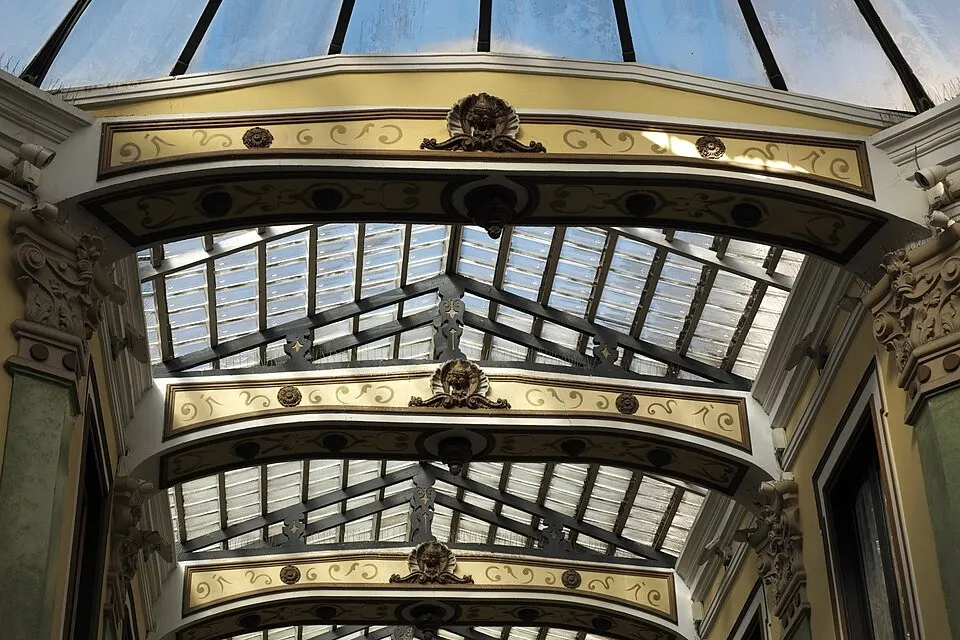
Its slender glazed roof with iron supports follows the direct influence of the passages of Paris and other European capitals of the industrial era. In the interior crossing of its two sections stands out an octagonal widening crowned by a glass dome that concentrates the zenithal light, illuminating a profuse eclectic decoration of plasterwork, caryatids, and pilasters. After overcoming a phase of severe decay during the 20th century, the passage was thoroughly rehabilitated, managing to remain today as one of the few and most alive historical passages preserved in Spain.
Highlights
- Iron and glass structure — The industrial roof of 1886 that filters the light from the sky
- Octagonal rotunda — The central widening crowned by the large glazed dome
- Statue of Mercury — The effigy of the Roman god of commerce in the center of the rotunda
- Eclectic plasterwork — Caryatids and classical reliefs that stage the bourgeois shopping
- Late 20th-century restoration — The heritage rescue that prevented the degradation of the corridor
Few corners in the old town of Valladolid produce such an immediate spatial surprise as the Gutiérrez Passage. Crossing one of its exterior entrances, the bustle and appearance of the ordinary Castilian street disappear to give way to a silent corridor, covered by a glass and iron structure and decorated with theatrical moldings. Inaugurated in 1886, this monumental shortcut brought to Valladolid the refined bourgeois fashion of European covered galleries, converting daily transit into a distinguished stroll.
Unlike other commercial passages that ended up abandoned or converted into modern shopping centers, this space retains its original theatricality. To understand what to see at the Gutiérrez Passage of Valladolid and delve into the architecture of the Gutiérrez Passage of Valladolid, it is necessary to travel its sections paying attention to the decorative and architectural details. The EarGuide audio guide proposes a sound route stop-by-stop under its zenithal light to reveal the history of its recovery and validity.
From the passage, Valladolid Cathedral and the Plaza Mayor are a few minutes’ walk away, as is the Cervantes House Museum, to the south.
A bourgeois shortcut opened in the block
Gutiérrez Passage
Summary of this stop
The tour starts initially in front of the entrance on Fray Luis de León street, in a discreet-looking entrance that, once crossed, completely transforms the scale of the city. In front of the visitor’s gaze opens the straight access section. The merchant from Valladolid Eusebio Gutiérrez conceived this passage at the end of the 19th century as an elegant, roofed shortcut to boost trade in the historic center. The architect Jerónimo Ortiz de Urbina assumed the project in 1886, puncturing the residential heart of the block to trace this urban seam.
This passage represented a very unusual urban operation in Castile, where streets followed irregular medieval layouts or the sober alignments of classicism. The entrance to the passage acted as an immediate lure for the pedestrian: the promise of a space protected from rain and heat, conducive to contemplation and shopping. The keys to its design and the way the architecture guided steps through this interior corridor are detailed when listening to the audio guide during the advance down the hallway.
The rotunda where shopping became a show
Central rotunda
Summary of this stop
Upon reaching the central point of the passage, the straight hallway widens into an octagonal space crowned by a glazed dome. The zenithal light pours from above, cutting the shadows of the arches and changing in intensity according to the clouds that cross the sky of Valladolid. The architect Ortiz de Urbina designed this central rotunda as the main spatial distributor and light focus of the entire passage.
The decoration of the space is deliberately scenic. The interior facades show plaster caryatids, decorative pilasters, and moldings that combine classical styles with a refined eclecticism. The passage combined commercial premises on the ground floor with rental housing on the upper floors, reflecting the functional bourgeois typology of the era. Stopping in the center of this octagon transfers the imagination to the elegant stroll of the late 19th-century bourgeoisie, where letting oneself be seen under the dome was part of Valladolid’s social ritual.
Mercury and the rescue of a living stage
Statue of Mercury
Summary of this stop
In the center of the widening stands out an effigy of the Roman god Mercury. Eusebio Gutiérrez commissioned this statue to crown the symbolic program of the building: Mercury, god of commerce and merchants, figuratively presides over the trade of the shops. The popular lore of local merchants jokingly associates looking at Mercury or photographing oneself under his statue with an omen of prosperity for business and commercial fortune.
However, the survival of this spectacular interior decoration was not always guaranteed. Throughout the 20th century, the passage suffered progressive deterioration, roof damage, and the almost total loss of commercial activity, putting the preservation of the plasterwork at risk. The rehabilitation campaigns promoted by the City Council of Valladolid at the end of the 20th century rescued the Gutiérrez Passage from collapse, restoring the iron and glass structure and returning a living heritage to the city, whose rescue history is detailed in the on-site narration.
The exit that proves it still works
Gutiérrez Passage
Summary of this stop
Advancing along the second section to the exit on Castelar street and looking back, the constant flow of pedestrians reveals that the Gutiérrez Passage has managed to preserve its condition as a useful and daily shortcut for the people of Valladolid, avoiding inert musealization. It is one of the few historical examples of 19th-century passages that remain fully active in Spain, keeping daily life going under its roof.
The combination of cafes, traditional shops, and daily walkers consolidates this corner as a living organ of the city. The Gutiérrez Passage is not a bourgeois archaeological remnant of the 19th century kept in a showcase; it continues to function every day of the week. The audio guide narration reveals the last anecdotes and historical details of this glazed street to those who complete the route on the ground.