Isabelline Gothic
Church of San Pablo Audio Guide (Iglesia de San Pablo)
The great Dominican church of Valladolid famous for its altarpiece-facade and its close relationship with the Spanish crown. A tour of the history of the Church of San Pablo of Valladolid and its legacy linked to the court.
- 35 min of audio
- Late Gothic
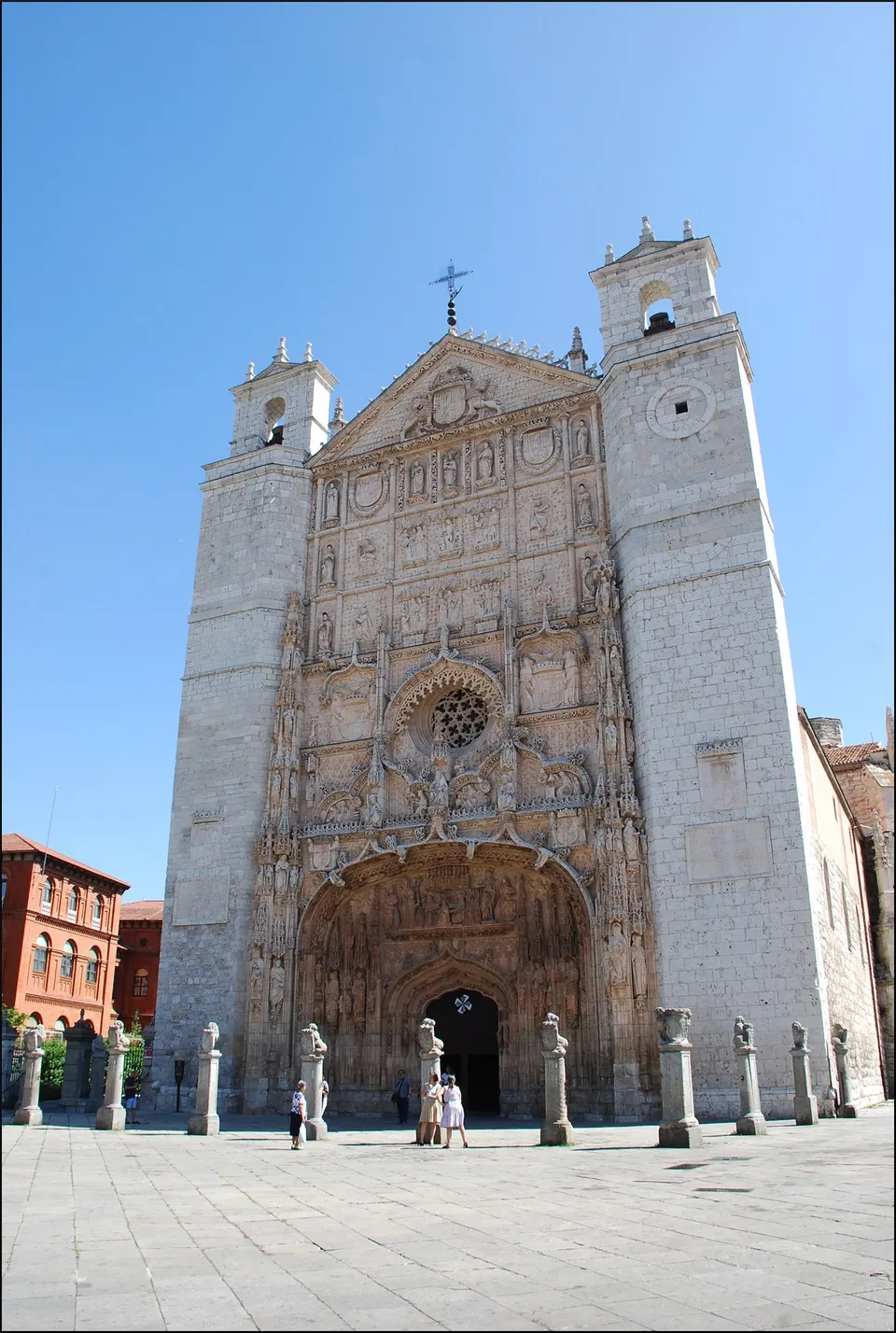
The Church of San Pablo of Valladolid stands in the square of the same name as one of the peak works of Late Gothic in Spain. Its impressive carved stone facade, sculpted at the end of the 15th century under the patronage of Bishop Alonso de Burgos, functions as a gigantic open-air altarpiece. However, this temple was not conceived solely for the contemplation of the Dominican friars: it was designed as a monument of enormous courtly symbolic load, prepared to project power and prestige.
Due to its location adjacent to the royal palace and the institutional center of the era, San Pablo was the scene of key milestones of the Spanish monarchy, hosting ceremonies as significant as the baptisms of kings Philip II and Philip IV. After the 19th-century reforms and the loss of most of the original convent complex due to the confiscation, the temple stands today detached on a deeply redefined square, inviting the exploration of the secrets that its dense stone continues to guard.
Highlights
- Isabelline altarpiece-facade — The dense labyrinth of sculpted stone linked to the circle of Simón de Colonia
- Royal baptisms — The liturgical and dynastic stage of Philip II and Philip IV
- Patronage of Alonso de Burgos — The confessor of the Catholic Monarchs who rebuilt the temple
- Convent of 1276 — The Dominican dependencies lost after the confiscation of 1835
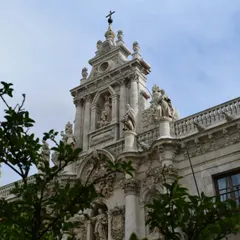
Few monuments in Castile manage to saturate the gaze as immediately as the Church of San Pablo. Standing before it forces the eyes to take time to bring order to a surface where decoration seems to climb the stone without respite. This labyrinth of carved stone is an outstanding exponent of the Isabelline style, the result of the patronage of Fray Alonso de Burgos and traditionally attributed to the circle of the master Simón de Colonia at the end of the 15th century. More than a simple ornamental facade, it constitutes an immense instrument of propaganda and noble and royal prestige.
Its privileged location, adjacent to the old centers of civil power, made this Dominican temple a fundamental witness to the history of Spain. To understand what to see at the Church of San Pablo of Valladolid and delve into the architecture of the Church of San Pablo of Valladolid, it is necessary to observe not only its front, but its spatial relationship with the square and with the absent structures of the original convent. The audio guide provides the keys necessary to interpret each relief and understand the messages that the stone hides beneath its majestic appearance.
Right next door stands the National Sculpture Museum, in the College of San Gregorio, and Valladolid Cathedral lies a few minutes to the south.
A work that wanted to impress a kingdom
Main facade
Summary of this stop
The tour begins by contemplating the facade from a few steps back, where a colossal tapestry of sculpted stone unfolds, filled with canopies, shields, and figurative reliefs. Fray Alonso de Burgos, confessor of the Catholic Monarchs and bishop of Palencia, promoted the great reconstruction of the Dominican convent temple from 1445, culminating at the end of the 15th century with this famous Isabelline portal linked to the artistic environment of Simón de Colonia.
The facade of San Pablo functions as an authentic sculpted visual sermon. The density of the stone does not seek to be a modest ornament, but a resounding statement of status. Among the reliefs, popular and heraldic figures stand out, inviting the visitor to look up and decipher the patron’s message. The choice of this detailed and vertical language in the altarpiece-facade has explanations that are revealed in the audio guide, where the struggle for social prestige and the hidden symbolism in the upper rose window are detailed.
A church close to the heart of the court
Plaza de San Pablo
Summary of this stop
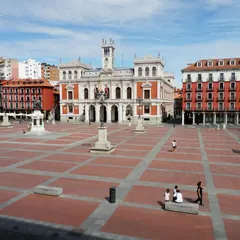
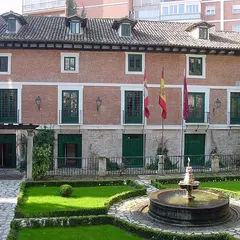
Moving across the square, the temple reveals itself in relation to the palaces that surround it. A few steps from this space is the Palace of the Vivero, where in 1469 the marriage of Isabella of Castile and Ferdinand of Aragon was celebrated, a union that immediately attracted the presence of the court to the geography of Valladolid. With the effective capital status of the monarchy in Valladolid between 1601 and 1606, this Plaza de San Pablo consolidated itself as the absolute ceremonial and protocol center of the empire.
This stage witnessed milestones that marked the dynastic destiny. Here was celebrated in 1527 the baptism of Philip II, born in the city, in a solemn ceremony in which the infant was transferred from the neighboring royal palace in a route decorated with tapestries before the eyes of the citizens of Valladolid. In 1605, San Pablo once again housed the baptism of the future Philip IV, in a ceremony described by chronicists as an exhibition of etiquette and illuminations of the House of Austria. The narration on-site reveals the historical details that turned the temple into the great theater of the court.
The disappeared convent that is still felt
Church of San Pablo
Summary of this stop
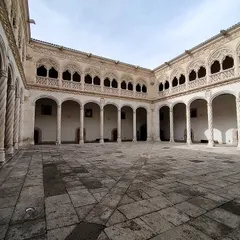
Observing the exterior side of the church, one appreciates that it stands detached and clear in the face of modern public space. However, this solitude constitutes the trace of a historical loss. For centuries, this temple was only a part of an immense Dominican convent house founded in 1276 by Queen Violante of Aragon, wife of Alfonso X the Wise. The dependencies of the medieval and modern convent surrounded and embraced the church on several sides.
The ecclesiastical confiscation of 1835 decreed the exclaustration of the Dominican friars and the beginning of the ruin and subsequent demolition of the cloisters and cells. The loss of these structures and the urban reforms of the 19th and 20th centuries cleared the square, giving the church a detached visual prominence it never had in the past. The emptiness that today surrounds the monument indicates the scale of the disappeared convent, whose layout and historical uses are reconstructed in detail in the on-site audio.
The nave where San Pablo kept beating
Main nave
Summary of this stop
Passing through the main portal to access the interior of the temple, the contrast is immediate: from the vibrant light of the square, one passes into a cool and silent twilight. Under this high Late Gothic nave, intensely reformed in the 15th century, the sound is gathered between austere pillars and side funerary chapels. Unlike the disappeared convent dependencies, the interior of San Pablo has maintained its uninterrupted religious use to the present day, serving as the custodian of Valladolid’s devotion through the centuries.
The great height of the nave and the remains of Late Gothic arches return to San Pablo its original scale as a temple of Dominican preachers. Far from the agitation of the court, these walls preserve an intimate and lasting devotional pulse. As one walks along the axis of the nave, it becomes clear that the monument’s value lies in its capacity to continue functioning as a living space that has housed reigns, losses, and daily devotions, whose final stories await in the audio guide.