
Forest Temple
Wat Umong Audio Guide
A king had a labyrinth of painted tunnels dug beneath a stupa so that a monk incapable of staying still could finally concentrate. Find out what to see at Wat Umong.
- 60 min of audio
- Theravada Meditation
Wat Umong hides in dense forest at the foot of Doi Suthep, about two kilometres west of Chiang Mai's historic centre. King Mangrai founded it around 1297 under the name Wat Welukadtharam, and during the reign of Kue Na, in the second half of the fourteenth century, it was repaired and extended with the work that gave it its present name: a network of vaulted brick galleries — umong means tunnel in northern Thai — cut beneath the mound of the main chedi and decorated with Buddhist paintings.
It is a wat pa, a forest temple, a monastic type conceived for meditation far from urban noise and connected to the Theravada tradition of the wandering forest monks. Its distance from the city was not an accident but a requirement. It still works for exactly that today: meditation retreats, a programme of conversation with monks in English, and grounds where turtles, fish and birds share the paths with visitors.
Highlights
- Fourteenth-century tunnels — Vaulted brick galleries under the chedi, with traces of the original painting scheme
- Maha Thera Chan — The wandering monk for whom, by tradition, the passages were dug
- Talking trees — Tablets of Buddhist maxims hung from trunks and branches since the mid-twentieth century
- Field of damaged Buddhas — Fragmented images gathered from across the region and kept with respect
- Fasting Buddha — The emaciated figure before which local custom offers water, not flowers
Chiang Mai has temples that dazzle and temples that do the opposite: they switch the light off. Wat Umong belongs to the second group, and its gloom is a design requirement rather than a consequence of neglect. Founded around 1297 by King Mangrai as a forest temple, it sits about two kilometres west of the historic centre, in an area that in the late fourteenth century lay clearly outside the city. That distance was the project’s condition, not its inconvenience.
The secret history of Wat Umong begins where any other monastery’s ends: underground. Its network of brick galleries is an anomaly in Thai religious architecture, to the point that the temple is literally named “tunnel”. Understanding what to see at Wat Umong means walking the site above and below ground, and accepting that much of what is known about its origin is sustained tradition rather than proven document. The EarGuide audio guide accompanies those four stops through forest and galleries.
Further up the mountain, Wat Phra That Doi Suthep crowns the same slope, and back in the old city, Wat Phra Singh is the great temple in the west of the walled square.
The Indian pillar in a forest temple
Ashoka Pillar
Summary of this stop
The route opens at the main entrance, where the complex’s first mismatch appears. The atmosphere is forested, silent, deliberately austere, and yet the approach is marked by an element that points to a context very different from — and much older than — the Lanna kingdom.
That dissonance is a good introduction to what follows. Wat Umong is classified as a wat pa, a forest temple, a type conceived for meditative practice in natural settings and connected to the tradition of the forest monks, the araññavasi. It is not a decorative variant of the urban monastery: it is a different model, with another relationship to noise, light and vegetation.
The forest around the entrance is not ornamental gardening but part of the apparatus. Around the chedi mound lies a pond where turtles, fish and birds live unfenced alongside visitors. Why that wildlife forms part of how the temple works, and not merely of its scenery, is something the narration develops from the very first stop.
A chedi raised over a handmade cave
The great Chedi
Summary of this stop
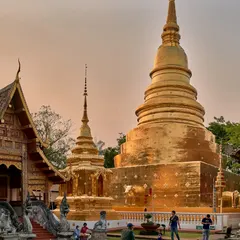
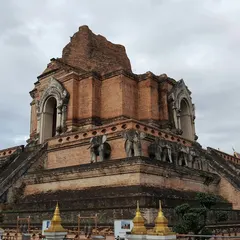
The second stop sits at the base of the great chedi, a circular bell-shaped brick stupa of stepped silhouette whose proportions reflect the Sinhalese prototype that shaped religious architecture across northern Thailand. From the pond and from the gardens, its volume dominates the grounds.
What matters is not its form but its structural function. The chedi does not merely crown a mound: it covers and unifies the system of galleries running beneath. It is, literally, the lid of a handmade cave. The tunnel mouths — semicircular brick arches opening in the flank of the mound — make that relationship visible from outside.
The dating of the whole ensemble is more fragile than tradition suggests. Although local accounts place the excavation in the time of King Kue Na, between roughly 1355 and 1385, some researchers hold that the present structures may correspond to later remodelling, and there is no consensus on which parts belong to the fourteenth century. How each position is argued is explained in front of the tunnel mouths.
The tunnels where painted birds still linger
Tunnel network (Umong)
Summary of this stop
The interior of the galleries changes the register of the route completely. The vaulted brick passages allow walking upright and form a network beneath the chedi; natural light disappears almost immediately and the sound of the forest goes out. That is precisely the effect they were built for, according to tradition.
The story is among the most singular in northern Buddhism. It tells that King Kue Na held great reverence for a monk named Maha Thera Chan, celebrated for his meditative gifts and equally for his inability to stay in one place: he wandered aimlessly through the forest. The king ordered the galleries dug and their walls painted with Buddhist scenes to create an environment without light, without views and without urban noise, in which that restless mind might finally settle. A retreat built to the measure of a temperament.
Of that painting scheme only fragments survive: traces of pigment and outlines of Buddhist figures — birds among them — on some stretches of wall. Their loss is due not only to time but partly to a twentieth-century restoration that damaged the paintings. It should be added that the tunnels’ original function is not precisely documented either: some scholars point to cult chambers or relic storage, and regard the wandering-monk story as a later narrative elaboration. What supports each hypothesis is set out inside the galleries.
Broken statues and trees that still teach
Buddha graveyard
Summary of this stop
The forest path leads to the most disconcerting part of the grounds: an open field where dozens of Buddha images lie fragmented, decapitated or eroded. The first reading, almost unavoidable, is one of abandonment. The second is more accurate: the pieces were collected from various points across the region and gathered here as a deliberate practice of respectful conservation for sacred objects that could no longer be kept in ritual use.
The local belief that reads the field as the literal trace of the temple’s own neglect circulates strongly, but does not match the record. It is true that Wat Umong went through a prolonged period of decay — placed roughly in the centuries of Lanna instability and Burmese domination — before being restored and revived as a meditation centre through the twentieth century.
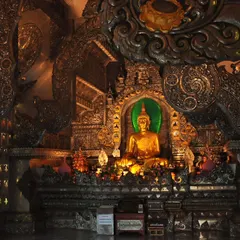
Among the trees along the same path hang tablets bearing Buddhist proverbs and maxims in Thai, Pali and English. They are not a closed installation: resident monks have been adding them since at least the mid-twentieth century, so the collection grows and shifts. In the gardens a Fasting Buddha also waits, the extremely thin figure representing the period of privation before enlightenment, before which local custom offers water rather than flowers or incense. Why that gesture and not another is the question with which EarGuide closes the route.