
Royal Temple
Wat Phra Singh Audio Guide
The highest-ranking temple in Chiang Mai's old town guards a Buddha image whose authenticity three cities dispute and whose head was stolen in 1922. Find out what to see at Wat Phra Singh.
- 60 min of audio
- Lanna Art
Wat Phra Singh began life in 1345 as a tomb. King Phayu of the Mangrai dynasty founded it to house the funerary chedi holding the ashes of his father, King Kham Fu, and that private commission eventually became the highest-ranking monastic complex inside the walls: in 1935 King Ananda Mahidol granted it the distinction of woramahawihan, the highest a Buddhist temple can receive in Thailand.
The grounds bring together the great bell-shaped chedi on a square base decorated with elephants, the austere Wihan Luang in daily monastic use, a scripture library raised on stilts and, above all, the Wihan Lai Kham, a wooden pavilion built between 1815 and 1821 whose gilded stucco and nineteenth-century murals make up the most detailed surviving portrait of everyday life in Lanna.
Highlights
- Phra Buddha Sihing — The most venerated image in the north, claimed by Chiang Mai, Bangkok and Nakhon Si Thammarat
- Wihan Lai Kham — Wooden pavilion of 1815–1821 with gilded stucco in vegetal motifs
- Nineteenth-century murals — The Sang Thong and the Suwannahong painted as an album of Lanna society
- Funerary chedi of 1345 — Raised for the ashes of King Kham Fu and decorated with elephants
- Ho trai — Library lifted on stilts against floodwater and termites
There are more than thirty temples inside Chiang Mai’s walled square, but only one holds the rank of woramahawihan. Wat Phra Singh obtained it in 1935, almost six centuries after its founding, and that gap between origin and recognition sums up its trajectory: it started as a family mausoleum in 1345 and ended up the ceremonial centre of the city, the place from which the only Buddha image Chiang Mai parades through its streets sets out every April.
Understanding what to see at Wat Phra Singh means accepting that the site operates in two registers at once. On one hand, the architecture of Wat Phra Singh offers an almost complete catalogue of the Lanna building repertoire: chedi, assembly viharn, ornamented pavilion and stilted library. On the other, the temple keeps a secret history made of uncertain attributions, an unsolved theft and a long century of institutional silence. The EarGuide audio guide walks the four stops that link both planes.
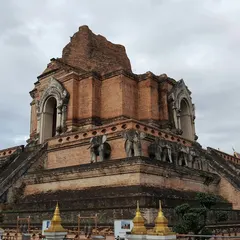
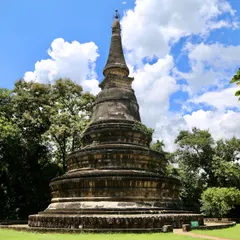
Wat Chedi Luang is very close by; on the way to the mountain, Wat Umong hides in the forest and, high above, Wat Phra That Doi Suthep overlooks the city.
The chedi was born as a royal tomb
Main Chedi
Summary of this stop
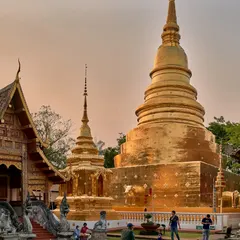
The first stop stands in front of the great chedi, in the centre-east of the grounds and visible from the main entrance. Its form — a circular bell-shaped body on a square base, crowned by a gilded spire and decorated with elephant sculptures — follows the classic Lanna model, but its original function was strictly funerary: to contain the ashes of King Kham Fu, commissioned by his son King Phayu in 1345.
That fact reorders how the whole complex reads. The temple was not planned as a pilgrimage centre or as the city’s ritual seat; those conditions arrived later, by accumulation. The structure has been enlarged and restored on several occasions across the centuries, so what stands today is a composite object, with layers stacked over a fourteenth-century core.
The building also needs placing in its context of discontinuity. Burmese rule over Chiang Mai lasted roughly from 1558 to 1775, and after the withdrawal the city was largely depopulated until 1791, when Prince Kawila undertook its restoration. It cannot be claimed that the temple remained in uninterrupted active use throughout that period, and that gap is more eloquent than it appears. What survived and what had to be remade is set out in the narration in front of the chedi.
A roof that lowers itself to protect
Viharn Lai Kham
Summary of this stop
On the west side of the grounds stands the Wihan Lai Kham, the most ornamented building in the complex and the smallest of its principal structures. It was built between 1815 and 1821 under Prince Thammalangka, second prince of Chiang Mai, at the moment when the city was rebuilding itself after the long Burmese parenthesis.
Its most recognisable feature is the three-tier stepped roof, which descends in successive planes until the eaves come close to the ground. The solution is not merely aesthetic: it reduces the walls’ exposure to monsoon rain and keeps the interior in shadow, an indispensable condition for conserving what it holds. The gables carry the gilded stucco decoration in vegetal motifs that gives the pavilion its name, the lai kham pattern.
Seen from outside, the façade works as an announcement: the density of gilding signals that the building guards something exceptional. The contrast with the neighbouring Wihan Luang — the great assembly hall in daily monastic use, far soberer in line — makes that hierarchy explicit. How ritual labour is divided between the two pavilions is explained during the audio route.
The Buddha disputed between faith and theft
Phra Buddha Sihing
Summary of this stop
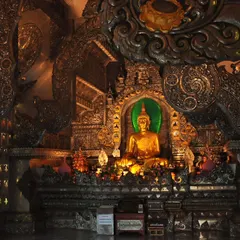
The interior of the Wihan Lai Kham houses the Phra Singh, or Phra Buddha Sihing, a seated image in meditative posture with the features and crown characteristic of the Lanna-Sukhothai style. The chronicles say it was created in Sri Lanka and travelled through several Southeast Asian kingdoms; authoritative sources place its arrival in Chiang Mai around 1400, received by King Saenmueangma from Chiang Rai, and its consecration in the temple in 1407.
This is where the problem starts. Thailand holds three images sharing that name and that origin story — this one, the one in the National Museum in Bangkok and the one in Nakhon Si Thammarat — and each claims to be the original. No art-historical study has managed to establish which one is, if any, and the Sinhalese origin is today regarded as founding legend rather than documented fact. The most venerated image in northern Thailand is, technically, a disputed attribution.
To that uncertainty a concrete episode adds itself: in 1922 the image’s head was stolen and never recovered. What presides over the altar today is a faithful replica made to replace it, so the figure before which the faithful kneel is a composite object, ancient body and modern head. Every April, during Songkran, that same image is carried through the streets of the old town so that tens of thousands of people can bathe it in scented water. The pavilion walls add a third layer of reading: the nineteenth-century murals narrate the Sang Thong and the Suwannahong and, in passing, portray men with extensive ritual tattoos and figures of foreign — Burmese or Chinese — appearance, making them an ethnographic document without equal on northern society of the period.
The library built against water and termites
Ho Trai
Summary of this stop
The final stop pauses before the ho trai, the scripture library. It is a structure raised on stilts, with the main body at mid-height and stucco decoration on the upper floor, and its design answers two very concrete threats: monsoon-season flooding and the wood-boring insects that devour palm-leaf manuscripts.
This building type is a distinctive feature of the great Lanna monastic complexes and explains, in large part, why texts from northern Thailand survive at all. The constructive solution — separating the archive from the ground and isolating it — is as pragmatic as it is revealing of the importance the monastic community placed on the written word.
Positioned at the end of the route, the ho trai delivers the final key to the complex: a temple that began by keeping ashes, went on to keep a disputed image and ended up keeping the written memory of the kingdom as well. Exactly what those manuscripts contained, and what is known of them today, is what closes the EarGuide narration at this point.