From the City of Arts and Sciences to the Carmen neighbourhood. Discover 2,000 years of Valencian history with audio guides.
Explore ValenciaWalk the Art Nouveau town of the North Atlantic with 29 audio stops narrated by experts. From the Jugendstilsenteret to Alnes lighthouse, every stop explains how a catastrophe made Ålesund what it is.
Ålesund packs a remarkable story into very few kilometres: the Jugendstilsenteret, housed in the old Swan Pharmacy that Schytte-Berg built between 1905 and 1907; Ålesund Church, consecrated in 1909, sober marble outside and covered in frescoes within; the Fjellstua viewpoint, reached by 418 steps from the Byparken; the Brosundet canal, with its salt-cod warehouses and the red Molja lighthouse of 1858; the Atlanterhavsparken, with four million litres of real Atlantic behind the glass; the Sunnmøre Museum, built over the buried medieval town of Borgund; and Alnes lighthouse, on the north-west tip of the island of Godøya.
With the EarGuide Ålesund audio guide, every site reveals its history through professional narration prepared by guides who know the town and its coast inside out. Unlike a free walking tour or a conventional guided visit, you set the pace, the order and the stops. No groups, no timetables, no internet connection.
The old Swan Pharmacy holds the best preserved Art Nouveau interior in Ålesund and explains, inside a single building, how a wooden town burned in fifteen hours and rose again in three years. This is what to see at the Jugendstilsenteret.
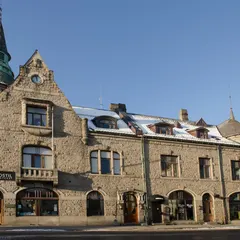
The Jugendstilsenteret occupies the former Swan Pharmacy, the Svaneapoteket at Apotekergata 16, a building that the architect Hagbarth Martin Schytte-Berg (1860-1944) designed and built between 1905 and 1907 on ground still warm from the fire. It is one of the most recognisable Jugendstil pieces of the rebuilt Ålesund: granite dressed in two textures, one fine and one rough, and undulating cornices that in 1907 resembled nothing this coast had seen before.
In 1984 it became the first Jugendstil building in the town to be listed as a protected monument, and since 6 June 2003 — when Queen Sonja of Norway opened it — it has housed the Norwegian national centre for Art Nouveau, sharing its entrance with the KUBE art museum, installed in the former Norges Bank branch of 1906. The detail that unsettles almost everyone who stops in front of the façade is not the swan of the name: it is the owl, the bird of knowledge, tangled among ornaments in the Urnes style, the medieval repertoire of the Norwegian stave churches.
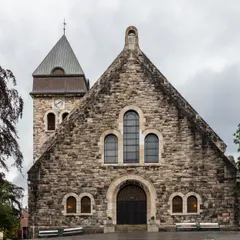
01 From outside, a mass of stone clad in white, yellow and red marble that seems to contradict the Art Nouveau town around it. Inside, a chancel covered in frescoes and a nave steeped in coloured light. This is what to see at Ålesund Church.
Ålesund kirke is the town's Lutheran parish church: a three-aisled langkirke built in stone to a design by the architect Sverre Knudsen and consecrated on 15 September 1909. It replaced Ålesund's first church, raised in 1853-1854 and consecrated on 25 January 1855, which vanished in the great fire of 23 January 1904 along with almost everything else. Knudsen won the competition called after the catastrophe with a project submitted under the Latin motto Ave Maria, and the foundation stone was laid on 13 July 1906 by the newly crowned King Haakon VII.
The building went up in local stone masonry — the so-called ålesundsmur — and was faced outside with some 2,000 square metres of white, yellow and red marble from the Eide quarries in Nordmøre: the same regional stone with which the town rebuilt itself fireproof. And there lies the twist that surprises almost everyone: architectural historians do not classify it as Jugendstil but as a work of natural-stone romanticism, neo-Romanesque and neo-Norman in root and German in inspiration. The Art Nouveau a visitor expects is not in the walls; it is kept inside, in the colour of the frescoes and the stained glass.
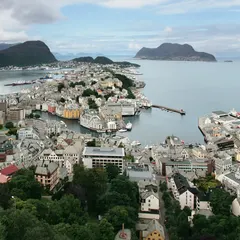
02 418 stone steps climb from the Byparken to the Fjellstua terrace, high on Mount Aksla. From the top some 200 summits can be counted, and a single glance explains why the fire of 1904 was able to run the whole length of Ålesund.
Fjellstua is the viewpoint and restaurant leaning out over Ålesund on the western flank of Mount Aksla. It is reached by 418 stone steps that set off from the Byparken, a public garden laid out by the municipality in 1885 along the contours of the hillside, and the terrace at the top opens a view of almost 270 degrees over the town centre, the archipelago and the Sunnmøre Alps. The Fjellstua platform sits at around 130 metres above the sea; the mountain's highest viewpoint, Rundskue, reaches some 195, and the round figure usually given for Aksla is 189.
What can be seen from up there is not simply a postcard: it is a diagnosis. Ålesund is packed onto narrow stone islands and peninsulas — Aspøya, Nørvøya, Hessa — wedged between fjords and the Atlantic, and that dense timber weave explains why, in the early hours of 23 January 1904, a fire that started in a canning factory on Aspøya destroyed almost the entire town in some fifteen hours. Below, the stone and Art Nouveau Ålesund on view today is exactly the one raised on those ashes.
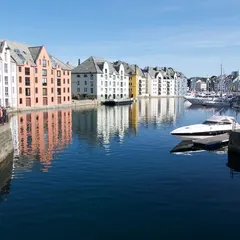
03 The real centre of Ålesund is not a square but an arm of the sea between two islands. Cod warehouses turned into hotels, a fisheries museum that predates the 1904 fire, and a red lighthouse from 1858 that is still lit. This is what to see at Brosundet.
Brosundet is the strait dividing the two central islands of Ålesund, Aspøya and Nørvøya, crossed today by the Hellebroa bridge. When the old medieval trading post at Borgund faded away around 1500, the fishing settlement gathered around this sheltered channel, and the present-day town grew out of it. The rise that followed was administrative: limited loading-port rights in 1793, full rights in 1824, and market-town status (kjøpstad) in 1848, always with this natural harbour as its axis.
The word to learn here is klippfisk, literally 'rock fish': cod salted and then dried in the open air on the bare stones of the coast. In the second half of the nineteenth century, as the fleet grew, klippfisk became Ålesund's main export and opened an intense trade with southern Europe and South America. The wooden warehouses — the sjøbuer — that lined this canal burned along with almost the whole town in January 1904 and were rebuilt afterwards; today they hold hotels, restaurants and shops, their walls still rising straight out of the water.
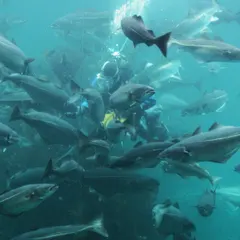
04 Four million litres of unfiltered seawater behind a 30-tonne acrylic pane, the largest open-air seal enclosure in Europe and a diver who goes in to feed the fish at one o'clock. The North Atlantic told from inside the water.
Atlanterhavsparken is wedged into the rocky coast of the Tueneset headland, on Hessa, the westernmost of the islands that make up Ålesund, some three kilometres west of the centre. The society behind it was founded in 1951, but the present building opened its doors on 15 June 1998, and it has ranked ever since among the largest saltwater aquariums in northern Europe. With more than 200,000 visitors a year it is one of Norway's biggest attractions and the great aquarium of the country's west coast.
Its centrepiece is the Atlantic tank, the Atlanterhavstanken: 36 metres long by 17 wide and 7 high, four million litres of unfiltered seawater, and cod, halibut, wolffish, conger eel, salmon and rays moving on the far side of the acrylic. The water is not a recreation: it is pumped straight out of the fjord through a pipe that runs some 800 metres out and draws from around 42 metres down, and up to 21,000 litres a minute come in. The same sea that beats against the rock outside is the one breathing inside.
05 More than fifty old houses brought here piece by piece, a fleet of traditional boats including the only original åttring still preserved and, underneath it all, one of the few genuine towns of medieval Norway. This is what to see at Sunnmøre Museum.
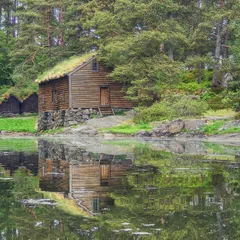
Sunnmøre Museum was founded in 1931 at Borgundgavlen, on the edge of Ålesund, on the initiative of the youth association Sunnmøre frilynde Ungdomssamlag, with Rasmus Buset and Anders Vassbotn among its driving forces. No nobleman and no ministry put it there: it grew out of the determination of young people who wanted to save a way of life slipping through their fingers. Today it gathers more than fifty old buildings moved to the site — around 55 by 2009 — from farms and mills to boathouses and fishermen's cabins, spread across a site of some 120 hectares.
What makes this more than a reconstructed village is the ground it stands on. The site lies over Borgundkaupangen, a medieval market town whose settlement goes back to the first half of the eleventh century and which, by the thirteenth, was the largest place on the Norwegian coast between Trondheim and Bergen. Excavations begun in the 1950s have brought some 45,000 objects to light, one of the largest medieval archaeological assemblages in Norway. Ålesund did not begin with the fire of 1904: it began here, and here it once went out.
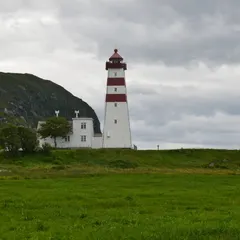
06 A red-and-white striped wooden tower on the far tip of the island of Godøya, facing the open Atlantic. It began as a lantern holding four candles and is today one of the most visited lighthouses in Norway, with a café and a gallery in the keeper's house.
Alnes Lighthouse stands on Alnestangen, the north-western point of the island of Godøya in the municipality of Giske, some 27 kilometres from Ålesund, with open sea in front of it and no land to shelter it all the way to the horizon. Below it lies Alnes, for a long time the largest fishing village — the largest fiskevær — in all of Sunnmøre. The way there runs through a chain of undersea tunnels; the last of them, the Godøytunnelen, opened in 1989, is 3,844 metres long and drops to 153 metres below sea level.
The tower visitors climb today is not the one usually quoted. Many tourist sources speak of the 'lighthouse of 1876', but that year marks the appointment of the first permanent keeper, when the light went over to continuous operation; the present tower — the fourth raised on this point — was built in 1937: some 22.5 metres of timber over a load-bearing frame of angle iron, painted in red and white stripes so as to stand out against a grey sky or snow. Its character is Oc(2) 8s, with a range of about 16 nautical miles for the white light.
07 The EarGuide app is free. The Ålesund audio guide includes 7 independent routes with close to an hour of professional narration across 7 sites and 29 audio stops, and it sits inside the app itself.
No. EarGuide works entirely offline. Download the routes over WiFi before you set out and you can use the audio guide with no connection and no data use throughout your walk around Ålesund and its islands. The map shows your GPS position in real time even without coverage.
The Ålesund audio guide is available in English and Spanish, with professional narration prepared by guides and experts in the history and architecture of western Norway.
The audio guide gathers 7 independent routes with close to an hour of narration in total. Each route takes between 30 and 90 minutes to visit, since the time spent walking each site adds to the audio. You can do them separately or chain several in one day.
They are different experiences. The EarGuide audio guide lets you walk Ålesund without timetables or groups, pause and resume whenever you like, and replay any explanation as often as you need. It suits independent travellers, families, cruise passengers with only a few hours in port and anyone who prefers a more flexible tour than a conventional free walking tour.
The Ålesund audio guide covers 7 main sites: the Art Nouveau Centre (Jugendstilsenteret), Ålesund Church, the Fjellstua viewpoint on Mount Aksla, the Brosundet canal, the Atlantic Sea Park (Atlanterhavsparken), the Sunnmøre Museum and Alnes lighthouse on the island of Godøya.
The centre can: the Jugendstilsenteret, Ålesund Church, the Brosundet canal and the climb to the Fjellstua viewpoint link up on foot. The Atlanterhavsparken, the Sunnmøre Museum and Alnes lighthouse lie outside town or on the islands and need a car, a bus or a boat.
The Ålesund audio guide sits inside the EarGuide app, free and ready to use offline. Carry it in your pocket and walk the town at your own pace.

From the City of Arts and Sciences to the Carmen neighbourhood. Discover 2,000 years of Valencian history with audio guides.
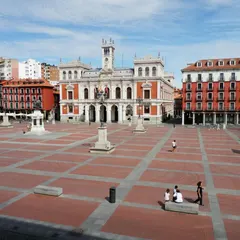
Explore Valencia
From the Plaza Mayor that inspired Madrid to the house where Cervantes wrote Don Quixote. Discover the former capital of the court of Philip III with audio guides.

Explore Valladolid
From the sacred mountain of Doi Suthep to the market built over the royal cemetery. Explore the old capital of the Lanna kingdom with audio guides.
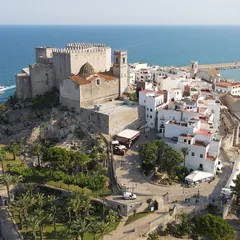
Explore Chiang Mai
From the Templar castle where a pope refused to stop being one to the range this coast deliberately left wild. Explore the walled town of the Papa Luna with audio guides.
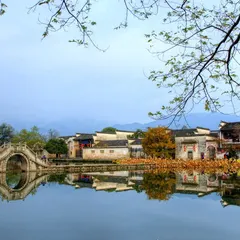
Explore PeñíscolaWe are working to bring EarGuide to more cities in Spain and Europe. Where do you want to discover culture?
Notify me