
Monumental Ruin
Wat Chedi Luang Audio Guide
The tallest stupa the Lanna kingdom ever built lost its upper third in 1545 and never got it back. What remains is still the ritual heart of Chiang Mai. Find out what to see at Wat Chedi Luang.
- 45 min of audio
- Lanna Architecture
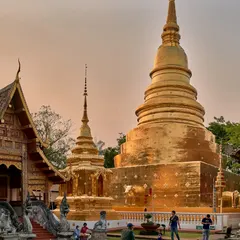
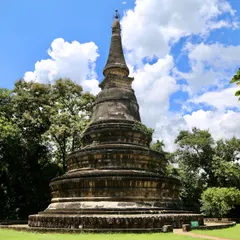
Wat Chedi Luang occupies the geographic and symbolic centre of Chiang Mai's old town with a mass of reddish brick cut off flat at the top. King Saen Muang Ma began the work around 1391 as a royal mausoleum, and King Tilokaraj raised it to some 82 metres in the mid-fifteenth century, making it the tallest structure in all of Lanna and one of the largest buildings in mainland Southeast Asia of its time.
Around 1545 the upper third came down. The Lanna chronicles blame a major earthquake; some researchers also point to instability accumulated by Tilokaraj's ambitious enlargement. The chedi was reduced to roughly 52 metres and has stayed that way: the 1990–1995 restoration funded by Japan and UNESCO rebuilt the platform, the nagas and the elephants at the base, but chose not to reconstruct the dome. The wound remains visible, and that decision is itself part of the monument.
Highlights
- 82-metre chedi — The tallest structure in the Lanna kingdom until the 1545 collapse
- Eastern niche — Home to the Emerald Buddha for some 84 years, from 1468 to around 1552
- Sao Inthakhin — The city pillar raised in 1296 and moved here by King Kawila in 1800
- Brick elephants — Eroded originals stand alongside those remade in the 1990s
- Yang na tree — The giant in the north-east corner entrusted by tradition with protecting Chiang Mai
Chiang Mai preserves dozens of intact temples and yet the one that best explains the city is the broken one. Wat Chedi Luang was the royal temple of the Lanna kingdom, the setting for state ceremonies and oaths of allegiance through the fifteenth and sixteenth centuries, and today it holds the rank of worawihan within the Thai system of royal temple classification. Its chedi was begun around 1391 under Saen Muang Ma and reached its maximum height — around 82 metres — under Tilokaraj, who reigned roughly between 1441 and 1487.
The secret history of Wat Chedi Luang is not that of an abandoned ruin but of a place that kept working after losing everything that made it famous. It lost its crown in 1545, lost the Emerald Buddha around 1552, and still houses the pillar on which the city’s fortune ritually depends. To grasp what to see at Wat Chedi Luang and how to read the architecture of Wat Chedi Luang, its four faces need to be walked slowly; the EarGuide audio guide accompanies that circuit stop by stop.
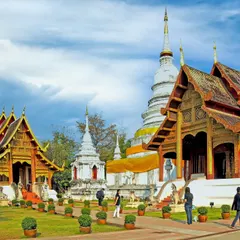
Within the walls, a few minutes away, is Wat Phra Singh; to the east lies Tha Phae Gate, and south of the old city gleams the Silver Temple.
First sight of a broken mountain
Wat Chedi Luang
Summary of this stop
The opening stop sits at the main entrance, at the point where the chedi enters the field of vision whole. What imposes itself first is not the scale but the cut: the top ends abruptly, without finial or spire, as though the building had had its conclusion withdrawn. The mass of reddish brick that remains measures roughly 52 metres, the result of subtracting from the original 82 the thirty or so that collapsed.
From this position the monument’s second stratum is also legible: the chromatic contrast between fourteenth- and fifteenth-century brick and the areas worked between 1990 and 1995 by the project jointly funded by Japan and UNESCO. That restoration rebuilt the stepped platform, the stairway nagas and part of the elephants, but left the dome unreconstructed.
The decision remains contested. Art historians and conservators argue over whether the new materials respect original methods and how far the form of some restored elements is hypothetical; for some it is responsible restoration, for others speculative reconstruction. The cause of the collapse admits nuance too: the dominant earthquake hypothesis coexists with one of structural fatigue, and the occasional mention of damage from Burmese cannon lacks solid documentary support. How each version holds up is one of the things the narration unpicks on site.
The pillar that protects and divides
Sao Inthakin
Summary of this stop
At the northern end of the grounds, a small shrine guards the Sao Inthakhin, the city’s sacred pillar. It is a wooden column wrapped in gold cloth, and its history runs longer than the temple’s own: it was raised in 1296, when King Mangrai founded Chiang Mai, at Wat Inthakhin, and only arrived here in 1800, when King Kawila had it moved. Tradition holds that the city’s prosperity is tied to its remaining upright.
Each year, around the sixth lunar month — generally May or June — the grounds become for seven days the epicentre of the Inthakhin festival. The people of Chiang Mai come in procession with garlands of marigold and jasmine, laid before the pillar, while monks and laypeople sprinkle holy water over the column. It is one of the oldest civic-religious rites still active in the city, and residents describe it less as a festival than as an annual symbolic recharge.
In the north-east corner grows an old yang na, a Dipterocarpus alatus with a thick trunk and visible surface roots, marked with garlands as a guardian tree. Popular belief, recorded in the temple’s own guides, holds that while the tree stands, Chiang Mai is safe. What relationship the pillar and the tree hold to each other, and why both should be concentrated in the same enclosure, is the thread the audio guide follows at this stop.
The elephant that gives the wound away
Wat Chedi Luang Chedi
Summary of this stop
The south face of the chedi offers the most discreet and most eloquent lesson of the whole complex. Brick elephants are set into the buttresses of the base platform. Seen in a row, they immediately reveal two different hands: the surviving originals show pronounced erosion, with internal brick exposed and slightly irregular proportions; those remade in the 1990s present a uniform finish and clean contours.
The same phenomenon repeats in the nagas of the four stairways, where fractured original pieces alternate with modern reproductions of a different texture. Walking the base of the chedi reading those seams amounts to reading a conservation report written into the monument itself, with no labels or explanatory panels.
This is probably where the technical debate stops being abstract. The difference between conserving and reconstructing becomes tangible when comparing two adjacent elephants separated by five centuries of weather. The criteria that guided each intervention, and what was lost and gained by them, are set out in the narration in front of the figures.
The niche that held the most coveted Buddha
Eastern niche of the Chedi
Summary of this stop
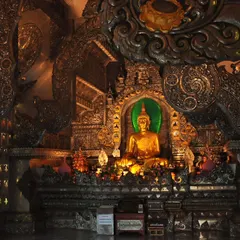
The east face of the chedi holds a recess that was, for eighty-four years, the most important place in Thai Buddhism. Between 1468 and around 1552, this niche housed the Phra Kaew Morakot, the Emerald Buddha, the most venerated sacred image in Thailand. It resides today in the Grand Palace in Bangkok, some seven hundred kilometres away.
Its departure was no administrative transfer. It happened during a period of political disintegration in which Lanna was losing power: King Setthathirat, who had inherited the Lanna throne and preferred to rule from Luang Prabang, took the kingdom’s most sacred image with him. For the people of Chiang Mai at the time, the Emerald Buddha’s departure amounted to abandonment of the city by its own kings, and the niche stood empty for centuries.
What occupies the recess today is a green jasper replica donated by King Bhumibol Adulyadej in 1995 to mark the temple’s six hundredth anniversary. A few metres away, the Monk Chats programme — launched around 1996 and linked to Mahamakut Buddhist University, Lanna campus — allows visitors to talk with resident monks in English, one of the first such formats in Thailand. The coincidence of a four-century gap and a conversation opened to foreigners sums up rather well what this temple does with its own loss, and it is where the audio route closes the circle.