FeaturesHow it works Privacy Policy
Chiang Mai, Thailand

Chiang Mai Audio Guide

Walk the old capital of the Lanna kingdom with 27 audio stops narrated by experts. From Wat Phra That Doi Suthep to Warorot Market, every temple keeps a story worth hearing.

+6h of audio
7 routes · 27 audio stops
Offline mode
English

What to see in Chiang Mai with the EarGuide audio guide

Chiang Mai packs seven centuries of Lanna history into a very short radius: Wat Phra That Doi Suthep, founded in 1383 on the summit an elephant chose; Wat Chedi Luang, whose 82-metre stupa lost its upper third in 1545 and still guards the city pillar; Wat Phra Singh, with the most venerated and most disputed Buddha image in the north; Wat Umong and its fourteenth-century tunnels cut into the forest; Warorot Market, raised in 1910 over the old royal cemetery; Wat Sri Suphan, sheathed in repoussé metal to save the silversmiths' trade; and Tha Phae Gate, laid out in 1296 and rebuilt in 1985.

With the EarGuide Chiang Mai audio guide, every landmark reveals its history through professional narration prepared by guides who know the city inside out. Unlike a free walking tour or a conventional guided visit, you set the pace, the order and the stops. No groups, no timetables, no internet connection.

No internet needed
Download the routes before you head out and explore without using data.
Smart geolocation
The narration starts by itself when you reach the point of interest.
01
Royal Sanctuary

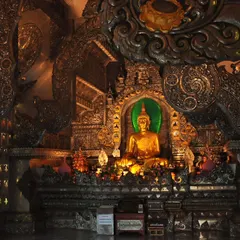
Wat Phra That Doi Suthep

The most revered sanctuary in northern Thailand stands 1,073 metres up, on a site chosen by neither king nor architect: an elephant picked it. Find out what to see at Wat Phra That Doi Suthep.

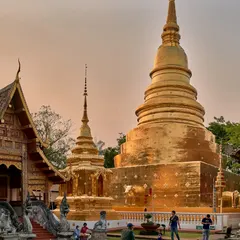
Wat Phra That Doi Suthep has crowned the mountain that gives the range its name since 1383, when King Kue Na, eighth monarch of the Lanna kingdom, ordered it built to house a relic of the Buddha carried north by the monk Sumanathera from the kingdom of Sukhothai. The complex is laid out as an ascent: first the stairway flanked by two stone nagas, then the gateway to the upper terrace, and finally the courtyard where the golden stupa, some 24 metres tall, gathers every scrap of available light.

What makes this temple singular is not its height or its gold but the fact that its access was won twice over. Until 1935, reaching it meant hours of walking through jungle; that year the monk Khruba Sriwichai mobilised thousands of volunteers from across northern Thailand, who cut the eleven kilometres of mountain road by pick and hoe in roughly five months, unpaid and without government funding. The convenience of driving up today is barely ninety years old.

Golden stupa of 1383 — Some 24 metres clad in gilded bronze plates housing the founding relic
Naga stairway — Around 306 steps flanked by two mythical stone serpents
Khruba Sriwichai — The monk who opened 11 km of road in five months with unpaid volunteers
North terrace — The viewpoint at 1,073 m from which the whole grid of Chiang Mai can be read
Ratchaworawihan rank — A second-class royal temple, maintained with funds from the Thai Crown
90 min of audioLanna Buddhism
Wat Phra That Doi Suthep 01
Wat Phra That Doi Suthep
02
Monumental Ruin

Wat Chedi Luang

The tallest stupa the Lanna kingdom ever built lost its upper third in 1545 and never got it back. What remains is still the ritual heart of Chiang Mai. Find out what to see at Wat Chedi Luang.

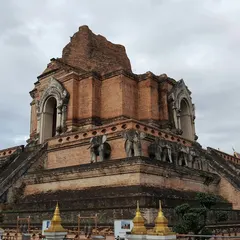
Wat Chedi Luang occupies the geographic and symbolic centre of Chiang Mai's old town with a mass of reddish brick cut off flat at the top. King Saen Muang Ma began the work around 1391 as a royal mausoleum, and King Tilokaraj raised it to some 82 metres in the mid-fifteenth century, making it the tallest structure in all of Lanna and one of the largest buildings in mainland Southeast Asia of its time.

Around 1545 the upper third came down. The Lanna chronicles blame a major earthquake; some researchers also point to instability accumulated by Tilokaraj's ambitious enlargement. The chedi was reduced to roughly 52 metres and has stayed that way: the 1990–1995 restoration funded by Japan and UNESCO rebuilt the platform, the nagas and the elephants at the base, but chose not to reconstruct the dome. The wound remains visible, and that decision is itself part of the monument.

82-metre chedi — The tallest structure in the Lanna kingdom until the 1545 collapse
Eastern niche — Home to the Emerald Buddha for some 84 years, from 1468 to around 1552
Sao Inthakhin — The city pillar raised in 1296 and moved here by King Kawila in 1800
Brick elephants — Eroded originals stand alongside those remade in the 1990s
Yang na tree — The giant in the north-east corner entrusted by tradition with protecting Chiang Mai
45 min of audioLanna Architecture
Wat Chedi Luang 02
Wat Chedi Luang
03
Royal Temple

Wat Phra Singh

The highest-ranking temple in Chiang Mai's old town guards a Buddha image whose authenticity three cities dispute and whose head was stolen in 1922. Find out what to see at Wat Phra Singh.

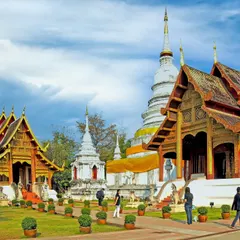
Wat Phra Singh began life in 1345 as a tomb. King Phayu of the Mangrai dynasty founded it to house the funerary chedi holding the ashes of his father, King Kham Fu, and that private commission eventually became the highest-ranking monastic complex inside the walls: in 1935 King Ananda Mahidol granted it the distinction of woramahawihan, the highest a Buddhist temple can receive in Thailand.

The grounds bring together the great bell-shaped chedi on a square base decorated with elephants, the austere Wihan Luang in daily monastic use, a scripture library raised on stilts and, above all, the Wihan Lai Kham, a wooden pavilion built between 1815 and 1821 whose gilded stucco and nineteenth-century murals make up the most detailed surviving portrait of everyday life in Lanna.

Phra Buddha Sihing — The most venerated image in the north, claimed by Chiang Mai, Bangkok and Nakhon Si Thammarat
Wihan Lai Kham — Wooden pavilion of 1815–1821 with gilded stucco in vegetal motifs
Nineteenth-century murals — The Sang Thong and the Suwannahong painted as an album of Lanna society
Funerary chedi of 1345 — Raised for the ashes of King Kham Fu and decorated with elephants
Ho trai — Library lifted on stilts against floodwater and termites
60 min of audioLanna Art
Wat Phra Singh 03
Wat Phra Singh
04
Forest Temple

Wat Umong

A king had a labyrinth of painted tunnels dug beneath a stupa so that a monk incapable of staying still could finally concentrate. Find out what to see at Wat Umong.

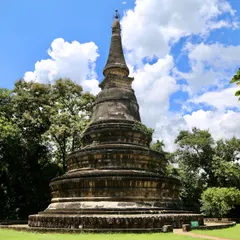
Wat Umong hides in dense forest at the foot of Doi Suthep, about two kilometres west of Chiang Mai's historic centre. King Mangrai founded it around 1297 under the name Wat Welukadtharam, and during the reign of Kue Na, in the second half of the fourteenth century, it was repaired and extended with the work that gave it its present name: a network of vaulted brick galleries — umong means tunnel in northern Thai — cut beneath the mound of the main chedi and decorated with Buddhist paintings.

It is a wat pa, a forest temple, a monastic type conceived for meditation far from urban noise and connected to the Theravada tradition of the wandering forest monks. Its distance from the city was not an accident but a requirement. It still works for exactly that today: meditation retreats, a programme of conversation with monks in English, and grounds where turtles, fish and birds share the paths with visitors.

Fourteenth-century tunnels — Vaulted brick galleries under the chedi, with traces of the original painting scheme
Maha Thera Chan — The wandering monk for whom, by tradition, the passages were dug
Talking trees — Tablets of Buddhist maxims hung from trunks and branches since the mid-twentieth century
Field of damaged Buddhas — Fragmented images gathered from across the region and kept with respect
Fasting Buddha — The emaciated figure before which local custom offers water, not flowers
60 min of audioTheravada Meditation
Wat Umong 04
Wat Umong
05
Historic Market

Warorot Market (Kad Luang)

In 1910 a princess ordered the ashes of Chiang Mai's former rulers moved so a market could be built over the royal cemetery. It is still trading. Find out what to see at Warorot Market.

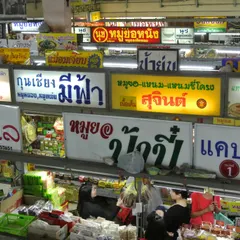
Warorot Market, which everyone in Chiang Mai calls Kad Luang — Great Market in the Lanna dialect — occupies the ground of the city's former dynastic cemetery. In 1910 Princess Dara Rasmi ordered the rulers' ashes transferred to Wat Suan Dok so that the city's commercial centre could be built here, a radical modernising decision that collided head-on with the traditional inviolability of dynastic ground.

Its position beside the Ping river is no accident either: until the railway reached Chiang Mai in 1922, the river was the only highway connecting the city with Bangkok. The original wooden building burned to the ground in 1968, and the present concrete structure, opened in 1972, is organised around a large square central atrium that lets you look down from the upper floors onto the mosaic of ground-floor stalls.

A royal cemetery turned market — Princess Dara Rasmi's decision of 1910
The 1968 fire — The blaze that erased the original wooden structure in a single night
Central atrium — The square void of the 1972 building, and the improvised hoist of the floods
Sai Ua and Nam Prik Num — Northern sausage and roasted green chilli dip, on the ground floor
Textile galleries — Hmong weaves, mor hom cotton and the Sikh and Hindu shops of the side lanes
60 min of audioLanna Cuisine
Warorot Market (Kad Luang) 05
Warorot Market (Kad Luang)
06
Lanna Silverwork

Wat Sri Suphan (Silver Temple)

In 2004 an abbot decided to clad a ruined temple in repoussé metal so that his neighbourhood's silversmiths would not lose their trade. Among the Buddhist reliefs there are spaceships. Find out what to see at Wat Sri Suphan.

Wat Sri Suphan was founded in 1502 by King Mueang Kaeo of the Mangrai dynasty, and the dazzling silvered building seen today sits precisely on the foundations and masonry base of that sixteenth-century compound. The transformation began in 2004, when abbot Phra Kru Phithatsuthikhun decided to sheathe the decaying building in metal with a very specific aim: to give work to the craftsmen of Wua Lai and halt the disappearance of their trade.

Despite the nickname, the exterior is not solid silver: for reasons of cost and weight it is clad mainly in an aluminium and nickel alloy, with pure silver reserved for the roofs and the most sacred areas. All the decoration is executed using the traditional dun loha technique, repoussé with chisel and hammer from the reverse of the sheet, without moulds. The grounds also operate as an active silversmithing school in full view of the public.

Metal-clad ubosot — Hand-worked repoussé over the foundations of the 1502 temple
Dun loha — The technique of striking the sheet from behind, with no moulds or presses
Pop-culture reliefs — Spaceships and city skylines hidden among the Buddhist iconography
Wua Lai Silversmith Art Center — A living school where monks and laypeople learn the craft
Phra Chao Chet Tue — The ancient bronze Buddha that survived every reconstruction
45 min of audioMetal Craft
Wat Sri Suphan (Silver Temple) 06
Wat Sri Suphan (Silver Temple)
07
Lanna Walls

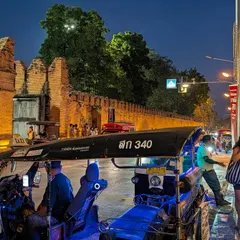
Tha Phae Gate

The most photographed image in Chiang Mai looks like a seven-hundred-year-old ruin and was in fact built in 1985, copied from a single photograph taken in 1899. Find out what to see at Tha Phae Gate.

Tha Phae Gate was laid out in 1296 by King Mangrai as the main eastern entrance to the new capital of the Lanna kingdom, the orientation considered most auspicious. Its name means, literally, raft landing: it was the gate connecting the walled city with the commercial port on the Ping river. Historically there were two Tha Phae gates, an outer one by the river, now gone, and this inner one, which acted as customs post and final filter for merchants and diplomats.

The immaculate brick wall framing today's photographs is not an intact ruin. The original thirteenth-century wall was an earthen palisade; King Kawila fortified it with red brick around 1796 to resist Burmese invasions, and what stands now is an almost total reconstruction carried out in 1985 by Thailand's Fine Arts Department, based on a single historic photograph taken in 1899.

Laid out in 1296 — The east gate of the capital founded by King Mangrai
1985 reconstruction — An arch remade from one photograph of 1899
Vongkrot — The U-shaped court that trapped attackers, of which only the front line survives
Suep Chata Mueang — The annual rite that wraps the arch in kilometres of sacred thread
Kilometre zero — Starting point of the Sunday Walking Street and epicentre of Songkran
30 min of audioUrban History
Tha Phae Gate 07
Tha Phae Gate

Questions about the Chiang Mai audio guide

How much does the Chiang Mai audio guide cost?

The EarGuide app is free. The Chiang Mai audio guide includes 7 walking routes with over 6 hours of professional narration across 7 landmarks and 27 audio stops. Download it free on Google Play.

Do I need an internet connection to use the audio guide?

No. EarGuide works entirely offline. Download the routes over WiFi before you set out and you can use the audio guide with no connection and no data use throughout your walk around Chiang Mai. The map shows your GPS position in real time even without coverage.

What languages is the Chiang Mai audio guide available in?

The Chiang Mai audio guide is available in English and Spanish, with professional narration prepared by guides and experts in the culture of northern Thailand.

How long does the full tour take?

The audio guide includes 7 independent routes with more than 6 hours of narrated content in total. Each route runs between 30 and 90 minutes. You can do them separately or combine several in one day, at your own pace.

Is the audio guide better than a free walking tour or a guided visit?

They are different experiences. The EarGuide audio guide lets you walk Chiang Mai without timetables or groups, pause and resume whenever you like, and replay any explanation as often as you need. It suits independent travellers, families and anyone who prefers a more flexible and deeper tour than a conventional free walking tour.

Which landmarks and points of interest does it include?

The Chiang Mai audio guide covers 7 main sites: Wat Phra That Doi Suthep, Wat Chedi Luang, Wat Phra Singh, Wat Umong, Warorot Market (Kad Luang), Wat Sri Suphan (the Silver Temple) and Tha Phae Gate.

Is the app available for iPhone?

For now the Chiang Mai audio guide is available on Google Play for Android devices. The iPhone version is coming soon to the App Store.

Download the Chiang Mai audio guide free

Download EarGuide free and carry every Chiang Mai audio guide in your pocket. Offline, at your own pace.

More audio tours in cities around the world

Valencia
Valencia

From the City of Arts and Sciences to the Carmen neighbourhood. Discover 2,000 years of Valencian history with audio guides.
Explore Valencia
Valladolid
Valladolid

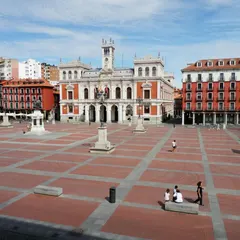
From the Plaza Mayor that inspired Madrid to the house where Cervantes wrote Don Quixote. Discover the former capital of the court of Philip III with audio guides.

Explore Valladolid
Ålesund
Ålesund

From the Art Nouveau town reborn out of the 1904 fire to a wooden lighthouse on the edge of the Atlantic. Explore Ålesund and its islands with audio guides.
Explore Ålesund
Peñíscola
Peñíscola

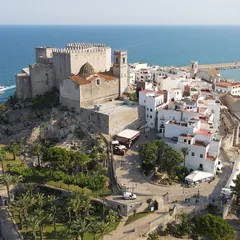
From the Templar castle where a pope refused to stop being one to the range this coast deliberately left wild. Explore the walled town of the Papa Luna with audio guides.
Explore Peñíscola
Coming soon
Your city?

We are working to bring EarGuide to more cities in Spain and Europe. Where do you want to discover culture?

Notify me