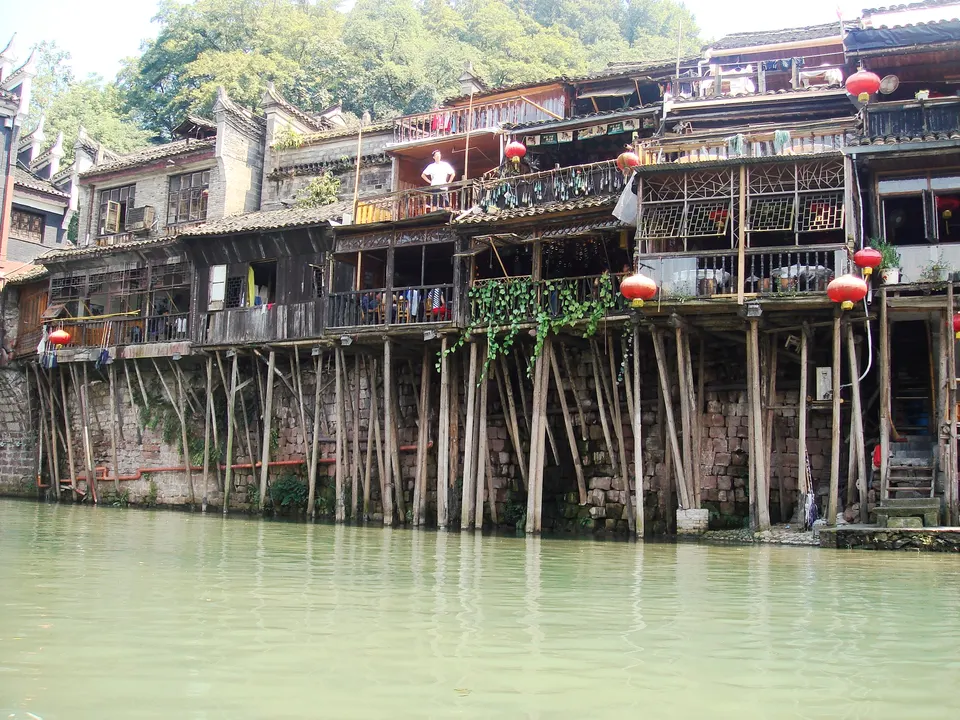
Houses hanging over the river
Huilongge Stilt Houses Audio Guide (Huilongge Diaojiaolou)
A row of some 240 metres of timber houses that face the old flagstone street at the front and hang their backs over the Tuo River, held up by the thin pillars Shen Congwen called "skinny legs".
- 45 min of audio
- Qing dynasty
In the southeast of Fenghuang's old town, the Huilongge stilt houses face the old official road at the front and hang over the Tuo at the back. Its buildings date from the Qing dynasty and the early years of the Republic of China, and are raised with an ancient trick: the hillside cut into a terrace, long timber pillars beneath its edge and, on top, a two-storey house with the stable suspended below, over the water.
Those skinny legs are also their weak point. On 15 July 2014 an extraordinary flood of the Tuo completely submerged the ground floors of the houses on the bank, and by 2025 many had been reinforced with brick and stone, so the timber pillars are disappearing. The same street, today full of bars and inns, ends in silence at the foot of Mount Tingtao, where Shen Congwen rests.
Highlights
- Timber pillars in the Tuo — The skinny, helpless legs Shen Congwen described
- Row of some 240 metres — Timber houses from the Qing era and the early Republic
- Cantilevered halls — Timber floors suspended over the river, with the old stable beneath
- Brick and stone bases — The reinforcement gradually replacing the old timber posts
- Huilongge flagstone street — The old official road, now bars and inns, all the way to Shen Congwen's grave
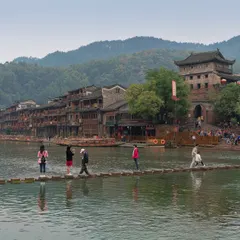
In the southeast of Fenghuang’s old town, a row of timber houses lives with two faces. At the front, the Huilongge Stilt Houses (回龙阁吊脚楼群, Huilongge Diaojiaolou) face the old official road, a flagstone street; at the back, they hang over the Tuo River, resting on long, thin pillars. The complex stretches some 240 metres along the bank, and its buildings date from the Qing dynasty and the early years of the Republic of China.
The history of the Huilongge Stilt Houses is bound up with that of their street. This flagstone street is part of the commercial axis of more than 3,000 metres that crosses Fenghuang and continues to Jieguanting, the pavilion where officials were received, and to Shen Congwen’s grave. It formed between the Yuan and Ming dynasties and keeps its Qing-era layout; some guides even present it as the oldest street in the old town, a primacy on which not all sources agree. Nor is there agreement on the houses’ family name: some sources call them Tujia hanging houses and others stress their markedly Miao features. Both peoples live together in Fenghuang and the type is shared.
The architecture of the stilt houses solves a problem of slope. The hillside is cut into an earth terrace, pillars hold up beneath its edge a hall suspended over the water and above it rises the main two-storey house, roofed with tile or Chinese fir bark. In the houses beside the Hong Bridge, the timber frame is of the chuandou type, in the “five columns and six hangers” or “five columns and eight hangers” variants. The writer Shen Congwen, born in Fenghuang, portrayed them in two words: xijiao lingding, skinny-legged and forlorn.
Today the hanging houses are mostly shops, bars and inns. How much domestic life remains in them is a matter of debate: one source counts more than ten families still living in the complex, another considers it entirely turned into business, and some guide claims that of the old houses on the bank only a dozen or so remain with pillars in the river. To know what to see at the Huilongge Stilt Houses, the audio guide offers 45 minutes and four stops: first from the water, at the Wind Bridge; then from the street; then at river level, at the Guanjing Bridge; and finally following the street to where the bustle fades.
From the riverside inns one sees, upstream, the Wanshou Palace, the guild hall of the Jiangxi merchants; and inside the old town, Shen Congwen’s Former Residence holds the childhood of the writer who named these “skinny legs”.
Skinny legs over the Tuo
Wind Bridge
Summary of this stop
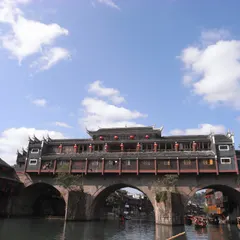
Halfway across the Wind Bridge appears the face the street hides. From the water, Huilongge is a line of timber halls cantilevered over the Tuo, held up by long, thin posts that go down to the current, with windows and balconies open to the river and a continuous line of black-tiled roofs, stepped along the bank, with the eave tips curled upward. From here one takes in a good part of the row of some 240 metres that occupies the southeast of the old town.
It was this image that Shen Congwen fixed with the expression xijiao lingding: houses with skinny, helpless legs. Seen from the bridge, the description still makes sense, and leaves in the air a question about how much of those timber pillars is fragility and how much is craft.
The bank has its own hour too. According to a documented tradition, at dawn, with the river still covered in mist, a dry, repeated thumping can be heard beneath the houses: women washing clothes in the Tuo and beating them, while locals pass with bamboo baskets on their backs, and the first tourists. It is the moment when the village, before the bars open, still belongs to those who live in it, and with that sound the narration begins on the bridge.
Low façades, stables over the river
Huilongge
Summary of this stop
On leaving the Wind Bridge, already in Huilongge, the same house changes scale. The one that seemed tall and suspended from the water shows toward the flagstone street a low façade, almost that of any village house, with its shop, its bar or its inn.
The trick is in the terrain. Each house rests on the bank’s slope, cut into an earth terrace with a profile in the shape of the character 厂. Beneath the edge of that terrace, long timber pillars hold up beams and planking at the same height, and thus the front hall suspended over the river is born. On the terrace, the main house has two floors: the first for living and the upper one for storing belongings, under a roof of tile or Chinese fir bark.
A gap remains: the space between the pillars, beneath the cantilevered hall. That is where the pigsty, the cow stable or the junk store went. In front of these façades, the audio guide takes apart piece by piece a house that kept its animals hanging over the water.
The 2014 flood and the new brick
Guanjing Bridge
Summary of this stop
From the Guanjing Bridge, looking upstream, the complex is seen at water level, and it is here that its weak point is understood. On 15 July 2014 an extraordinary flood of the Tuo completely submerged the ground floor of the houses on the old town’s bank and left a metre of water in the flat areas of the city.
Between the timber posts, stretches of brick or stone wall peek out. By 2025, many of the old stilt houses, originally held up by timber pillars, had been reinforced this way for safety, and the pillars are disappearing from the bank: Shen Congwen’s skinny legs are becoming scarce.
At night, the same river fills with small flames. Along the Tuo, paper lanterns are sold, lit, set on the water and carried downstream amid the reflections of the lit houses; according to popular belief, each one carries a wish. Around 2014 they were so cheap that, in high season, one yuan bought eight small lanterns and, in low season, twelve. On the bridge, the narration sets the flood and those wishes travelling down the same channel face to face.
The street that ends at Shen Congwen
Shen Congwen's grave
Summary of this stop
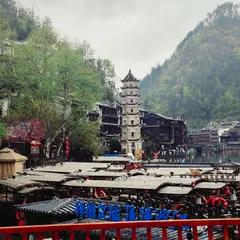
Huilongge’s flagstone street was an official road and is now a succession of businesses: the bars cluster in the first half and the inns in the second. It is part of the commercial axis of more than 3,000 metres that runs through Fenghuang and, according to one source, between shops and hostels more than ten families still live. From some riverside inns one sees, upstream, the Wanming Pagoda, the Shawan bend and the Wanshou Palace.
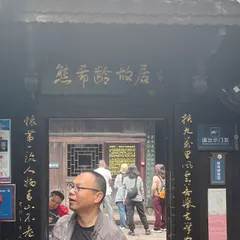
Downstream, beyond the bars, the crowd thins until, at the foot of Mount Tingtao, nearly everything is silence. There rests Shen Congwen, returned to his land after more than sixty years away from it. There is no mound: only a five-coloured stone slab and, higher up, a large natural rock with some lines composed in his own calligraphy: “Thinking as I think, I can be understood; thinking as I think, people can be known”.
Beside the slab stands a stele raised by the painter Huang Yongyu, with a dry sentence that does not sound like praise. At the foot of Mount Tingtao, the audio guide’s last stop reveals what that sentence says and why it is the right ending for the street of the skinny-legged houses.