
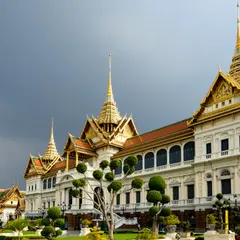
Royal Palace
Grand Palace and Wat Phra Kaew
The citadel with which Bangkok was born in 1782: the Emerald Buddha and its golden robes, the giants of the Ramakien, the gilded stupa and the throne halls.
Bangkok, Thailand
Walk the old capital of Siam with 53 audio stops narrated by experts. From the pillar the astrologers drove into the ground in 1782 to Chinatown's Dragon Street, every place explains how a city of kings, monks and Chinese merchants rose on the banks of the Chao Phraya.
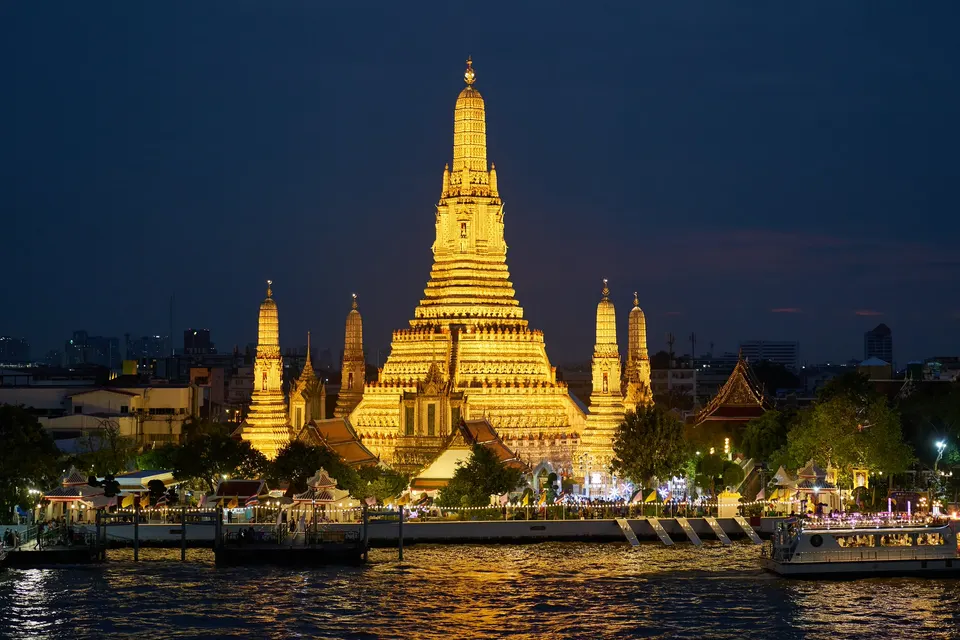
Photo: Radek Kucharski, CC BY 2.0
Royal Palace
The citadel with which Bangkok was born in 1782: the Emerald Buddha and its golden robes, the giants of the Ramakien, the gilded stupa and the throne halls.
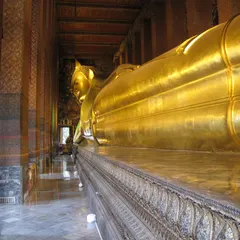
Royal Temple
The 46-metre Reclining Buddha with its mother-of-pearl feet, the four ceramic chedis of the Chakri kings, the cloister of 400 golden Buddhas and the pavilions where modern Thai massage was born.
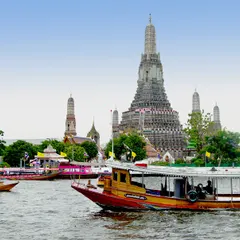
Royal Temple
The 1851 prang clad in Chinese porcelain and topped with a borrowed crown, the vihara that housed the Emerald Buddha and the two giants who guard Rama II's ashes.
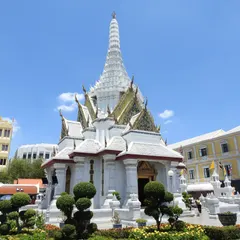
Founding Shrine
Bangkok's two founding pillars with the city's birth chart inside, the shrine of the five guardian deities and a living worship of gold leaf and offering dances.
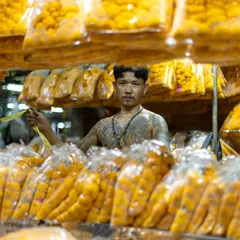
Historic Market
The wholesale flower market that never closes: jasmine and marigold for offering garlands, an old fish wharf and the Yodpiman terrace over the Chao Phraya.
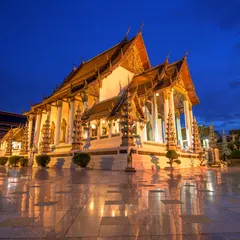
Royal Temple
The red gateway where Brahmins flew to bite at coins, the Hindu shrine that keeps the rite alive and an eight-metre bronze Buddha brought from Sukhothai.
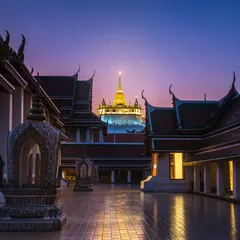
Sacred Mount
The artificial mount born of a sunken prang, the 344 steps between bells, the golden chedi with its Buddha relic and the vultures that recall the cholera epidemics.
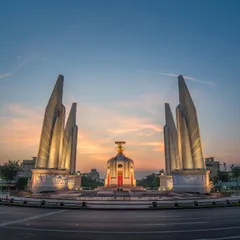
Historic Monument
The 24-metre wings that encode the date of 1932, the fence of 75 cannons, the reliefs of Silpa Bhirasri and the roundabout that is kilometre 0 of Thailand and the stage of its great protests.
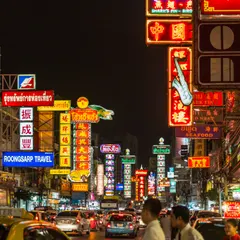
Historic Neighbourhood
Bangkok's Dragon Street: the red gate at Odeon Circle, the gold shops, the pre-war skyscrapers, the old market and the Sampheng alley where the neighbourhood was born.
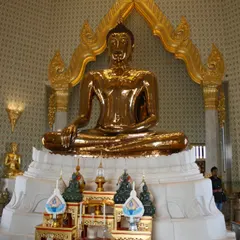
Temple of the Golden Buddha
The 5.5-tonne solid gold Buddha, the pieces of the stucco that hid it, the 1947 ubosot and the high gallery over Chinatown's rooftops.
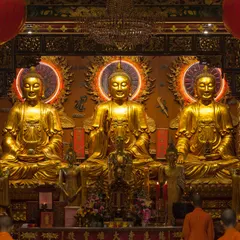
Chinese Mahayana Temple
Chinatown's great Chinese monastery: four guardian kings, three golden Buddhas, 58 deities and the little red book ritual with which the Sino-Thai community wards off bad luck.
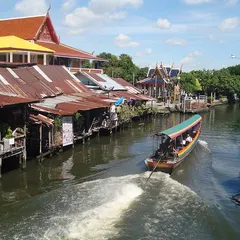
Historic Canal
The old course of the Chao Phraya in Thonburi: wooden houses on stilts, a goldsmiths' house built around a chedi, Thai puppets and two Ayutthaya-era temples.
Bangkok Audio Guide
Bangkok was born in 1782 around a wooden post and a green Buddha brought back as war booty. On Rattanakosin island rise the Grand Palace and Wat Phra Kaew, the citadel of the Emerald Buddha; the City Pillar Shrine, with the capital's birth chart; and Wat Pho, the temple of the 46-metre Reclining Buddha and cradle of Thai massage. Across the Chao Phraya, Wat Arun raises its prang clad in Chinese porcelain, and in Thonburi Khlong Bang Luang preserves the old course of the river. To the east wait the Giant Swing and Wat Suthat, the 344 steps of the Golden Mount, the Democracy Monument and the Pak Khlong Talat flower market, which never closes. And in Chinatown, Yaowarat Road, the Chinese monastery of Wat Mangkon Kamalawat and Wat Traimit, with the solid gold Buddha that, according to tradition, spent centuries disguised in stucco.
With the EarGuide Bangkok audio guide, every place reveals its history through professional narration prepared by guides who know the city and Thai culture inside out. Unlike a free walking tour or a conventional guided visit, you set the pace, the order and the stops. No groups, no timetables, no internet connection.
No internet needed
Download the routes before you head out and explore without using data.
Smart geolocation
The narration starts by itself when you reach the point of interest.
Frequently asked questions
The EarGuide app is free. The Bangkok audio guide includes 12 independent routes with more than nine hours of professional narration spread across 12 sites and 53 audio stops, and it is found inside the app itself.
No. EarGuide works entirely offline. Download the routes over WiFi before you set out and you can use the audio guide with no connection and no data use throughout your walk around Bangkok. The map shows your GPS position in real time even without coverage.
The Bangkok audio guide is available in Spanish and English, with professional narration prepared by guides and experts in the history of Bangkok and Thailand.
The audio guide brings together 12 independent routes with more than nine hours of narration in total, from 20 minutes to two hours per route. The usual approach is to spread them over two or three days: Rattanakosin and Wat Arun one day, Chinatown and the east of the old town another, and Khlong Bang Luang in Thonburi as a separate outing.
They are different experiences. The EarGuide audio guide lets you walk Bangkok without timetables or groups, pause and resume whenever you like, and replay any explanation as often as you need. It suits independent travellers, families and anyone who prefers to understand the city at their own pace, with no prior knowledge of Thailand.
The Bangkok audio guide covers 12 sites: the Grand Palace and Wat Phra Kaew, Wat Pho, Wat Arun, the City Pillar Shrine, the Pak Khlong Talat flower market, Wat Suthat and the Giant Swing, Wat Saket and the Golden Mount, the Democracy Monument, Chinatown, Wat Traimit, Wat Mangkon Kamalawat and Khlong Bang Luang.
Almost all of it. The Grand Palace, Wat Pho, the City Pillar Shrine and Pak Khlong Talat are a few minutes' walk apart on Rattanakosin island; Wat Suthat, the Golden Mount and the Democracy Monument lie somewhat further east, and Chinatown, Wat Traimit and Wat Mangkon Kamalawat make up another walk. For Wat Arun it is enough to cross the Chao Phraya on the ferry, and Khlong Bang Luang, in Thonburi, is best covered by boat or on a separate walk.
Yes. Purchases belong to your EarGuide account, not to one app or one phone. A city unlocked in the EarGuide app is also unlocked in that city's own app, and the other way round, on both iPhone and Android. Just sign in with the same account on the other device. The store's “restore purchases” button only covers the app the purchase was made in, so signing in is what carries it across.
The Bangkok audio guide is inside the EarGuide app, free and ready to use offline. Carry it in your pocket and explore the city at your own pace.
Coming soonMore destinations
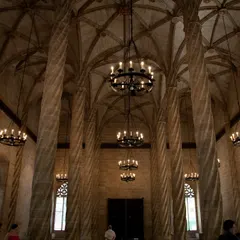
From the City of Arts and Sciences to the Carmen neighbourhood. Discover 2,000 years of Valencian history with audio guides.
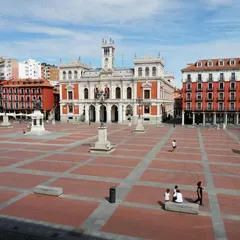
From the Plaza Mayor that inspired Madrid to the house where Cervantes wrote Don Quixote. Discover the former capital of the court of Philip III with audio guides.
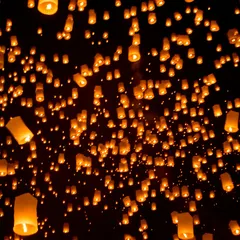
From the sacred mountain of Doi Suthep to the market built over the royal cemetery. Explore the old capital of the Lanna kingdom with audio guides.

From the Art Nouveau town reborn out of the 1904 fire to a wooden lighthouse on the edge of the Atlantic. Explore Ålesund and its islands with audio guides.
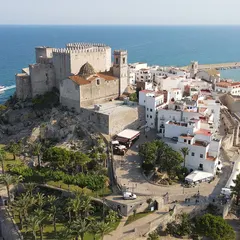
From the Templar castle where a pope refused to stop being one to the range this coast deliberately left wild. Explore the walled town of the Papa Luna with audio guides.
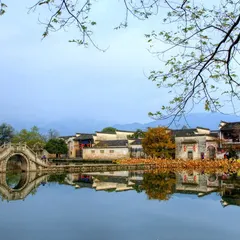
From a half-moon pond over a spring to the gilded mansion of a salt merchant. Explore the Wang clan's village, shaped by water, with audio guides.
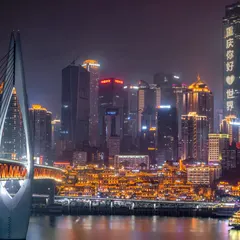
From the stilt houses of Hongyadong to the train that crosses a building at Liziba. Explore the mountain city of the Yangtze and the Jialing with audio guides.
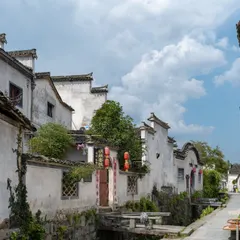
From the stone archway the clan nearly turned into lime to the corner a prefect gave up to the street. Explore the Hu clan's village, in Huizhou, with audio guides.
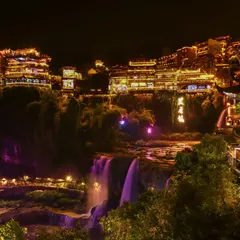
From the waterfall that splits the town in two to the bronze pillar that sealed a peace in 940. Explore old Wangcun, hanging over the You River, with audio guides.
We are working to bring EarGuide to more cities in Spain and Europe. Where do you want to discover culture?