Qing birthplace
Xiong Xiling's Former Residence Audio Guide (Xiong Xiling Guju)
In an alley off Wenxing Street, a timber-and-brick courtyard house of some 260 m² holds the cradle of the "Xiong Phoenix": Fenghuang's child prodigy who became prime minister of the Republic in 1913 and ended up raising orphans in a former imperial garden in Beijing.
- 30 min of audio
- Siheyuan courtyard house
The house dates from around 1868, the seventh year of the Tongzhi era of the Qing dynasty, and was acquired by his grandfather, Xiong Shigui, when he was a bazong, company officer, of the left battalion of the Zhen'gan garrison, today's Fenghuang old town. Xiong Xiling was born here and spent his childhood and adolescence here. It is a south-facing brick-and-timber siheyuan, with a main body of three bays in chuandou structure, a gabled roof between firewalls and small grey tile. It reopened restored in 2000 and since 2002 has been a provincial-level protected property of Hunan.
The boy from a house with a mortar room for hulling rice became, in Beijing, the owner of the mansion of the Keqin princes, and in 1932, after being widowed, he gave it up with all his fortune for education and charity. That is why, beneath the portrait that presides over the hall, there is a bronze bust that no institution commissioned: his former orphans cast it. And that is why the house holds a paradox: it keeps the Phoenix in bronze, but not in a tomb.
Highlights
- Bronze bust in the central hall — 51 cm, cast and donated in 2001 by fourteen former pupils of his orphanage
- Cai Yuanpei couplet — Two tablets at the second gate summing up his path from politics to the orphanage
- Red sandstone courtyard — Red flagstones, the rice-mortar room and stone mill of a frontier military family
- Lattice study — 72 m² open to the courtyard behind carved lattice windows lined with white paper
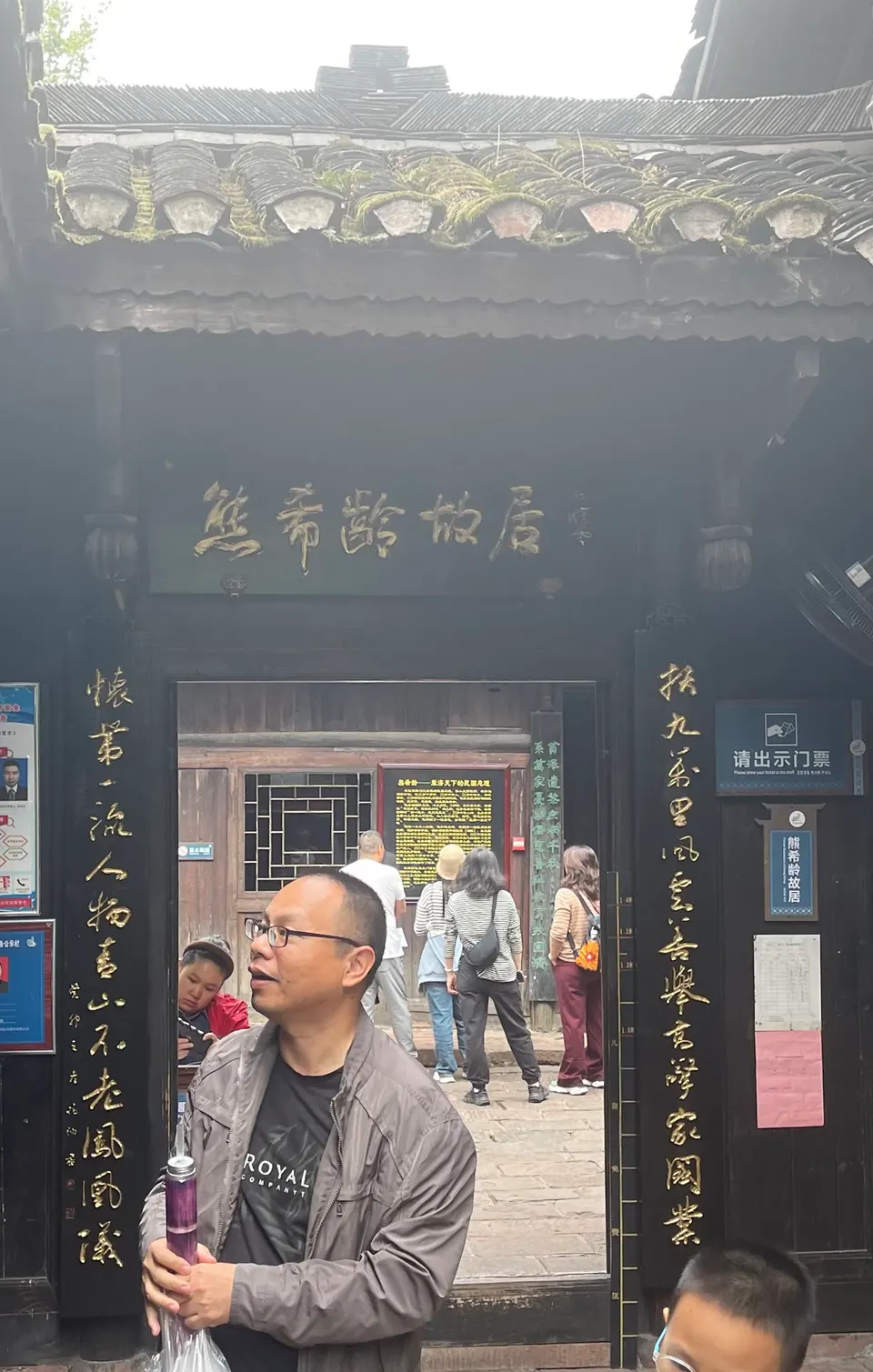
- Eave plaque — The characters 熊希龄故居 and the 熊 of the surname that inspired a famous word puzzle
At the end of an alley off Wenxing Street, in Fenghuang’s old town, a simple door opens onto Xiong Xiling’s Former Residence (熊希龄故居, Xiong Xiling Guju). Nothing about it announces a head of government: it is a timber-and-brick courtyard house, of 262.9 m² of plot and 157 m² built, which a grandfather who was a garrison officer bought around 1868. There was born, according to the date given by most sources, on 23 July 1870, the boy whom his homeland would come to call “Xiong Fenghuang”, the Xiong Phoenix.
The history of Xiong Xiling’s Former Residence is that of a dizzying rise. Nicknamed the “child prodigy of Hunan”, Xiong passed in 1894 the jinshi degree, the highest of the imperial examinations, and that same year entered the Hanlin Academy. Under the Republic, from 31 July 1913 to 12 February 1914 he was prime minister and finance minister under President Yuan Shikai, at the head of the so-called “cabinet of talents”. His fall took him down another path: after the great flood of 1917 around Beijing he opened a shelter for children of the victims that in 1920 became the Xiangshan Orphanage, installed in the former imperial garden of Jingyiyuan, in the Fragrant Hills, until 1948. He died in Hong Kong in 1937, where he had gone to raise funds for the wounded and refugees of the war with Japan.
On his origins a judgement of the time also circulates. According to documented tradition, when he passed the provincial examination, the examiner wrote of that youth from “the barbarian lands of the Chu frontier” that he was a talent “without precedent”. And the governor who later put him at the head of the Changsha School of Current Affairs, Chen Baozhen, had served years before in Fenghuang and knew these same streets.
The architecture of Xiong Xiling’s Former Residence is that of a well-off military family, but without luxuries: a courtyard paved with red sandstone, a three-bay main body under firewalls, a study with carved lattices, a room for hulling rice, a stone mill and a small garden of some 60 m² with a stone table and stools. The rooms gather photographs of Xiong and his family, furniture, writing tools and manuscripts of his in a display case. After reopening in 2000, in 2023 the Hunan Heritage Office approved a new restoration.
To know what to see at Xiong Xiling’s Former Residence, the audio guide covers it in four stops and 30 minutes: the alley gate, the red sandstone courtyard, the lattice study and the central hall with the bronze bust. The thread is a single one: from this tiny house of frontier soldiers came a man who rose to the heights of power, fell and chose to spend what he had left on other people’s children. And it is those children, now elderly, who have brought him back here.
A hundred metres away the North Gate Tower opens in the wall, and some 300 away, in another alley, Shen Congwen’s Former Residence holds the childhood of Fenghuang’s other illustrious son.
A neighbours’ gate for the Phoenix
Xiong Xiling's Former Residence
Summary of this stop
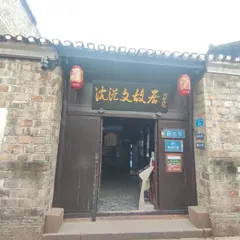
Access is a narrow passage from Wenxing Street to a simple courtyard-house gate, so discreet it is hard to find. On this door hung the couplet dedicated to him by the Xiangshan Orphanage alumni association, with lines about “a whole life of sincere patriotism” and “half a life of charity and schools”.
The house was acquired by his grandfather, Xiong Shigui, when he was a bazong, company officer, of the left battalion of the Zhen’gan garrison, which is what Fenghuang’s old town was then called. His father, Xiong Zhaoxiang, rose to commander of the Chengxiang river marine battalion of Hengzhou. It was, therefore, a well-off family of soldiers, and in it Xiong Xiling was born in 1870, although one source gives 1869 and some biographical dictionary even 1867.
His nickname came from the city: from his native land he became known as “Xiong Fenghuang”, the Xiong Phoenix. The wordplay followed him all his life, and in 1935, at his wedding to Mao Yanwen, a disciple of his, Liu Fuxuan, dedicated to him a couplet that began with “the phoenix takes flight”. In front of the gate, the narration explains why an entire city ended up lending its name to a man.
Red sandstone, rice mortar and a bear
Red sandstone courtyard and mortar room
Summary of this stop
Past the gate opens a small tianjing, the skylit courtyard, paved with blocks of red sandstone and surrounded by the main body, the study opposite and the wings. From the centre one sees the brick firewalls and the small grey tile that covers the gabled roof, and under the eave of the main house hangs a horizontal plaque with the characters 熊希龄故居, the work of the calligrapher Mao Zhiyong. The date of the house is not entirely settled: the most cited dating puts it around 1868, but another source takes it back a generation, to the Daoguang era (1821-1850).
Beside the courtyard lies the duiwu, the mortar room for hulling rice, and in the east-side gallery a stone mill: the practical, austere part of a frontier house. On the other side of that gallery hides a small garden of some 60 m², with plants, a stone table and stools.
On the plaque there is also a character with a history. It is told in Hunan that a xiucai challenged the boy Xiong with a couplet that played on his surname: if from 熊, “bear”, you remove the four dots below, the “paws”, what remains is 能, “capable”. But the verse, according to the sources, was born in another way and with another intention, far less innocent. In the courtyard, the audio guide takes the character apart stroke by stroke and tells how an insult ended up turned into legend.
The study of the prodigy who fell twice
Carved lattice study
Summary of this stop
Opposite the main body rises the study, of 72 m², with its façade to the courtyard closed by windows of carved lattice with geometric motifs, lined with white paper. It is the corner that best fits the youth who studied here: in 1894, the 20th year of the Guangxu era, Xiong passed the jinshi degree and that same fifth month entered the Hanlin Academy as shujishi, bachelor of the imperial academy. The ages at his earlier examinations vary from source to source; that date is the only firm one.
His first fall came early. According to documented tradition, in 1898 a censor presented the Guangxu emperor with a memorial against Governor Chen Baozhen in which he ridiculed the Southern Study Society of Changsha, and at the centre of the scene placed the young Xiong with a small bell in his hand. In autumn came the blow against the Hundred Days’ Reform and Xiong was dismissed with a ban on holding any office again.
The second fall was from higher up. Prime minister since 31 July 1913, in early 1914 the press revived the scandal of the theft of treasures from the Rehe summer palace, from when he was military governor of that region; on 7 February he resigned under suspicion and on the 12th he left office. The sources do not agree on the true cause: some point to the scandal, others present it as a pretext fabricated by Yuan Shikai and others speak of his opposition to Yuan’s monarchical restoration. Before the lattices, the narration reconstructs the scene of the small bell that his enemies turned into proof of subversion.
A bust paid for by his orphans
Bronze bust in the central hall
Summary of this stop
In the centre of the main hall, beneath Xiong’s portrait, rises a bronze bust 51 cm high and 35 wide. It was cast and donated in October 2001 by fourteen former pupils of the Xiangshan Orphanage. At its sides hangs his own couplet, “the spirit wears down amid the bustle; the body transforms in a hundred years”, and in the hall there is also a text from 1936 by the chairman of the National Government, Lin Sen, comparing the children taken in to ears of grain and catalpas raised “to a hundred feet”. At the second gate, two vertical tablets with semi-cursive calligraphy by Cai Yuanpei sum up the whole life: tired of sailing the sea of offices, he returns to the mountain and tries out an orphanage.
According to documented tradition, the vocation came to him as a child, when he watched his mother, née Wu, help the poor and hungry, take in children and pay for doctors. In 1931 his wife, Zhu Qihui, his companion in the orphanage work, died, and in 1932 Xiong gave away his entire fortune in her memory: more than 275,000 silver dollars and 62,000 taels, along with the Beijing mansion that had belonged to the Keqin princes.
The house remembers him in bronze, but does not keep him: Xiong died in Hong Kong on 25 December 1937 and does not rest in Fenghuang. Facing the bust, the audio guide’s last stop follows the long journey of his remains and closes the circle between the boy of this courtyard and the orphans who brought him home.