Temple of the Great Relic
Wat Mahathat Audio Guide
The monastery of the kings of Ayutthaya and seat of the Supreme Patriarch lost its tower of some 50 metres twice; what is left is an empty base that hid a crypt of gold and, among the roots of a sacred fig tree, a Buddha head the tree has been embracing for half a century.
- 60 min of audio
- Royal monastery in ruins
Wat Mahathat, the monastery of the Great Relic, began as a reliquary east of the royal palace: around 1374 Borommaracha I ordered the Phra Si Rattana Mahathat built, and Ramesuan enlarged it into a great temple. It was a royal monastery and the seat of the Supreme Patriarch of the urban order until the end of the kingdom, and every year the king arrived in procession for the Kathin ceremony. In the compound remain the platform of the Vihara Luang, the ubosot with its sema stones, a gallery of headless Buddhas and an octagonal chedi found nowhere else in Ayutthaya.
The most valuable thing in the temple was never in view. Its great gilded prang collapsed all at once without storm or lightning, in 1631 according to the Dutchman Jeremias van Vliet; Prasat Thong rebuilt it in 1633 to some 50 metres, and in 1904 it fell again, finishing its crumbling in 1911. Beneath the empty base, in 1956, a 17-metre shaft led to a crypt with a solid gold lion, nested stupas and tiny relics preserved in sandalwood oil.
Highlights
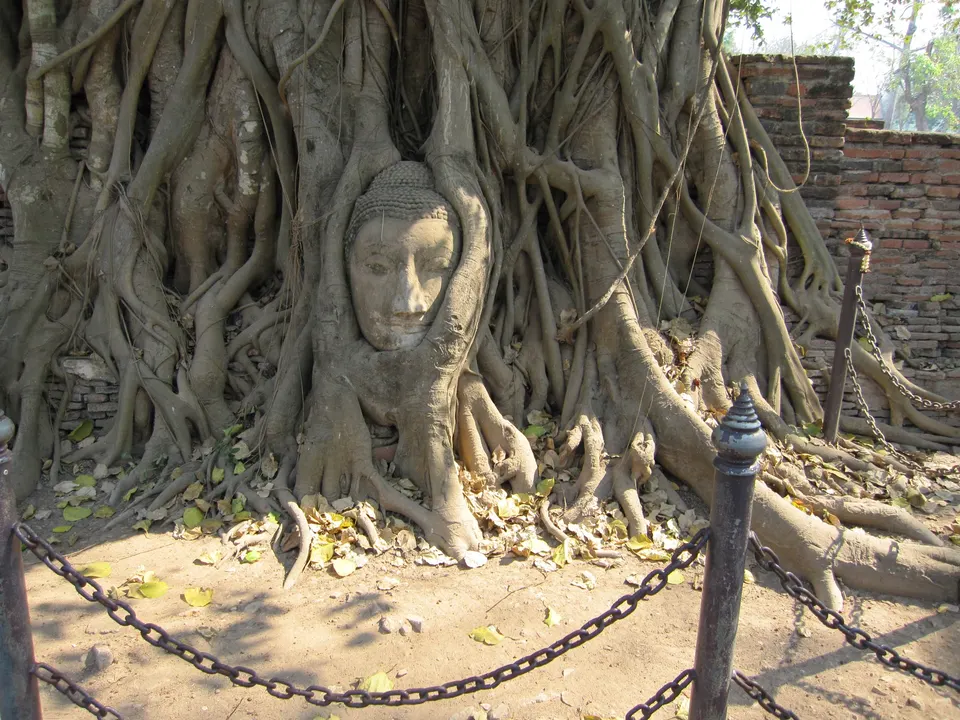
- Buddha head among roots — Ayutthaya-period sandstone wrapped by a sacred fig tree since around 1968
- Base of the central prang — What remains of a tower of some 50 metres that fell between 1904 and 1911
- Crypt of 1956 — Solid gold lion, nested stupas and relics in sandalwood oil at 17 metres
- Vihara Luang — Great royal assembly hall of some 40 by 20 metres, a few steps from the palace
- Octagonal chedi — Four stepped tiers and a small prang, a design unique in Ayutthaya
A few steps from the Grand Palace of Ayutthaya, Wat Mahathat (วัดมหาธาตุ) was the monastery of the Great Relic: the temple of the kings and the seat of the Supreme Patriarch of the urban order, the Khamawasi, until the end of the kingdom. Every year the king came here in royal procession for the Kathin, the offering of robes to the monks. Of that religious heart there remain brick walls, a gallery of headless Buddhas and an empty platform on which a tower of some 50 metres once rose.
The history of Wat Mahathat begins with a reliquary. The most common reading places the beginning around 1374, year 736 of the Chula Sakarat era, when King Borommaracha I ordered the Phra Si Rattana Mahathat built east of the palace, and its completion with Ramesuan, who enlarged it into a great temple in 1384. The sources do not agree: the Luang Prasoet chronicle gives 1374 and Borommaracha I; later versions of the Royal Chronicles credit the work to Ramesuan in 1384, a year that does not fit his reign (1388-1395), and the Dutchman Jeremias van Vliet ascribed it in 1640 to U-Thong, Ramathibodi I. According to tradition, Ramesuan was keeping the precepts in the Mangkhalaphisek pavilion when he saw a relic of the Buddha working a miracle to the east; he went out in a palanquin, had stakes driven to mark the spot and raised there a reliquary of 19 wa with a nine-branched finial of 3 wa.
The temple was also a showcase of a defeated empire. According to a documented tradition, around 1431 King Borommaracha II took Angkor, the Khmer capital, had sacred images of oxen, lions and other creatures torn from its temples and, back in Ayutthaya, presented them as offerings, some at Wat Mahathat and others at Wat Phra Si Sanphet. In 1595 the Bruges gem merchant Jacques de Coutre described, in a temple that was probably this one, life-size bronze figures leaning against the wall and brought from a ruined city in Cambodia that the natives called “Anguor”. The Dutch of the 17th century knew it as Nopphathat, Nappetat or Nappetadt, and the name Wat Na Pa Than also circulated, which the Siamese prince Prisdang, by then a monk named Jinawarawansi, explained as “the monastery facing the charcoal quarter”: Pa Than was the charcoal-burners’ district.
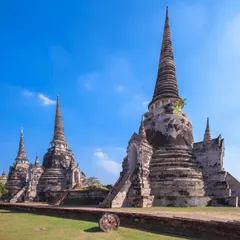
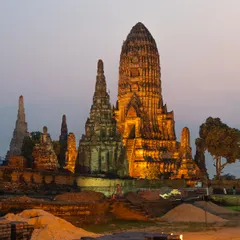
The architecture of Wat Mahathat is arranged around the central prang, surrounded in a quincunx by four smaller prangs at the corners of the platform and closed by a cloister of seated Buddhas, mostly headless. To the east lies the Vihara Luang, the great royal assembly hall; to the west, the ubosot, the ordination hall, ringed by the inner wall and by the bai sema stones that mark the sacred space. A Ceylonese embassy that visited the temple in 1750, in the reign of Borommakot, left a description of the base of the reliquary surrounded by sculptures of lions, bears, swans, peacocks, kinnaras, oxen, wolves, buffaloes and dragons, the creatures of the mythical Himaphan forest. And the compound keeps a piece found nowhere else in Ayutthaya: an octagonal chedi of four stepped tiers crowned by a small prang.
To know what to see at Wat Mahathat, the audio guide walks the compound in four stops and 60 minutes, from the Buddha head among the roots to the royal hall, the base of the central prang and the minor prang of the northwest. A paradox joins them: the sanctuary of the kings is read today in an empty brick base, and its true treasure was always below, not above.
Across the street, Wat Ratchaburana keeps standing the best preserved prang on the island, with its own crypt looted in 1957, and on the west bank of the river Wat Chaiwatthanaram is the temple-mountain of Prasat Thong, the same king who rebuilt the great prang here in 1633. Off the island, at the confluence of the Chao Phraya and the Pa Sak, Wat Phanan Choeng holds a 19-metre seated Buddha older than the city itself.
A Buddha head embraced by a tree
Buddha head among the roots
Summary of this stop
Beside a small satellite vihara, a sacred fig tree (Ficus religiosa) holds among its aerial roots a sandstone Buddha head of the Ayutthaya period. The area is cordoned off and a guard is always beside the tree: the temple’s best-known image is seen from a certain distance, with the serene face peeping out of a tangle of roots.
Several versions circulate about how it got there. The popular ones speak of a thief who hid it and never came back for it, or of a victim of the Burmese sack of 1767. The documented explanation is more prosaic: around 1968-1970, during a restoration, a workman removed it from an area about to be restored and left it at the foot of this fig tree, whose roots gradually wrapped it; a local guard places it there for more than 50 years. The tree has not stopped. Between 2017 and 2018 the roots advanced between 0.5 and 2.5 centimetres further over the head, and the staff of the Historical Park slow its growth with synthetic substances so that it does not swallow it entirely.
A gesture of respect also applies before it. Signs ask visitors to crouch or kneel to photograph it, so that their own head never sits above the Buddha’s; standing over it is considered disrespectful. Right there, the audio guide separates what is legend from what is history in the arrival of that head among the roots.
The royal hall where a monk conspired
Vihara Luang
Summary of this stop
East of the prang extends the raised platform of the Vihara Luang, the great royal assembly hall, of some 40 by 20 metres. The pedestal of the main Buddha and stretches of wall with false windows remain. This was the monastery of the kings and the Supreme Patriarch, a few steps from the Grand Palace, which every year received the royal Kathin procession.
It is also the setting of a dark episode that history debates. According to the transmitted account, in 1611 a monk staged a coup from this temple. Prince Si Sin, ordained in 1602 and become the revered scholar Phra Phimon Tham, gathered his followers at Wat Mahathat; his men broke down the Gate of Good Fortune, entered the palace and seized the one-eyed king Si Saowaphak, who was executed with a sandalwood club at Wat Khok Phraya. The monk rose to the throne as King Songtham.
The walls close the scene. In the fall of Ayutthaya, in 1767, the Burmese attack set fire to the monastery, although another source maintains that the temple largely withstood the blaze and that the visible ruins date mostly from the late 17th and the 18th century. Afterwards, for generations, it lay exposed to looting and clandestine digging: beneath the pedestal of the main Buddha, the Fine Arts Department found the shaft of looters who had secretly dug down two metres, kept digging another two and came upon five small clay jars full of thin sheets of gold bearing various figures. On this platform, the audio guide reconstructs the plot that took a monk from the habit to the crown.
Fifty metres of tower that are no more
Base of the central prang
Summary of this stop
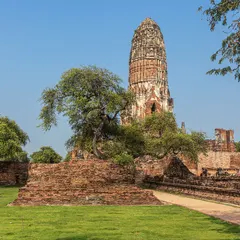
In the centre of the compound, a symmetrical platform of laterite and brick with stairs on all four sides is all that remains of the central prang. Its lost scale is understood by looking across the street, where the prang of Wat Ratchaburana still stands: here, on this base, there was a tower of some 50 metres, the heir of the reliquary that Borommaracha I ordered raised around 1374 and Ramesuan completed.
It is the story of a tower that fell twice. In 1631, third year of the reign of Prasat Thong, according to Jeremias van Vliet, the tall gilded Khmer-style prang collapsed all at once, with no storm, thunder or lightning; during the reconstruction the bamboo scaffolding also came down in the middle of rain, and the soothsayers kept the bad omens secret. The Royal Chronicles place that first collapse earlier, in the reign of Songtham. What nobody disputes is the response: in 1633 Prasat Thong rebuilt it taller than the original, which he judged too squat. The new one reached 1 sen and 5 wa, some 50 metres, topped by a metal spire of six metres, in works that lasted nine months.
The second fall was final. On 25 May 1904, at five in the morning, the main prang collapsed down to the level of the niches, and in 1911, under Rama VI, it finished crumbling. The sources do not date that end alike, between the reign of Rama V and that of Rama VI, and the sequence of 1904 and 1911 is the one that reconciles both. It was never rebuilt. At the foot of the few steps that remain, the audio guide measures the tower that is missing.
The gold crypt beneath the empty base
Northwest minor prang
Summary of this stop
At the northwest corner of the platform survive the remains of one of the minor prangs that surrounded the central one, the one that still keeps traces of early murals with rows of Buddhas. From here, the gaze returns to the empty base and to what it hid below.
In 1636, Jeremias van Vliet noted a popular saying: with the riches buried beneath the Buddha images of Wat Mahathat and Wat Phra Si Sanphet a ruined kingdom could be restored. Three centuries later, in 1956, workmen of the Fine Arts Department dug with crowbar and basket a narrow shaft down to the main crypt, 17 metres beneath the prang, lighting their way with a lantern and lowering guava branches to move the air. The first thing to appear was a solid gold lion inside a fish-shaped vessel. On 30 August 1956 a hollow stone pillar of 3.20 metres was opened: inside was a series of nested stupas, of lead, silver, nag alloy and crystal with garnets, emeralds and rubies, and a tiny gold casket with relics the size of a third of a grain of rice preserved in sandalwood oil. They are kept today in the Chao Sam Phraya National Museum.
Among the objects in the crypt an inscribed sheet of tin also appeared: the merit dedication of a couple, Pho Ai and Mae Chao, who at the age of 75 had as many votive Buddha images cast as the days they had lived, “twenty-seven thousand five hundred days”, a figure somewhat above the real one. Beside the northwest prang, the last stop of the audio guide goes down to that crypt, where the gold of the kings shared space with the day count of an anonymous couple.