Living temple by the river
Wat Phanan Choeng Audio Guide
An active temple at the confluence of the Chao Phraya and the Pa Sak, where a 19-metre gilded Buddha, dated 1324 by the chronicle, was already seated when Ayutthaya did not yet exist, and where saffron robes are still offered to it beside the shrine of a Chinese princess.
- 40 min of audio
- Active Buddhist temple
Wat Phanan Choeng stands outside Ayutthaya island, to the southeast, facing the point where the Pa Sak gives its waters to the Chao Phraya. The Luang Prasoet chronicle dates its great image to 1324, 26 years before King U-Thong founded the capital in 1351, which points to an earlier settlement on this bank. That image, Luang Pho To, is a seated Buddha of brick and mortar covered in stucco and gilded, some 19 metres high, filling its hall almost completely. King Mongkut restored it in the mid-19th century and gave it its official name, Phra Phuttha Trairattana Nayok.
The same Buddha answers to two names. For the Thais he is Luang Pho To, the Great Venerable Father; for the Chinese and Sino-Thai community he is Sam Po Kong, protector of sailors. A few steps away, in a two-storey Chinese shrine beside the river, Soi Dok Mak is venerated, the princess who according to tradition died on her boat off this landing and to whom love and children are asked for today. In 2024 King Vajiralongkorn and Queen Suthida presided over the ceremony for the image's 700 years.
Highlights
- Luang Pho To — Gilded seated Buddha of 19 metres dated 1324, older than Ayutthaya itself
- Shrine of Chao Mae Soi Dok Mak — Kuan Yin below and the Chinese princess above, among silks and ex-votos
- Ubosot — Three Buddhas; when cleaned in 1963, gold appeared beneath the stucco of one
- Great vihara — Walls with hundreds of niches of small Buddhas and carved wooden doors
- Confluence riverbank — The Pa Sak joins the Chao Phraya before the setting of the legend
Outside Ayutthaya island, on the southeast bank, just where the Pa Sak joins the Chao Phraya, stands Wat Phanan Choeng (วัดพนัญเชิง). It is no part of the landscape of ruins left by the old capital: it is a living temple, with monks, incense, sailors who pray and couples who ask for children. And it keeps a paradox of the calendar: its great Buddha is older than the city around it.
The history of Wat Phanan Choeng begins before that of Ayutthaya. The Luang Prasoet chronicle dates the Phra Phanan Choeng image to 1324, year 686 of the Chula Sakarat era, 26 years before King U-Thong founded the capital in 1351; everything points to an earlier settlement on this bank. Not all sources agree: some reference works place the Buddha in 1334 and reserve 1324 for the building of the temple, and another, disputed tradition attributes the image to King Naresuan, who would have commissioned it from Mon craftsmen under the name Phra Borom Trailokanat. Around 1690, the traveller Kaempfer also described it as Mon work. Not even the temple’s name has a clear origin: one explanation derives it from Khmer, with choeng as “foot”, from the Buddha’s crossed legs; another ties it to the legend of a princess.
Since then, the temple has watched the city’s history pass by on the river. In 1575 the fleet of the Cambodian king Barom Reachea I of Longvek hid beside the monastery before being driven off by cannon fire, and in 1585 a Khmer army camped in its vicinity. King Mongkut (Rama IV) had the whole image restored in the mid-19th century and gave it its official name, Phra Phuttha Trairattana Nayok; on 1 April 2024, King Vajiralongkorn and Queen Suthida presided here over the ceremony for its 700 years.
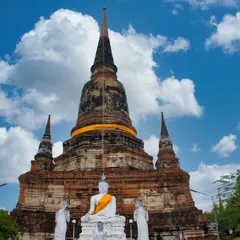
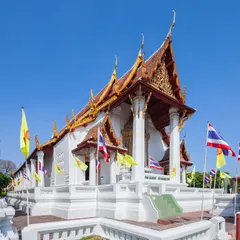
The architecture of Wat Phanan Choeng is spread over several halls. The great vihara, ringed outside by bas-reliefs of the Ramakien, opens with large wooden doors carved with floral motifs, deities and mythical animals, and inside its walls are pierced by hundreds of niches with small Buddhas. To the north, another hall combines a seated Buddha with Chinese-style murals; the ubosot, the ordination hall, gathers three images, and beside the water rises the Chinese shrine of Princess Soi Dok Mak.
To know what to see at Wat Phanan Choeng, the audio guide walks it in five stops and 40 minutes, from the confluence riverbank to the interior of the ubosot. A single thread joins them: this is not a place to remember among ruins, but a temple that came before the city, watched it fall and keeps praying beside the river.
About 1.6 km to the east, Wat Yai Chai Mongkhon is another living monastery, whose monks file down in procession from the stairs of its great chedi. On the island itself, Wat Mahathat was the seat of the Supreme Patriarch until the end of the kingdom.
The bank where a princess landed
Confluence riverbank
Summary of this stop
The route starts on the riverbank, facing the point where the Pa Sak joins the Chao Phraya. Here stood the old ferry landing to Hua Sarapha, and from here the temple reads as what it was for centuries: a place of arrivals by water. Up this stretch in 1575 came the fleet of Barom Reachea I, king of Longvek, in Cambodia, who hid it beside the monastery before the cannon of Nai Kai fort forced it back.
The most famous arrival, however, belongs to legend. According to the tradition recorded in the Northern Chronicle (Phongsawadan Nua), the Chinese princess Soi Dok Mak came up the river to marry King Sai Nam Phueng. Offended that the king did not come to receive her at the landing, she died on her boat holding her breath, and the king raised the temple on the site of her cremation.
On the opposite bank is a district with a shipwreck in its name: Samphao Lom, “where the junks sank”. It is said that, after the princess’s funeral, the Chinese who had accompanied her bored holes in the hulls of their own ships to die with her. There is a less romantic explanation: at the confluence the water runs fast and abundant, an inexperienced pilot could capsize, and downstream, off Wat Kai Tia, remains of sunken boats have been found. Beside the river, the audio guide sets the two versions of the place name face to face.
Mirrors and silks for a Chinese princess
Shrine of Chao Mae Soi Dok Mak
Summary of this stop
Beside the water rises the shrine of Chao Mae Soi Dok Mak, a two-storey Chinese building: the ground floor is dedicated to Kuan Yin and the upper one to the princess. It smells of incense and is full of candles and ex-votos, because people come here to ask for love and children, and whoever sees a wish fulfilled returns to leave silks, pearls and miniature Chinese junks.
The princess is treated almost like a bride. The offerings are for the dressing table: seven-coloured silk, cosmetics, mirrors, combs and auspicious fruits such as oranges and pomegranates; fulfilled promises are paid with a sabai shawl or a red Thai dress, and sometimes with a Chinese opera performance. Locals also repeat a rule nobody dares break: never bring pork into her enclosure. The same Chinese community venerates the great neighbouring Buddha under another name, Sam Po Kong, protector of sailors; some sources place a visit here by Admiral Zheng He in 1407, while others see in that link a later construction of the myth.
The figure prayed to has a double story. The two old versions agree that Soi Dok Mak was not born of a woman but of an areca palm inflorescence, and her name means precisely “areca flower garland”. They differ on the ending: in one she dies young and childless off this landing; in the other she marries Prathum Suriyawong, king of Inthapat, in Cambodia, and lives a long life surrounded by sons and daughters. In the shrine, the audio guide tells why that second ending changes the meaning of what is asked for here.
A gilded giant older than Ayutthaya
Luang Pho To
Summary of this stop
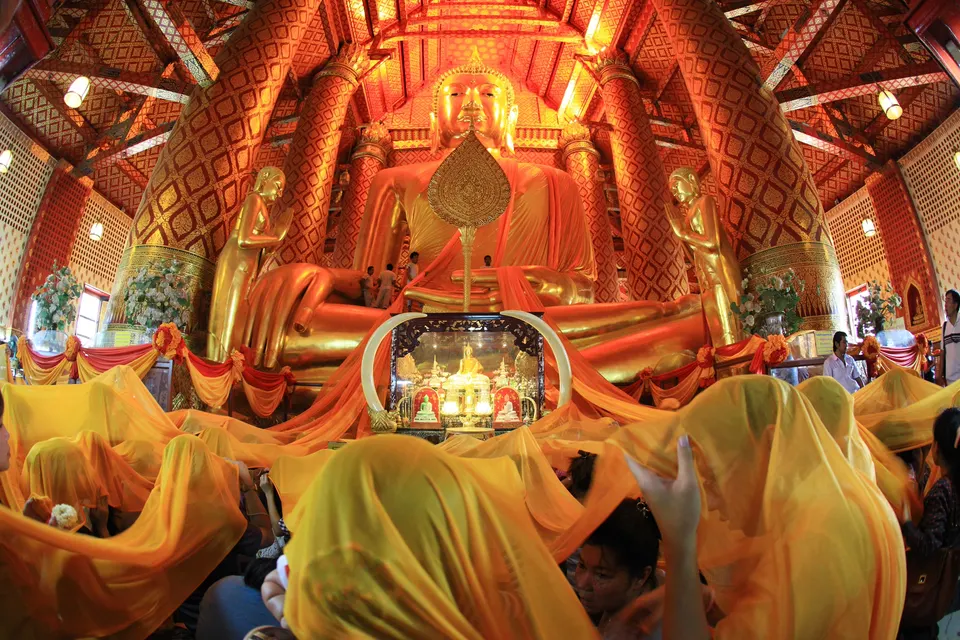
Inside the great vihara, Luang Pho To fills the hall almost completely. He is a seated Buddha of brick and mortar, covered in stucco and gilded, in the posture of subduing Mara. He measures some 14 metres from knee to knee and 19 metres in height with the head’s finial, 19.30 to the tip of the flame, although the lap figures vary by source. He often wears a saffron robe laid over the shoulder.
That scale has a date: the chronicle places it in 1324, before the founding of Ayutthaya, and in 2024 King Vajiralongkorn and Queen Suthida celebrated its 700 years here. The rite that defines the temple is dressing the giant in a robe offered by worshippers, laid across his gilded body.
In front of the image is a table with a story behind it. For years devotees threw the robes into the air so they would fall on the Buddha’s shoulders, convinced they were really dressing him. On 3 October 2017, the deputy abbot Phra Khru Suthikitchaphon forbade it: since then the offering formula is recited and the robe is left on the table, with signs explaining it. That same day the amulet display cases left the vihara and the images of Chinese gods moved to the princess’s shrine. A 74-year-old worshipper accepted it without drama: as a child, nobody threw robes. Before the table, the audio guide explains how the custom that has now been corrected was born.
The mountain of gold that wept and broke
Walls of niches with small Buddhas
Summary of this stop
On the walls of the vihara, hundreds of niches hold small Buddhas around the giant, and from there his face is seen differently. In 1655, the VOC’s Dutch physician Gijsbert Heeck measured 42 feet from knee to knee and wrote that it looked more like a mountain of gold than a human figure.
That mountain has suffered. According to the tradition recorded in the Khamhaikan Chao Krung Kao, before the fall of Ayutthaya to the Burmese in 1767, tears welled from its eyes and ran down to the navel. On 21 December 1901 a fire damaged the temple and the image, which King Chulalongkorn (Rama V) had restored; the works ended the following year. On 15 March 1928 the cheeks and lower jaw broke into pieces, and in 1929 the Royal Institute paid for the repair of the face. Before that, King Mongkut had ordered it restored entirely, in 1854 according to most sources and in 1851 according to others.
Even affection nearly harmed it. During Songkran, the Thai new year, locals went to bathe Luang Pho To, and at some point in the 20th century water came to be sprayed in jets over the image until it was damaged. After it was restored and covered again in gold leaf, a replica was cast: since then it is the copy that leaves the vihara for the festivals. Before the wall of niches, the audio guide goes over the wounds of a survivor who looks whole.
The gold hidden beneath the stucco
Ubosot with three images
Summary of this stop
The route ends in the ubosot, the ordination hall, where three Buddhas sit in the same posture of subduing Mara. For a long time they seemed stucco images like so many others, until in 1963, during a cleaning, the stucco came away and metal appeared beneath.
One of the images turned out to be of gold, 145 centimetres wide and 190 high, and two are attributed to the Sukhothai period, around 1357. To the north, another hall, the north vihara, accompanies its Buddha with Chinese-style murals, one more echo of the community that shares this temple.
The hall closes the circle opened in the great vihara: if the giant is a survivor remade layer by layer, here the layers hid the opposite: metal, and in one case gold. Inside the ubosot, the audio guide’s last stop leaves the feeling that Wat Phanan Choeng has still not shown everything it keeps.