Three-country border
Golden Triangle Audio Guide (Sop Ruak)
The bank where the Ruak falls into the Mekong and Thailand, Myanmar and Laos face one another: a former opium crossroads dressed in gold with a giant Buddha and a royal museum, opposite the dome of a Laotian casino sanctioned for drug trafficking.
- 60 min of audio
- Mekong and opium
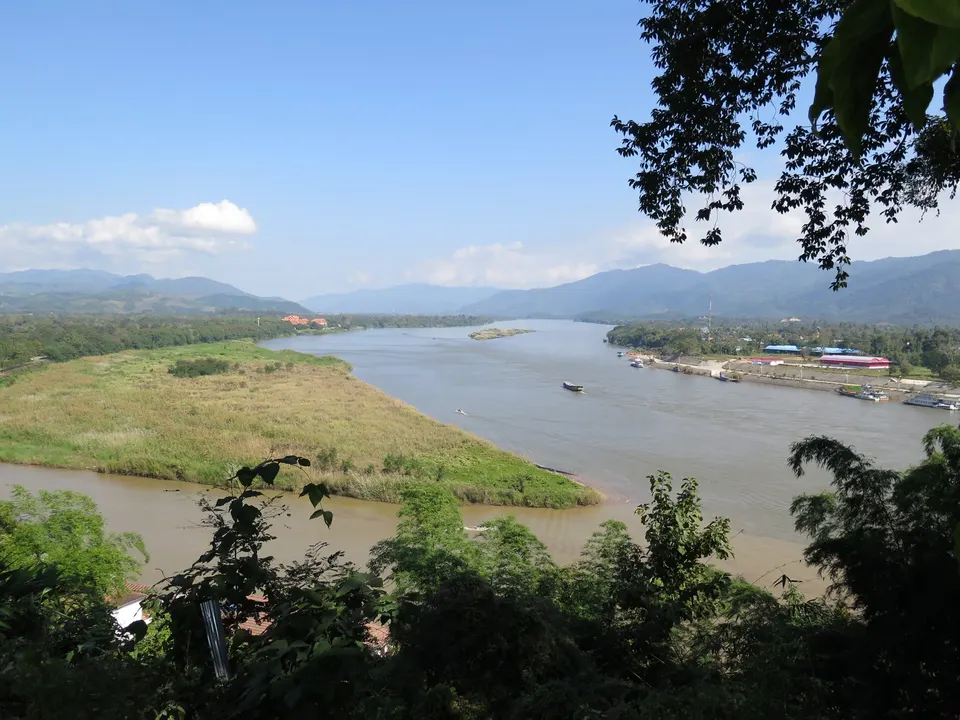
River viewpoint of Ban Sop Ruak, in the Chiang Saen district of Chiang Rai province, where two border rivers draw three countries: the Mekong separates Thailand from Laos and the Ruak separates it from Myanmar. The name “Golden Triangle” was coined in 1971 by a US State Department official speaking of the opium trade. Today the Thai bank gathers the great gilded Buddha in the Chiang Saen style raised in 2004, the memorial for Queen Sirikit's 72nd year, the ruined chedi of Doi Pu Khao and the Hall of Opium, officially inaugurated in 2005.
The Thai bank no longer grows opium and lives off tourism, but the business did not vanish: it only changed banks. In 2023 Myanmar, across the narrow Ruak, became the world's largest opium producer, with some 1,080 tonnes, and opposite, in Laos, gleams the dome of the former Kings Romans casino, which the US Treasury sanctioned in 2018 together with its owner as a transnational criminal organisation.
Highlights
- Confluence of the Ruak and the Mekong — Thailand, Myanmar and Laos in view from the same bank
- Phra Chiang Saen Si Phaendin — A 15-metre gilded Buddha seated on a dragon-boat, raised in 2004
- Gilded dome of Laos — The former Kings Romans casino, sanctioned by the United States in 2018
- Wat Phra That Doi Pu Khao — Ruined chedi atop the hill, overlooking the confluence
- Hall of Opium — Museum dug into a hillside, with a tunnel of reliefs some 140 metres long
At Ban Sop Ruak, in the Chiang Saen district of Chiang Rai province, a small river falls into an enormous one and with that gesture draws three countries. The Ruak, narrow and named for a species of small bamboo, separates Thailand from Myanmar; the Mekong, much wider, separates Thailand from Laos. From the Thai bank all three shores are seen at once, and that confluence is the Golden Triangle (สามเหลี่ยมทองคำ, Golden Triangle): a name that for decades was synonymous with opium, smuggling and private armies, and which today is read on the photo signs of the bank.
The history of the Golden Triangle is that of a business that moved from one bank to another. In 1949 thousands of defeated Kuomintang soldiers crossed from Yunnan into Burma, took control of its border regions and sent almost all their opium south, to Thailand. The name came later: it was coined in 1971 by Marshall Green, a US State Department official, at a press conference on the opium trade, although the popular local explanation derives it from opium as “white gold” and presents it as an ancient name, and some works attribute it to the CIA. The most famous of the region’s opium lords, Khun Sa, did not surrender until January 1996.
The Thai bank responded with gold and with a museum. In 1988 the Princess Mother Srinagarindra, mother of King Bhumibol, created the Doi Tung Development Project of the Mae Fah Luang Foundation to give another livelihood to the mountain villages that lived from opium and slash-and-burn. In 2004, for Queen Sirikit’s 72nd year, elephants, gilded panels and a great gilded Buddha seated on a dragon-boat were raised on the bank; in 2005 the Hall of Opium was officially inaugurated, north of the village, and in the centre the small House of Opium, a private museum, remains open. The river also has its festival: at Songkran, the new year in mid-April, the bank road fills with 200-litre drums of water pumped from the Mekong itself to drench passing cars, to the point of causing traffic jams.
To know what to see at the Golden Triangle, the audio guide walks the bank in five stops and 60 minutes: it starts at the border sign, continues along the gilded Buddha and the piers facing Laos, climbs the hill of Doi Pu Khao and ends at the entrance to the Hall of Opium. A single thread joins them: this postcard of gold and river is not the end of the opium empire, but its most recent mask.
The Chiang Saen style of its gilded Buddha has another chapter at Wat Phra Kaew, in central Chiang Rai, where the Emerald Buddha appeared in 1434. On the way back, on the northern outskirts of the city, lies Thawan Duchanee’s Black House.
Three countries and a name from 1971
Golden Triangle
Summary of this stop
The route starts on the main street of Ban Sop Ruak, where a border marker pillar, arches, photo viewpoints and several signs mark the “heart” of the Golden Triangle. It is the spot of the border photos, and rightly so: from the bank, on one side runs the Ruak, narrow, with Myanmar on the other shore; opposite, across the wide Mekong, Laos begins. Two border rivers, three countries and a single glance.
The sign holds a less obvious story than the landscape. Popular tradition says the name comes from opium, the “white gold” of these mountains, and takes it as ancient. The documentation places it much closer: in 1971, in the mouth of the American diplomat Marshall Green, and on the cover of the Far Eastern Economic Review of 24 July 1971. Not even the authorship is settled, because some works attribute it to the State Department and others to the CIA.
Facing the sign, the audio guide explains how an expression born at a press conference on opium ended up as the tourist brand of a bank of the Mekong.
A gilded Buddha that replaces a sunken one
Gilded Buddha on the boat
Summary of this stop
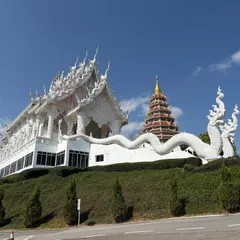
Beside the mouth of the Ruak rises Phra Chiang Saen Si Phaendin, “the Chiang Saen of the four lands”: a great seated gilded Buddha in the Chiang Saen style, 15 metres high and 9.99 across the lap, on a platform in the form of a dragon-boat. It is surrounded by statues of elephants and tall gilded bas-relief panels, the tung kradang. The whole ensemble was raised to commemorate Queen Sirikit’s sixth twelve-year cycle, whose 72 years were celebrated nationwide from 12 August 2004. The statue was built that same year, 2547 of the Buddhist Era, on the initiative of the governor of Chiang Rai Narin Panitchakit, and a foundation was later created to look after it.
Its official name, Phra Phuttha Nawa Lan Tue, refers to another Buddha. According to Chiang Saen tradition, an enormous bronze Buddha called Phra Chao Lan Tue presided over the main temple of Ko Don Thaen, an island in the Mekong downstream on which, it is said, there were more than ten temples. When the river changed course, the island sank and the Buddha went to the bottom with it. Before 1903 a piece of flame or halo believed to be his was pulled from the water, now in the Chiang Saen National Museum, and in the twentieth century there were several attempts to rescue it, with rites, monks, metal boats, elephants and, in 1966, divers. The gilded Buddha was raised as a symbolic restitution of the lost one, and many locals still believe the original will return one day.
The new statue has not escaped unscathed either. In 2007 its interior structure was reinforced; in 2011 a strong earthquake in Myanmar cracked the back of its head and brought down one of its curls, and in 2017 it again showed cracks in the cheek, arm and back. On the platform, the narration tells why the great river never gave back the bronze giant.
The gilded dome across the Mekong
Mekong boat piers
Summary of this stop
Beside the Buddha are the piers for the pleasure boats; 500 metres south of the monument is the river border crossing to Laos. Boatmen hire out long-tail boats, for about five passengers, that go upriver and then down to Don Sao, a little Laotian island where, for a token fee, one enters a so-called free zone without being able to pass into the rest of the country without a visa. The boatmen leave visitors there about half an hour to tour the market: cotton sarongs, Beer Lao, liquor fermented with snakes and souvenirs.
From the pier, the view goes to the opposite bank, where the gilded dome of the former Kings Romans casino gleams. The Chinese businessman Zhao Wei began investing there on 26 April 2007, and on 4 February 2010 the Golden Triangle Special Economic Zone was approved: 10,000 hectares at Ton Pheung, in the Laotian province of Bokeo, with 2 billion dollars of investment and a 99-year lease. In 2018 the US Treasury sanctioned the casino and Zhao Wei as a transnational criminal organisation, and accused the complex of serving to store and distribute narcotics for the United Wa State Army, launder money and traffic in people and protected animals. Around 2022 it was renamed ALLUXI Casino, leased long-term to Singapore investors, and was open 24 hours.
The same river of the boat trips was the scene of a dark episode. On the morning of 5 October 2011, on this stretch of the Mekong, some eight armed men attacked two Chinese cargo ships, the Hua Ping and the Yu Xing 8; their thirteen crew members died, and some 900,000 amphetamine pills were found on board. The case ended in Kunming, with a former associate of Khun Sa executed in 2013, and changed the policing of the river. Facing the dome opposite, the audio guide reconstructs that outcome and what it left on the Mekong.
The map of opium from a ruined chedi
Wat Phra That Doi Pu Khao
Summary of this stop
At the top of the hill that rises behind the village, a staircase flanked by nagas climbs to Wat Phra That Doi Pu Khao: a new viharn, a crumbled main chedi and the remains of five satellite chedis, overlooking the confluence. Its antiquity is a matter of debate. Local legend attributes its foundation to an eighth-century king of the kingdom of Wiang Hirannakhon Ngoen Yang; archaeology dates the surviving chedi to around the fourteenth century.
From above, the geography of the business that made the region famous becomes clear. In 1949 the defeated Kuomintang soldiers came down from Yunnan into Burma, seized its border regions and channelled their opium into Thailand. Then came Khun Sa (Zhang Qifu), who began as commander of a militia allied to the Burmese government and ended up the most famous opium lord of the Golden Triangle, until the surrender of his Mong Tai Army in January 1996.
Between the two was fought, according to documented history, the so-called opium war of 1967: a mule caravan of Khun Sa more than a mile long, with some sixteen tons of raw opium, dug in at a logging village on the Laotian bank of the Mekong, downstream, after the Kuomintang remnants cut it off. After several days of fighting with no victor a third party intervened, and the spoils ended up in his hands. Beside the chedi, the narration tells who he was and how he managed it.
A museum that waited two years for the king
Hall of Opium Golden Triangle Park
Summary of this stop
One kilometre north of the village, the Hall of Opium is the official answer to all of the above. It is run by the Doi Tung Development Project that the Princess Mother Srinagarindra created in 1988 with the Mae Fah Luang Foundation to give another livelihood to the mountain villages. The museum, costing some 10 million dollars and covering about 5,500 m², is dug into a hillside; its initial construction was paid for by Japan’s Overseas Economic Cooperation Fund through the Tourism Authority of Thailand, with help from China’s Ministry of Culture.
Its dates have their own story. It received its first visitors around 2003, but was not officially inaugurated until 6 July 2005, in a ceremony presided over by Crown Prince Vajiralongkorn: the foundation had delayed it two years hoping the king himself would attend in honour of his mother. The halls are entered through a tunnel of some 140 metres, 137 according to other sources, with bas-reliefs of anguished figures that opens onto a recreated poppy field. Inside await reconstructed opium dens, a glass floor over a dungeon and, at the end, the Hall of Reflection, a tall, bright room with framed quotations carved into the pillars.
The visit closes on the paradox that gives it meaning: the Thai bank of Sop Ruak no longer grows opium and lives off tourism, while in 2023 Myanmar, across the Ruak, became the world’s largest opium producer, with some 1,080 tonnes. At the museum entrance, the last stop of the audio guide ties up the loose ends of a bank that redeemed itself while the business changed banks.