Contemporary Buddhist temple
Wat Huay Pla Kang Audio Guide
A hill of ruins and straw huts turned since 2005 into a temple where a white Guanyin 69 metres tall dominates the landscape and every visitor helps sustain an orphanage for hill-tribe children and a free hospital.
- 60 min of audio
- Sino-Lanna architecture
A Buddhist temple raised on the ruins of an abandoned monastery, which the monk Phob Chok reached on 19 November 2005 and which received official temple status in 2009. Today it gathers a white concrete Guanyin 69 metres tall with a lift to its head, the Phop Chok Dhamma Chedi, a nine-storey tower with Chinese roofs and a Burmese spire ringed by 12 small chedis, and a white stucco ubosot, in a blend of Chinese and Lanna tradition.
While above the goddess of compassion gazes at the horizon, below, in the car park, whoever washes the visitor's car for 50 baht may be a man just out of prison. Under the motto “Returning good people to society”, the temple gives work and training to hill children and ex-prisoners, who learn discipline, languages and how to serve coffee; in 2022 that coffee sold for 1 baht an ounce, 20 baht for the large cup.
Highlights
- White Guanyin — 69 metres of concrete and a 25-storey lift to its head
- Head chamber — Hand-carved white stucco with dragons and Buddhist scenes, with the landscape seen through the statue's eyes
- Phop Chok Dhamma Chedi — Nine storeys of Chinese roofs and a Burmese spire, ringed by 12 small chedis
- Sandalwood Guanyin — 7 metres tall by 7 wide, carved in 108 days
- White ubosot — A staircase of nagas and a white Buddha beneath a silver tree
On a hill north of Chiang Rai, a white figure the size of a building looms from the road long before one arrives. It is the great Guanyin of Wat Huay Pla Kang (วัดห้วยปลากั้ง): the bodhisattva of compassion in white concrete, 69 metres tall, about the height of a 25-storey building. Beside it rises a nine-storey tower with Chinese roofs and a Burmese spire, and around it are spread a white stucco ubosot, the residences of the temple’s children and a hospital. Two decades ago there was none of this here.
The history of Wat Huay Pla Kang is very recent. Until 2005 the hill held only the ruins of an abandoned temple amid the undergrowth. On 19 November 2005 the monk Phob Chok settled in them, and the residents of the Huay Pla Kang community helped him restore it. On 24 July 2009 that monastic retreat received official temple status under its present name, and Phob Chok became its first abbot. There is another chronology: according to some sources, the residents had already begun to build a monastery on the site in 2001, before the monk’s arrival.
The monument is also the showcase of a social work. In the first year, the villagers brought two orphans to the temple; by 2015 the temple was supporting more than 700 orphans and elderly people. The girls’ residence, three storeys and 28 rooms built with the support of the Thai Government Housing Bank, was named “Phob Chok Condo Dhamma”, Phob Chok’s Dharma condominium, and that same year housed more than 200 girls, from preschool to university, six to eight to a room. An orphans’ dormitory christened with Bangkok real-estate vocabulary sums up the tone of the place well.
The architecture of Wat Huay Pla Kang crosses China, northern Thailand and Burma: coloured dragons, tile roofs topped with dragons, a bell-shaped spire and halls of carved stucco. To know what to see at Wat Huay Pla Kang, the audio guide walks it in four stops and 60 minutes: from the base of the Guanyin to the chamber in its head, and from the dragon staircase of the chedi to the white ubosot. A single thread joins them: the colossus seen from the road is not a monumental whim, but the façade of a recent and fragile charitable work that every visit helps to keep standing.
Another white temple raised on an earlier one is the White Temple of Chalermchai Kositpipat, south of the city. Closer, about 5 km away, lie the Blue Temple and Wat Phra Kaew, where the Emerald Buddha appeared in 1434.
A 69-metre Guanyin on ruins
Wat Huay Pla Kang
Summary of this stop
The route begins at the feet of the white Guanyin, the statue that dominates the hill. Its base is ringed by an outer staircase with free access, and inside a lift runs through it. The figures for its height do not quite agree: the most repeated is 69 metres, equivalent according to some sources to 23 storeys and according to others to almost 25, while other descriptions from the temple itself speak of 79. In September 2015 it was still under construction.
The disproportion is better understood by looking back. When Phob Chok arrived in 2005, the first things raised were a meditation hall and some timber monk’s cells with ya kha grass roofs. Between those straw huts on a ruined temple and the concrete colossus lies a distance hard to imagine.
There is also a misunderstanding in the place’s own nickname: the complex is popularly known as the “Big Buddha” of Chiang Rai. The giant figure, however, represents Guanyin, a bodhisattva of the Mahayana tradition, and not a Buddha. At the foot of the statue, the audio guide tells who the figure gazing down from on high really is and why she is here.
Seeing the north through Guanyin’s eyes
Head chamber of the Guanyin
Summary of this stop
The ascent has its own prologue. Before entering the lift, those who greet the visitor and press the button are young people in military-style uniform or Chinese qipao, who speak several languages. That is how some students visiting the temple found it in 2022, while the abbot Phob Chok set them riddles and told them moral tales: a mix of barracks, Chinese parlour and hotel hard to find anywhere else.
The lift rises 25 storeys to the head of the statue. Up there waits an entirely white chamber of hand-carved stucco with dragons and Buddhist scenes, open to the outside through windows set at the height of Guanyin’s eyes and forehead.
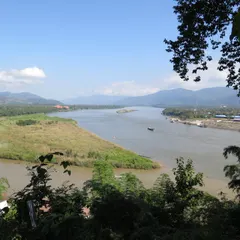
The rarity of the place lies in the point of view: the landscape of northern Thailand is contemplated from inside the goddess’s head, through her gaze. In the white chamber, the narration reveals what lies behind those windows and the reliefs around them.
The tower the abbot saw in a dream
Nine-storey chedi
Summary of this stop
The Phop Chok Dhamma Chedi bears the name of its abbot and stacks nine triangular levels, with Chinese-style tile roofs topped with dragons and a bell-shaped spire in the Burmese style. Its base is ringed by a crown of 12 small chedis, and the main staircase is climbed between two great coloured Chinese dragons that serve as banisters. Its design was born of a nimit, a dream vision Phob Chok had about this hill.
The dreamer came late to monastic life. He was born Phob Chok Maphaisankit on 13 July 1959, fourth child of a family of Chinese merchants in Tha Muang, in Kanchanaburi, and was not ordained a monk until 26 October 1997, aged 38, at Wat Bang Krawan Ram (Ratchaburi). To raise the tower, an engineer from Bangkok offered to build it and the Taiwanese businessman Chen Xian Bao put up the money; the first piles were driven on 26 April 2007.
Inside sits a sandalwood Guanyin of aromatic wood brought from China, Myanmar and India, carved in 108 days, 7 metres wide and 7 high; on other floors appear other forms of Guanyin and carved buddhas. According to a documented local tradition, each form attends to a different request: the healing Guanyin is asked for cures, the three-faced one that subdues demons for settling karmic debts with creditors from past lives, and others for promotions or for money to flow again. Beside the dragon staircase, the audio guide explains how this tower of spiritual service windows works.
A sack of rice for the children of the hill
White ubosot
Summary of this stop
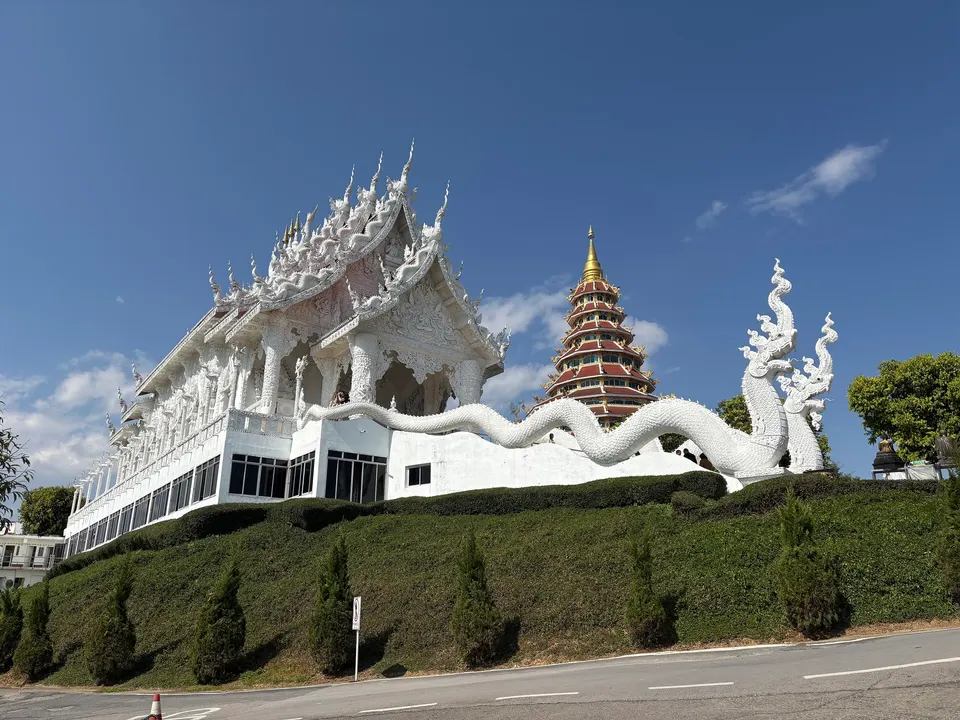
The white ubosot, the ordination hall, is reached by a staircase flanked by nagas; inside, the main Buddha, also white, sits beneath a silver tree. But the merit-making gesture most proper to this temple is not the candle or the flower, but a sack of rice: the visitor buys a bag for 100 baht and offers it, and that rice is cooked for the orphans and the hill-tribe children who live on the hill.
Those children are behind a good part of what is seen. In 2015, more than half of the children in care belonged to hill tribes, chiefly Akha and Lahu, as well as Yao, Karen, Hmong and Chinese Haw. That year, after each meal and in batches of 50 to 80, the children lined up before the abbot, recited the Dharani Sutra to Guanyin and received their day’s allowance: 10 baht in nursery and primary, up to 100 for university students.
The work was extended with a 90-bed hospital, built with more than 730 million baht in donations and opened on 1 December 2022, which sees some 300 people a day, free for those without means. Its balance is fragile: in June 2026, with monthly spending of more than 6 million baht and fewer visitors after the fuel price rise, the hospital had funds for about two months. Before the staircase of nagas, the last stop of the audio guide closes the circle between the statue, the sack of rice and whoever climbs the hill.