Discovery of the Emerald Buddha
Wat Phra Kaew Audio Guide
A small temple, born among bamboo clumps in the centre of Chiang Rai, where in 1434 an opened chedi revealed the Emerald Buddha that Bangkok now guards, and which in 1991 received back a jade double one millimetre shorter than the original.
- 45 min of audio
- Lanna Buddhist temple
Before bearing the name of the Emerald Buddha, the temple was called Wat Pa Yia, the monastery of the yia forest, a local thornless bamboo from which crossbows and bows were made. In 1434 its octagonal chedi was opened and a stucco-covered Buddha appeared which, as the stucco flaked off, proved to be of green stone: the Phra Kaew Morakot. Today the compound gathers an ordination hall in the Chiang Saen style dating from 1890, the gilded copper-clad chedi, a national monument since 1935, and a Lanna pavilion on pillars that houses the Phra Yok Chiang Rai.
The temple is famous for an image it no longer has. The Emerald Buddha left for Lampang, passed through Chiang Mai, Luang Prabang and Vientiane, and since 1785 has been in Bangkok. When King Prajadhipok visited Chiang Rai in 1926, he praised the city for that discovery, and the travel diary dispatched the temple in one line: a hall, a chedi behind it and a few wooden cells. In 1991 a jade copy from Canada, carved in Beijing, came back here in procession, escorted by a thousand monks: 65.9 centimetres against the original's 66.
Highlights
- Octagonal chedi — Clad in gilded copper where the Emerald Buddha appeared in 1434
- Phra Chao Lan Thong — Ungilded bronze Buddha, 2.80 metres tall and about 1,200 kilograms
- Haw Phra Yok — Lanna pavilion with the 65.9 cm jade copy that arrived in 1991
- Ubosot of 1890 — Chiang Saen-style hall with low roofs and carved doors
- Sariputta and Moggallana — Two bronze disciples with an inscription of 1726 beneath the base
In the very centre of Chiang Rai stands Wat Phra Kaew (วัดพระแก้ว), a small compound that carries in its name the image King Prajadhipok called the talisman of the Bangkok dynasty: the Emerald Buddha. It shares its name with the Temple of the Emerald Buddha in Bangkok, but the relationship between the two is that of an origin and a destination. Here the image appeared in 1434; there it has resided since 1785. And this Chiang Rai temple, left without it, has spent the centuries since filling that gap.
The history of Wat Phra Kaew begins with another name. The temple was Wat Pa Yia, the monastery of the yia forest, a local thornless bamboo with hard, flexible wood, and according to tradition it was here that Thao Maha Phrom, lord of Chiang Rai and brother of King Kue Na, enclosed in a laterite chedi an image brought from Kamphaeng Phet and covered in stucco. In 1434, year 1977 of the Buddhist Era, that octagonal chedi opened and revealed a stucco Buddha. The accounts differ on the cause: English-language sources and tourist accounts speak of lightning; the Thai version based on the chronicles says the chedi collapsed by itself. When the stucco began to flake, a green stone showed through, and the abbot stripped it entirely until he brought out the Phra Kaew Morakot, whose “emerald” means in Thai only “green-coloured”.
What came next explains why the present temple has so little of the ancient about it. The wars to expel the Burmese from Lanna left Chiang Rai abandoned from 1804, and the city was not resettled until 1843; its main temples were restored little by little. The hall that now serves as ubosot dates from 1890; the present chedi was registered as a national monument in 1935, and on 16 January 1926, the day King Prajadhipok praised Chiang Rai for the Emerald Buddha, the diary of his visit described Wat Phra Kaew as a small temple, with its hall, a chedi behind it and a few wooden cells. Since then the compound has filled with adopted images: a bronze Buddha that arrived in 1961 from another temple, two disciples dated 1726 and, to the west, behind the chedi, a stucco Buddha under a Bodhi tree rescued in 1980 from an abandoned temple on the outskirts.
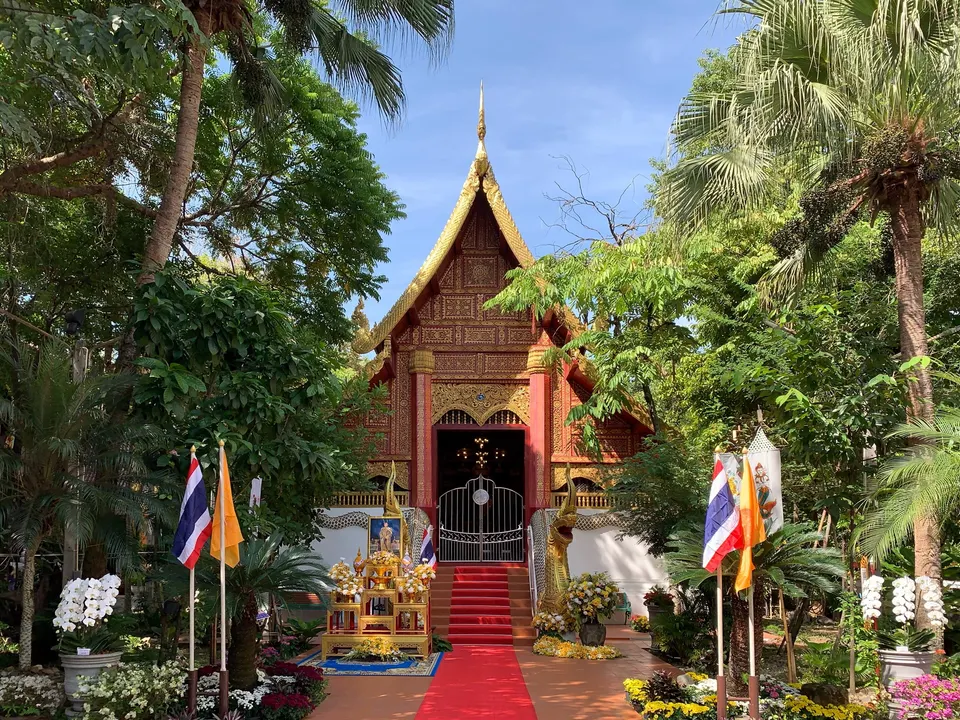
The architecture of Wat Phra Kaew is read in a few pieces: the low-roofed hall in the Chiang Saen style, the octagonal chedi clad in gilded copper sheet and, at the back, the Haw Phra Yok, a Lanna pavilion raised on pillars. South of the ubosot, the Hongluang Saengkaew Museum, a two-storey building in dark teak with gilded finials, has displayed religious art and Lanna texts since 2007. There are also minor details that say a lot: since August 2012, a sign presents the temple in six languages, Lanna, Lao, Burmese, Chinese, Japanese and Arabic, at the initiative of the abbot Phra Thammarachanuwat in view of the arrival of visitors from the ASEAN Economic Community.
To know what to see at Wat Phra Kaew, the audio guide walks it in four stops and 45 minutes, from the entrance courtyard to the interior of the jade pavilion. A single thread joins them: a modest temple, famous for something it no longer keeps, which ended up receiving back a double of its image without pretending it is the same.
Another lost buddha, the great bronze that tradition says ended up at the bottom of the Mekong, haunts the shore of the Golden Triangle, in the Chiang Saen district. About 2 km away, the Blue Temple shows the contemporary Buddhism of Chiang Rai.
A temple named for bamboo
Wat Phra Kaew
Summary of this stop
The route starts in the entrance courtyard, facing the ubosot. On one side of the compound clumps of yia bamboo still stand, tall canes of the same bamboo that gave the temple its first name, Wat Pa Yia. It was a local thornless bamboo, with hard, flexible wood, from which crossbows and bows were made: a forest monastery, still far from the fame the Emerald Buddha would bring it.
The city around that monastery came to be emptied. The wars to expel the Burmese from Lanna turned Chiang Rai into an abandoned city from 1804 (2347 of the Buddhist Era), and it was not resettled until 1843 (2386). The hall that dominates the courtyard belongs to that slow reconstruction: it was born in 1890 as a vihara, the assembly hall, in the Chiang Saen style, 9.50 by 21.85 metres, with carved doors and a low roof profile nicknamed “brooding hen”. Today it serves as ubosot, the ordination hall.
The roof has its own story. It is of glazed tile, bears four chofa, the curved finials that point to the sky from the ends of the ridge, and the gilded boards running down the edges end in naga heads. The main one was not placed like any other piece: on 13 February 2007 Princess Maha Chakri Sirindhorn raised it in person. From the courtyard, the audio guide tells how a bamboo monastery in an empty city came to receive that gesture.
The bronze Buddha that refused gold
Phra Chao Lan Thong
Summary of this stop
Inside the ubosot presides the Phra Chao Lan Thong, a bronze Buddha seated in the posture of subduing Mara, with the hand touching the earth. It measures 2 metres across the lap and 2.80 in height, weighs about 1,200 kilograms and does not bear the gilding usual on Thai images: the bronze is shown as it is.
Nor was it born for this hall. It presided at Wat Lan Thong, also called Wat Saen Thong, whose plot is now occupied by the Anuban Chiang Rai nursery school. When that temple was abandoned after the Second World War, in 1945, the image passed to Wat Ngam Muang, and on 9 November 1961 it arrived at the ubosot of Wat Phra Kaew. It did so in the middle of works: in the renovation finished in 1962, with a consecration festival on 14 March 2505 of the Buddhist Era, the timber pillars of the hall were replaced with reinforced concrete and the walls with plastered brick. Some of the old wood was reused and the most damaged ended up in the Chiang Saen National Museum. The name of Phra Khru Thammawong Wiwat (Wong Thanwangso) appears linked both to the arrival of the image and to that renovation.
Beside the main Buddha, two bronze disciples seated in meditation, Sariputta and Moggallana, arrived with it in 1961. Beneath their base, an inscription dates them to 1726 (2269 of the Buddhist Era) and names as donor Mang Phalasaphaek, governor of Chiang Rai under Burmese rule. Before the great ungilded Buddha, the audio guide explains how a hall rebuilt in concrete gradually filled with figures rescued from abandoned temples.
The chedi that opened in 1434
Gilded octagonal chedi
Summary of this stop
Behind the ubosot rises the octagonal chedi, 9.50 metres in diameter, clad entirely in lacquered, gilded copper sheet. It occupies the place of the one that opened in 1434, and the Fine Arts Department registered it as a national monument in 1935 (2478 of the Buddhist Era).
According to tradition, the story begins earlier: Thao Maha Phrom, lord of Chiang Rai and brother of King Kue Na, brought the image from Kamphaeng Phet, coated it with lime mixed with honey, cane juice and fine sand, lacquered and gilded it, and enclosed it in a laterite chedi that he built at Wat Pa Yia. In 1434, year 1977 of the Buddhist Era, that chedi opened and inside appeared a Buddha covered in stucco. Whether it was lightning or a spontaneous collapse depends on the account: lightning is the version of English-language sources, while the Thai version based on the Jinakalamali and Ratanabimbavamsa chronicles speaks of a collapse and attributes the lightning only to King Mongkut’s account. The image was kept in the temple itself, in the abbot’s residence or in the vihara depending on the source, and when the stucco began to flake, by the nose or by the ear depending on who tells it, a green stone showed through. The abbot stripped it entirely and out came the Phra Kaew Morakot, the Emerald Buddha.
Almost five centuries later, on 16 January 1926, King Prajadhipok (Rama VII), in full dress and accompanied by Queen Rambhai Barni, presented the royal sword to Chiang Rai and said in his speech that the name of the city lived in the hearts of the Siamese because the Emerald Buddha had been found there. That same afternoon the royal couple visited Wat Phra Kaew, and the travel diary dispatches it in one line: a small temple, with its hall, a chedi behind it and a few wooden cells. Before the chedi, the audio guide relives the moment of the discovery and measures the distance between that praise and that line.
A jade double one millimetre shorter
Haw Phra Yok
Summary of this stop
At the back of the compound, the Haw Phra Yok is a Lanna-style pavilion raised on pillars, 8 by 12 metres. Inside it keeps the Phra Yok Chiang Rai, a green jade Buddha of 65.9 centimetres in meditation, on a lotus base also of jade. The walls are painted with the legend of the Emerald Buddha, the carving and arrival of the Phra Yok, and two Bodhi trees in gold and silver.
The original never came back. The Emerald Buddha left Chiang Rai for Lampang, where it stayed 32 years, although the chronologies do not agree on when it left or why: some speak of an elephant that three times strayed from the road, others of a draw after the animal’s refusal. It passed to Chiang Mai in 1468, to Luang Prabang in 1552 and to Vientiane in 1564; in 1779 the Siamese took it to Thonburi, and in 1785 it entered the Temple of the Emerald Buddha in Bangkok, where it remains.
The return came in the form of a copy. The Phra Yok was commissioned for the 90th birthday of the Princess Mother Srinagarindra, in 1990 or 1991 depending on the source, and was carved in Canadian jade in a Beijing workshop as a deliberately inexact copy: 65.9 centimetres against the original’s 66. The monastic dignitary Somdet Phra Phutthachinawong went in person to collect it, the image entered Thailand on 2 May 1991 and on 20 September it was consecrated in the Temple of the Emerald Buddha in Bangkok, with King Bhumibol presiding and 37 senior monks meditating. On 18 October a caravan set out with it from Wat Si Khom Kham, in Phayao, and on 19 October 1991 it entered Chiang Rai in a parade with a thousand monks and a procession of offerings led by Khunying Boonruean Choonhavan, as far as the gates of Wat Phra Kaew. Beneath the murals that paint that scene, the last stop of the audio guide closes the circle of a temple that recovered its image without pretending it is the same.