Foreigners’ Street
West Street Audio Guide (Xijie)
Yangshuo’s oldest street climbs from the Li River landing and has never stopped being remade: in 1935 three metres were sliced off every house, from the 1970s it was the backpackers’ Foreigners’ Street, and its old-town look was stitched together between 1999 and 2004.
- 45 min of audio
- Historic pedestrian street
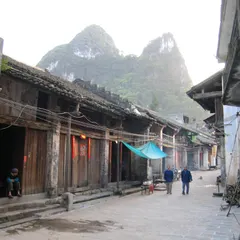
West Street was the obligatory route up from the Shuidong Gate landing. Several sources trace it to the year 590, when Emperor Wen of the Sui created Yangshuo County and its seat had a street some 200 metres long and 5 wide. When the Li flooded in the Qing era, residents of the east bank moved to the west bank and the street filled with shops until it became the town’s commercial centre. In 1935 the Republican government widened it to 8 metres by shaving off the facades, and between 1999 and 2004 a restoration unified its houses with grey tile, horse-head walls and the hanging balconies of northern Guangxi architecture.
The contrast lies in its people. During the war against Japan this small-town street housed staff of the Nanjing Central Research Academy, an internment centre for German, Japanese and Italian civilians and a language school for officers; the population rose from about 2,500 to more than 10,000. From the 1970s Western backpackers arrived, and with them cafés, bilingual signs and more than 200 marriages between young people of West Street and foreigners.
Highlights
- Li River landing — The town’s gateway, where goods, refugees and backpackers arrived
- 8-metre roadway — Widened in 1935 by cutting 3 metres off the houses on each side
- Shizijie crossing — Five big trading houses of the 1930s, looted in 1944
- Foreigners’ Street — Western cafés, bilingual signs and more than 200 weddings with foreigners
- Guibei facades — Grey tile, horse-head walls and hanging balconies unified between 1999 and 2004
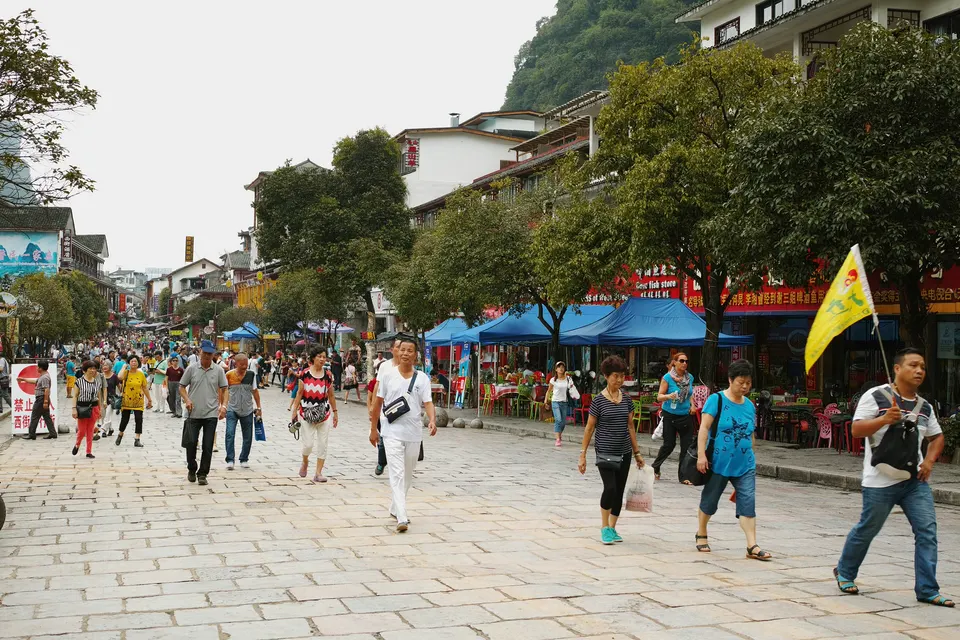
West Street (阳朔西街, Yangshuo Xijie) is the oldest street in Yangshuo: a pedestrian lane of stone flagstones that climbs from the Li River landing toward the heart of town. Its grey-tiled houses mix Chinese and English signs, cafés serving Western food and bars that recall its most famous nickname, the Foreigners’ Street. In 2023 it received 21.11 million visits and joined the second list of National Tourism and Leisure Streets of China’s Ministry of Culture and Tourism.
The history of West Street begins with a disputed date. Several sources place it in the year 590, when Emperor Wen of the Sui created Yangshuo County, and credit it with more than 1,400 years; the local historian Qin Zhen prefers “more than 1,000 years”. There is no agreement on the name either: some explain it as lying west of the county seat, others as lying west of the Shizijie crossing, a name said to date back at least to the Song, and a third version dates it to 1674 for its position on the west bank of the Li. What is certain is that in the Qing era it was an alley 2 metres wide and under 400 long, and that in 1935 it was widened to today’s 8 metres.
Almost everything that transformed the town came in through this end of the street. According to a documented tradition, in 1917 the preacher Li Shaogeng, remembered with the title of bishop, and his wife rented houses from neighbours in the stretch nearest the landing and began preaching from them: it was the arrival of Christianity in the district. It is also told that in November 1921 Sun Yat-sen, on his way to Guilin at the head of the expeditionary army, gave a speech in Yangshuo, though no one can say from where, and the street boasts of having received more than 300 leaders from over 150 countries and regions.
The architecture of West Street is deceptive at first sight. It is usually presented as a set of Ming and Qing houses, but according to Chinese Wikipedia most of them are 60 or 70 years old, with only a few from those dynasties, and its uniform look comes from the 1999–2004 restoration. To know what to see on West Street, the audio guide walks its historic stretch in five stops and 45 minutes, from the bank of the Li to the junction with Chengzhong Lu. The thread that joins them is that this is not a frozen postcard: the river, the war, a knife-cut and outsiders have remade it again and again.
Beside the landing rises Bilian Peak, and a few steps from the street lies Yangshuo Park. Upstream on the Li, Xingping Ancient Town keeps another flagstone street that runs down to the river.
The landing where everything came in
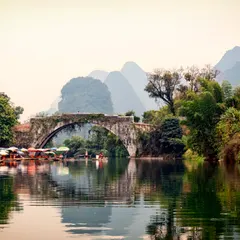
Li River landing
Summary of this stop
West Street ends at Binjiang Lu, beside the quay where Li River cruises dock today. This bank was the town’s gateway. In the Qing era, floods of the Li swamped the lower east bank, until then the more populated one; its residents moved to the town on the west bank, and West Street, the obligatory route up from the Shuidong Gate landing, filled with shops until it became the commercial centre. Goods came this way, and refugees, and, in the early 1970s, with the opening of Guilin to foreign tourism, the first Western travellers stepping off the cruise, who described the street in guidebooks published in the West.
The most striking thing about this spot is what is missing. Outside the eastern wall, along the river from the Shuidong Gate to the Qingyang Gate, ran a gallery 400 metres long and over 10 wide with houses on stilts that concentrated brothels, gambling dens and opium parlours. Locals summed it up in a phrase: “one wall, three roads to death”. A stretch of wall beside the river survived into the 1950s; today not a section of it nor a stilt house is left on the bank.
According to a documented tradition, the street and its surroundings were a workshop for the great Chinese painters of the 20th century: Zhang Daqian, Xu Beihong, Qi Baishi and Huang Binhong painted mountain-and-water landscapes here. In the sketches from life that the ink master Li Keran made in Yangshuo, the old wall, the wutong trees and the stilt houses of the bank still appear. By the water, the audio guide puts that vanished landscape back in its place.
A street cut wider with a knife in 1935
Eight-metre flagstone roadway
Summary of this stop
In the eastern stretch the roadway opens wide and regular, covered with large flagstones laid in the tourist renovation of 1984 and replaced in later works. That width of 8 metres is not the original. When Emperor Wen of the Sui created the county in 590, the seat had a street about 200 metres long and 5 wide, the seed of today’s West Street; another source puts it at under 200 metres by under 4.
Today’s measure is the result of a surgical operation. In 1935 the government of the Republic of China widened the street by cutting 3 metres off the houses on each side, top to bottom, until the roadway reached 8 metres. Since then it has been repaved and houses have been renovated, but the layout has hardly changed. Even its present length is disputed: some sources speak of about 800 metres, reached in 1926 when it joined the Gui-Li road, and others of 1,180.
On the flagstones, the audio guide teaches how to read the street as the scar of that cut.
The crossing of the looted trading houses
Shizijie crossing
Summary of this stop
At the junction with Xianqian Jie and Chengzhong Lu stood the old Shizijie, the heart of West Street. In the 1930s it gathered Yangshuo’s four great trading houses, Liu Laixing, Chen Gongxing, Wanlixiang and Yuan’an, joined by Pu Tongchang. In 1944 the Japanese occupation of Yangshuo looted them, and none ever got back on its feet.
Before the blow, the war had filled the street with unexpected guests. West Street housed staff of the Nanjing Central Research Academy, an internment centre for German, Japanese and Italian civilians and a language school where Nationalist Government officers studied English, French, German, Japanese and Russian. The town’s population rose from about 2,500 to more than 10,000. According to a documented tradition, two of China’s most celebrated scientists came to lecture at those classes: the geologist Li Siguang and the meteorologist Zhu Kezhen.
A few steps along Xianqian Jie stands the former residence of the painter Xu Beihong: the house he rented and which General Li Zongren bought to give him. At the crossing, the audio guide reconstructs the wartime street and the day its commerce collapsed.
Li Sha’s café and the 31 weddings
Bilingual signs and Western cafés
Summary of this stop
Toward the junction with Guihua Lu, the Foreigners’ Street shows itself in its bilingual signs and in its Western-food cafés and restaurants set in traditional-looking houses. One of its pioneers was Li Sha, owner of LISA CAFE and one of the first local women to open a business for foreigners: in 1982 she opened a hotel recommended by Lonely Planet and visited by former French president François Mitterrand. Thirty-one employees of that hotel married foreigners and went to live in France, Switzerland, Norway and other countries; since the 1980s, young people of West Street have contracted more than 200 marriages with foreigners.
In the 1990s the business changed hands. According to the Guilin Daily, 95% of the shops were run by outsiders from other parts of China, and foreigners’ businesses numbered a little over twenty; English Wikipedia, by contrast, claims that almost all were in foreign hands. Many residents became “ten-thousand-yuan households” just by renting out their ground floors.
Locals call the dozen or so Western families who settled here “resident foreigners”. One was the Australian Malcolm, who kept a shop for more than twenty years, spoke fluent Chinese and is A Tai to the old people of the neighbourhood; it is remembered that some years there were more foreigners than Chinese on the street and that at Christmas people danced on the flagstones. A café called Meiyou, “we don’t have it”, turned into a draw the answer that exasperated backpackers: no hot beer, no bad food, no bad service. On this stretch, the audio guide tells from the inside how a town adopted its neighbours from far away.
A Guibei skin stitched on between 1999 and 2004
Guibei-style facades
Summary of this stop
At the junction with Chengzhong Lu the facades unfold the repertoire of the northern Guangxi house, the Guibei style: small grey tiles, gabled roofs, stepped horse-head walls, wooden doors and windows and hanging balconies. That ensemble was unified in the protective restoration of 1999 to 2004, over the flagstone street renovated in 1984.
Under that skin lies the Qing street. It was then 2 metres wide and under 400 long, and ended at the Jiangxi Guild Hall, the Wanshou Gong: the oldest and largest guild of fellow-countrymen in Yangshuo, founded in the Ming era by merchants from Jiangxi, covering 1,000 m². To the west there was only waste ground. Its site is now occupied by a French restaurant, Lede.
Today’s scale contrasts with that alley: 252 premises, 106 of them restaurants, and since 2015 a parallel street of new construction, Yitian West Street, with a more modern look. At the last stop, the audio guide changes the way of looking at old and new on a layout that has barely moved.