Green Lotus Peak
Bilian Peak Audio Guide (Bilian Feng)
The limestone crag that closed the walled old Yangshuo on the south, beside the quay where the Li cruises end: a rock face smooth as a mirror that gave its name to a vanished Tang temple and a character almost six metres tall, written in 1834, that hides an entire sentence.
- 60 min of audio
- Inscriptions in rock
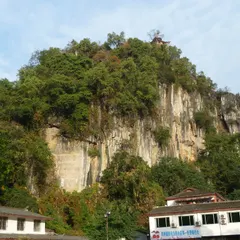
Bilian Peak, the green lotus peak, was formerly called Jianshan, mirror mountain, for the smooth rock face on its slope. Its present name was fixed in the Jiajing era of the Ming dynasty, when the senior official Hong Zhu had the characters 碧莲峰 carved on the eastern foot, beside the water. Around 713 the Jianshan Temple was founded at its base, and in 1637 the peak was the southern closure of the walled town: its cliff served as the wall. The inscriptions on its east and northeast feet have been a protected monument of Guangxi since 2009.
The rock is a page written over centuries. In 1834 the acting magistrate Wang Yuanren drew in cursive a single character, 带, almost six metres high, and within its strokes eight more characters can be read: a belt of mountains and rivers; young people, strive. In 2022 that sentence was the motto of a school in town. Of the bell temple, by contrast, nothing is left at the foot of the peak: its successor was consecrated in 2001 some 5 km from here.
Highlights
- The 带 character on the cliff — Almost 6 metres of cursive written in 1834 that hide an eight-character sentence
- Path of inscriptions — More than 20 carvings from the Ming era to modern times, protected since 2009
- Jianshan Lou — Two-storey building on the site of the bell temple, founded around 713
- Yingjiang Pavilion — Two-storey octagon on the cliff where Zhou Enlai rested in 1960
- Shuidongmen quay — End of the Li cruises beside a stretch of the old wall
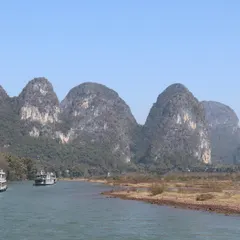
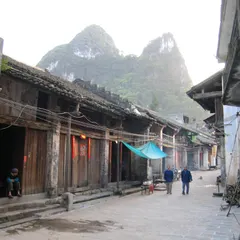
On the bank of the Li River, right where the cruises coming down from Guilin tie up, rises Bilian Peak (碧莲峰, Bilian Feng, “green lotus peak”). This limestone crag has been wall, mirror, temple and blank page all at once, and every era of the town has left written on its rock what it wanted the town to be.
The history of Bilian Peak begins with an ancient name, Jianshan (鉴山, “mirror mountain”): on its slope there is a rock face as smooth as a mirror, and jian was the old word for mirror. Around 713, at the start of the Kaiyuan era of the Tang dynasty, the Jianshan Temple was founded at the foot of the peak, and its bell, rung by the monks morning and evening, gave its name to one of the old eight sights of Yangshuo, “the bell of Jian Temple”. Between 874 and 879 the magistrate Shen Bin boasted in verse that neither Tao Qian’s willows nor Pan Yue’s flowers could match Yangshuo, “where people live inside the green lotus peak”. The name was set in stone in the Jiajing era of the Ming dynasty (1522–1566), when Hong Zhu, a senior official of the Guangxi provincial administration, had the three characters 碧莲峰 carved on the eastern foot, beside the water.
Locals also gave it other names, according to a documented tradition: Chenjia Shan, “mountain of the Chen family”, after the clan that lived on its north face, and Shouyang Shan. And “Bilian Feng” was at first the collective name of all the mountains of the county, peaks arranged in a ring and opened like flower buds; hence it was also called Furong Feng, “lotus peak”.
To know what to see at Bilian Peak, the audio guide walks its eastern foot in four stops and 60 minutes, from the Shuidongmen quay to the Yingjiang Pavilion, along a path between rock and water. On the way appear the great 带 character, more than 20 inscriptions protected as a monument of the Guangxi Autonomous Region since 2009, the building that occupies the site of the Tang temple and an octagonal pavilion hanging over the river.
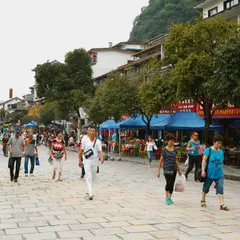
The Li River cruises disembark at this quay, where West Street begins; behind the houses of the old town, Yangshuo Park keeps the caves that Xu Xiake also explored.
Where the Li cruise stops sailing
Shuidongmen quay and gate
Summary of this stop
The river journey ends against a wall of natural stone. Li cruises usually disembark at the Shuidongmen quay (水东门), at the foot of the peak, where a stretch of the old wall survives with the gate of the same name. Beside the landing, a large smooth stone slab bears the name of Yangshuo, 阳朔, in two vigorous characters.
In 1637 the walled town of Yangshuo fitted entirely between two crags: Longtou Shan to the north and this peak to the south. On the east the wall was the very bank of the Li, and on the south and east sides of the peak the cliff served as the wall. The water gate was the entrance; the crag, the closure. On the eastern foot, beside the river, are still the characters that Hong Zhu had carved in the Ming era and that gave the mountain its definitive name.
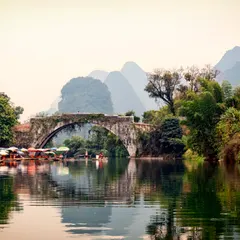
From the bank, the silhouette of the peak is reflected in the water and, in a breeze, the reflection ripples like a lotus bud opening. Legend says this rock is a fairy: the Green Lotus fairy, who slipped down from heaven to the Li, fell in love with a carp of the river and preferred to stay with it rather than go to the celestial pond, until the god of longevity punished her by turning her to stone. In front of the reflection, the audio guide tells what became of the carp.
A six-metre character that hides a sentence
Great character on the cliff
Summary of this stop
On the limestone wall beside the scenic path stands out a single cursive character, carved and painted: 带 (dai, “belt, band”), almost 6 metres high and almost 3 wide. It was written in 1834, in the Daoguang era of the Qing dynasty, by Wang Yuanren, then acting magistrate of Yangshuo. Sources do not quite agree: some write his name with other characters of the same sound and the measurements vary between about 5 and almost 6 metres in height. It is photographed from below and from the river.
The surprising thing is inside the strokes. The most widespread reading finds eight characters, “一带山河,少年努力”: “a belt of mountains and rivers; young people, strive”, though other sources read longer phrases. The advice is still alive: in 2022 Yangshuo’s No. 2 Middle School had that sentence as its motto.
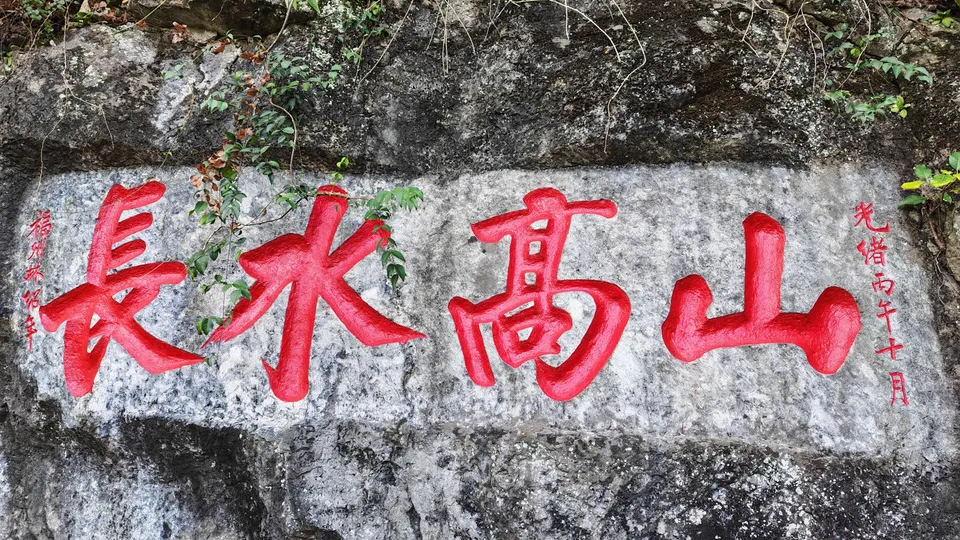
The character is not alone. Along the path, at the foot of the east and northeast faces, there are more than 20 inscriptions, large and small, from the Ming era to the modern one, protected as a Guangxi monument since 4 May 2009. Among them is the couplet that Wu Mai composed in 1935 and that half of Guilin repeats today: “Guilin’s scenery is the best under heaven; Yangshuo’s, the best in Guilin”. Beneath the great character, the narration dismantles stroke by stroke where each word hides.
The bell that no longer rings
Jianshan Lou
Summary of this stop
Set against the rock and open to the river stands the Jianshan Lou (鉴山楼), a two-storey building in old style, with a gallery open on three sides below and a viewing platform above. Looking up from here, the smooth wall that gave the mountain its old mirror name appears on the slope. It is the only thing that remains the same.
The Tang bell temple is gone. According to the most cited version, the Jianshan Temple was destroyed during the war against Japan (1937–1945) and this building was raised in its place; another source offers a different date and account. The new Jianshan Temple was not rebuilt here but in the Moon Hill area, some 5 km to the south: the reconstruction was approved in 1995, works began in 1997 and it was consecrated on 1 January 2001, with 5,589 m² built. From the foot of the peak it cannot be seen.
The name itself may hold an earlier scar. According to a disputed story, in 1916, in the midst of the campaign against “superstition”, the monks were supposedly expelled and the temple renamed Lou, building, a secular name instead of Si, temple. The same account places inside it a statue of the master Jianzhen carved from a single camphor trunk, though the monk’s passage through this temple is also disputed. In the lower gallery, the audio guide separates what is known from what is told.
Eight windows over Xu Xiake’s river
Yingjiang Pavilion
Summary of this stop
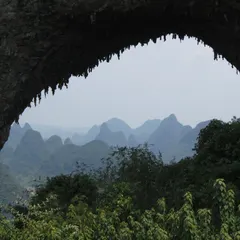
On the cliff, beside the Jianshan Lou, hangs the Yingjiang Pavilion (迎江阁, “pavilion that welcomes the river”), two storeys on an octagonal plan, about 40 m². Its windows frame the river, the Baisha bank and the limestone ridges. In 1960, Zhou Enlai, Chen Yi, Deng Yingchao and Zhang Qian rested and were photographed here.
That landscape was already described by the traveller Xu Xiake, who reached Yangshuo by boat on the 22nd day of the fifth lunar month of 1637. He placed the Jianshan Temple on the eastern foot of the peak, leaning against the rock and open to the river, with the southeast gate of the wall beside it. That same day he tried to climb the peak by the north face, gripping branches and cracks among the undergrowth, and had to come down without reaching the summit; afterwards, stifled by the midday sun, he took off his clothes beside a window of the temple.
Others did reach the top. According to a documented tradition, past the scenic path a trail rounds the peak on the west slope and climbs to the summit, where someone carved three characters in the rock: “登临好”, “how good to climb up here”. From there, at dawn or dusk, two classic sights of Yangshuo appear, “Dawn over the eastern ridges” and “Fishing lights of Baisha”. At the pavilion, the audio guide closes the walk with the verse that sums up that view.