Park and lookout
Lianhuashan Park Audio Guide
A Futian hill opened in 1997 where families fly kites and where, on the summit, a 6-metre bronze Deng Xiaoping strides south, facing the skyscrapers his reforms made possible.
- 75 min of audio
- Deng Xiaoping statue
Lianhuashan Park began to be planned in October 1992 and opened to the public on 23 June 1997 at the northern end of Shenzhen's new centre. Since 14 November 2000 its summit, at 100 metres above sea level, has held the first statue of Deng Xiaoping in all of China approved by the central government as urban sculpture: Jiang Zemin unveiled it, and in 2010 it was declared a municipally protected site. The figure, 6 metres tall on a 3.68-metre pedestal, faces due south, toward the central axis of Futian, and the plaza around it, about 4,000 m², is the highest open-air platform in the city.
The contrast lies in the waiting. The bronze was conceived in 1994 to replace a painted portrait that the sun kept cracking and that had to be replaced every six months; when Deng died in 1997, the central government authorised none of the statues Chinese cities were asking for, and Shenzhen's project stood still for three years with the figure already cast. Today it is the opposite of a forgotten statue: locals climb up to wish “Grandpa Deng” a happy new year, and the flowers they leave at the foot of the pedestal are cleared away in batches.
Highlights
- Deng Xiaoping statue — A 6-metre bronze in mid-stride, facing due south
- Pedestal and granite wall — Jiang Zemin's calligraphy and Deng's 1984 inscription on the special economic zones
- Summit lookout — Shenzhen's highest open-air platform, facing the central axis of Futian
- Kite Square — A 20,000 m² meadow where the city comes out to let out string
- Xi Jinping's banyan — Planted in 2012 at just over 3 metres, it topped 13 by 2020
In the Futian district, north of Shenzhen’s new centre, stands Lianhuashan Park (莲花山公园), the Lotus Hill: a large public park whose planning began in October 1992 and which opened on 23 June 1997, and on whose summit a bronze Deng Xiaoping strides south. It receives up to 10 million visits a year, and most do not come on a political pilgrimage: they come to stroll, to run or to fly kites. Up top, however, waits one of the most symbolically charged places in the city that Deng turned into a Special Economic Zone.
The history of Lianhuashan Park is as recent as the skyscrapers seen from its summit. Its area does not even have a single figure: official sources speak of 181 hectares, others of 150, and another of almost 2 km² of land with a little over 0.8 developed, figures that seem to follow different criteria or dates. The statue arrived in 2000 after seven years of work and a wait that nearly left it without a pedestal. On 8 December 2012, on his first trip outside Beijing as general secretary, Xi Jinping climbed up to lay flowers before it and planted a banyan on a nearby meadow, marked today with a granite plaque. According to accounts of that morning, the park was not closed: among the walkers still doing their morning exercise, four veterans who had escorted Deng on his 1992 southern tour accompanied him, and some two hundred people crowded around him as he came down the steps. On 14 October 2020, on the 40th anniversary of the Special Economic Zone, he saw the tree again: it had grown from a little over 3 to more than 13 metres.
Far from the summit, on the northwest slope, the park keeps a piece much older than everything else: the tomb of Huang Motang, built in 1248, under the Southern Song dynasty, for the founder of the Huang lineage of Xiasha village. It is made of granite, its front has collapsed, and it is protected as a heritage site of Guangdong province. And every November the hill changes its look: since 2003 it has hosted the Bougainvillea Exhibition, for Shenzhen’s official flower, with flower arches, decorated windmills, neighbours’ plant contests and flea markets; since it coincides with Reading Month, the city says that in November the centre is “half a mountain of books, half a sea of flowers”.
To know what to see in Lianhuashan Park without stopping at the photo of the statue, the audio guide covers it in four stops and 75 minutes of narration: from the kite meadow to the granite wall, Deng’s figure and the lookout over Futian’s axis. The thread is a single one: a statue that almost never existed, visited like a grandfather, facing a city that rose in just a few decades.
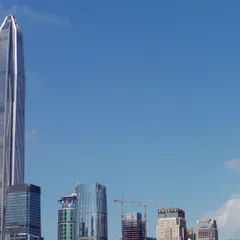
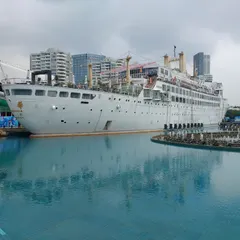
The statue faces the new centre of Futian, where the Ping An Finance Center rises; the other great stage of Deng in the city is in Shekou, on the ship he himself christened: Sea World.
Kites at the foot of Deng’s hill
Kite Square (莲花山风筝广场)
Summary of this stop
The route begins below, in Kite Square, an open meadow of about 20,000 m² in the southeast sector of the park. The first impression is not solemn: children, grandparents, couples and young families gather here to let out string, to the point that the scene is considered one of Shenzhen’s characteristic human landscapes. To the north, Lotus Lake adds another 50,000 m² of water to this great space of everyday leisure, opened in 1997 at the northern end of the new centre.
Locals sum it up with humour. In the joke about Shenzhen’s “three typical habits”, whichever version is going around, this hill always appears: climbing Lianhuashan at night or flying kites on Lianhuashan. The night climb has its logic, because the summit can be reached in five or six minutes running, or in a little over ten along the main path. On the meadow, the audio guide opens with what that joke says about the city’s relationship with its hill.
The cracked portrait and the bronze in waiting
Granite wall with the 1984 inscription
Summary of this stop
Behind the statue, to the north, stands a granite wall with two inscriptions. On its north face is the dedication Deng wrote during his 1984 visit: “Shenzhen’s development and experience prove that our policy of creating special economic zones is correct.” On the south face, his sentence “I am a son of the Chinese people.” On the front of the pedestal, five characters calligraphed by Jiang Zemin: 邓小平同志, “Comrade Deng Xiaoping”.
The bronze, however, almost never made it here. After Deng’s 1992 southern tour, his painted portrait was erected beside Shennan Avenue, at the southeast corner of Lizhi Park; the sun cracked it and it had to be replaced every six months, until in 1994 the sculptor Teng Wenjin proposed swapping it for a sculpture that would “not change in two thousand years”. When Deng died in 1997, many Chinese cities asked to erect statues to him and the central government authorised none: Shenzhen’s project stood still for three years. Where the already cast figure waited is not entirely clear. One source speaks of a warehouse; the testimony of the son of one of the sculptors, gathered second-hand in a news report, places it wrapped in plastic in the courtyard of the Shenzhen Sculpture Institute. Beside the wall, the narration reconstructs that three-year limbo.
The six-metre stride to the south
Deng Xiaoping Statue (邓小平塑像)
Summary of this stop
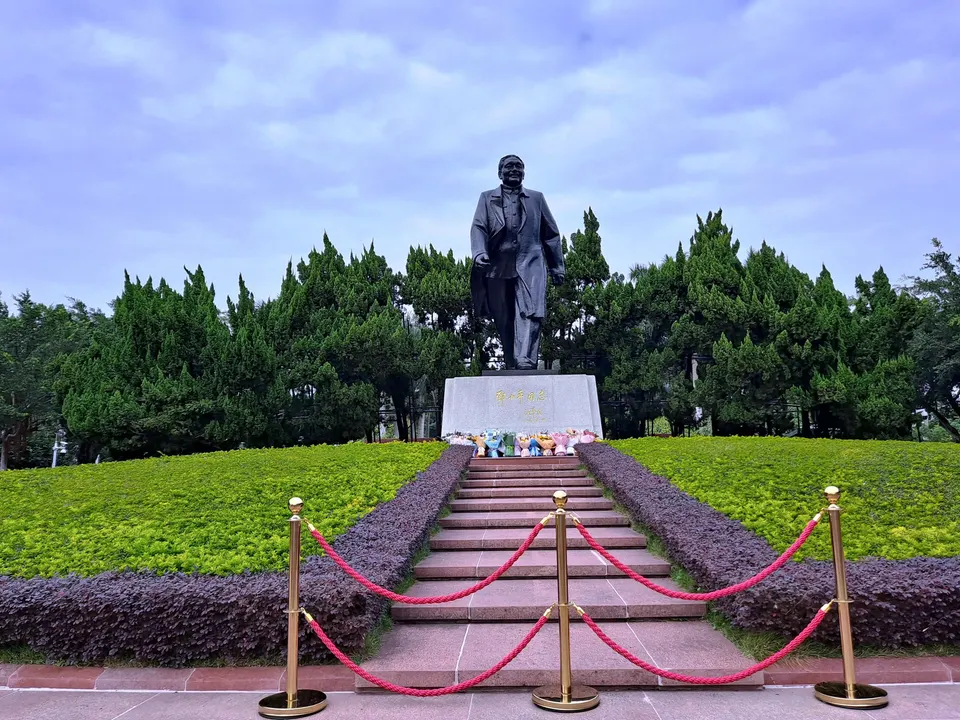
At the centre of the summit plaza stands the statue of Deng Xiaoping: 6 metres of bronze on a 3.68-metre pedestal, almost 10 metres in all, with a row of tall pyramidal cypresses as a dark green backdrop. Deng wears a trench coat and takes a great stride forward. It is no chance gesture: the pose alludes to the idea that the steps of Shenzhen’s reform and opening-up had to be even longer, and the initial sketch, based on a photo of Deng standing, was changed to show him walking. Four sculptors worked on it, Teng Wenjin, Bai Lansheng, Liu Lin and Yang Jinhuan, at the Military Museum of China in Beijing, and the work took seven years in all. Not even its weight is agreed: most sources give 6 tonnes, while the 2010 municipal notice declaring it a protected site gives 21 for the figure and pedestal together.
On 14 November 2000, Jiang Zemin unveiled it as the first statue of Deng in all of China authorised by the central government as urban sculpture. Since the first Lunar New Year after its inauguration, in 2001, locals have climbed up to “wish a happy new year” to Grandpa Deng: in those first days more than 200,000 people came, among them an 81-year-old man who climbed the more than five hundred steps with a cane. The gesture is repeated with bouquets, three bows and a family photo on holidays and, above all, every 19 February, the anniversary of his death, and around Qingming. The flowers at the foot of the pedestal are never missing, and their origin is what the audio guide tells in front of the figure.
Skyscrapers at the foot of a hill without history
Lookout over Futian's central axis
Summary of this stop
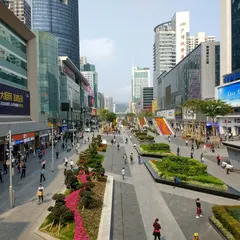
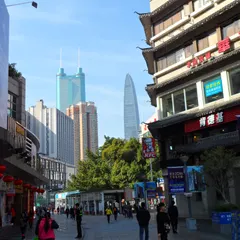
On the southern edge of the esplanade, the view opens in a straight line over the central axis of Futian and its centre of skyscrapers: the same direction the statue faces. The choice was not the first option. Before Lianhuashan, the Caiwuwei triangle, the plaza in front of the municipal government building and the plaza at the railway station were all ruled out. From this plaza of some 4,000 m², at 100 metres above sea level and considered Shenzhen’s highest open-air platform, Deng stands facing the city his reforms made possible. In 2004 the site entered the list of the Eight Sights of Shenzhen as “Early Spring on Lotus Hill”.
The hill’s name has its own local explanation: seven small peaks embrace one another like the petals of an open lotus flower. Despite that poetic name, the hill had no ancient fame, and the Kangxi-era chronicle of Xin’an county, which lists mountains such as Wutong or Nanshan, does not even mention it. At the lookout, the audio guide’s last stop tells how a symbol of Shenzhen turned out to be as recent as its skyscrapers.