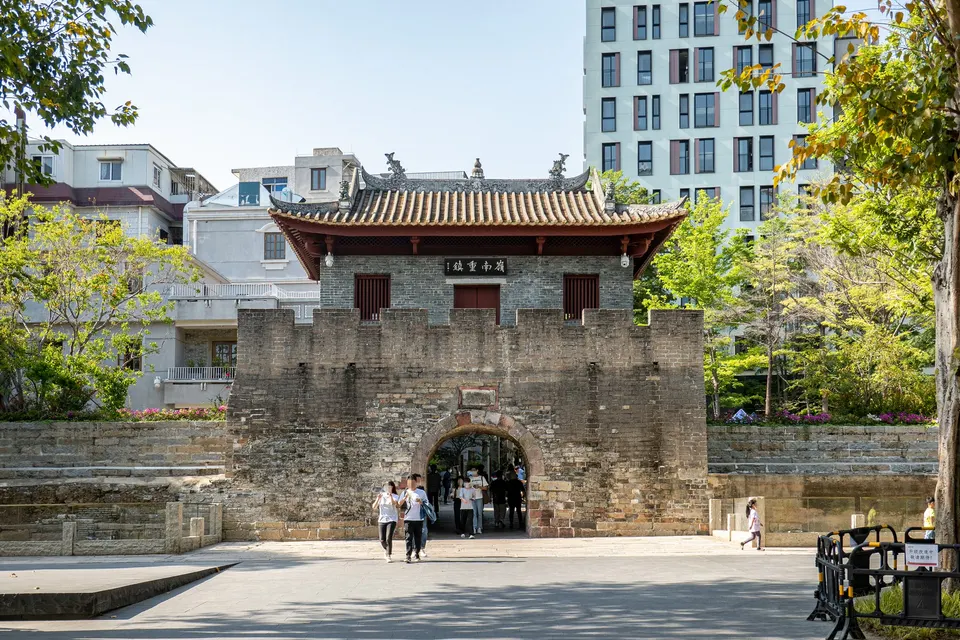
Ming walled city
Nantou Ancient City Audio Guide (Nantou Gucheng)
The walled city of 1394 that from 1573 governed the county from which Shenzhen and Hong Kong emerged, and that today survives in fragments among apartment blocks, cafes and exhibition halls: a Ming gate, a merchants' hall, an ancestral temple and a last stretch of wall.
- 75 min of audio
- Ming wall of 1394
In 1394 the Ming raised a garrison city here with a rammed-earth and yellow-sand wall, a perimeter moat and an enclosure of 680 by 500 metres. In 1573 7,608 families from the Dongguan region arrived by government order and Nantou became the seat of the new Xin'an county, whose territory covered roughly what is today Shenzhen and Hong Kong. It was the administrative head of the area until 1953, when the county capital moved east, beside the Kowloon-Canton railway; in 1979 the whole of Bao'an county was renamed Shenzhen.
The contrast lies in what remains standing. Since 1980 more than 900 multi-storey houses have gone up within the enclosure without planning, some with stone cut from the wall itself, and today fewer than 5% of the buildings predate the late Qing. Among the blocks stand the South Gate, the only guild building preserved in Shenzhen, and the ancestral hall that Wen Bi's descendants dedicated to his brother Wen Tianxiang. And what little survives of the wall was saved by a park born in 1925 as a tribute to Sun Yat-sen.
Highlights
- South Gate — A Ming arch with two inscriptions and a British assault of 1858 that each side tells its own way
- Dongguan Guild Hall — Shenzhen's only guild building, with four Qing stelae on markets and docks
- Baode Square — The heart of the capital of a county that covered Shenzhen and Hong Kong
- Wen Ancestral Temple — Wen Tianxiang's temple, raised by the descendants of his surrendered brother
- Zhongshan Park — The last stretch of the 1394 wall, saved by a tribute to Sun Yat-sen
Among multi-storey apartment blocks, a Ming-era stone gate marks the entrance to the Nantou Ancient City (南头古城, Nantou Gucheng). Its walled enclosure was raised in 1394, and from 1573 it was the seat of Xin’an county, whose territory covered roughly what is today Shenzhen and Hong Kong. The old capital of two future metropolises is now a renovated urban village of narrow streets, cafes and exhibition halls, where fewer than 5% of the buildings predate the end of the Qing dynasty.
The history of the Nantou Ancient City begins before its wall. In 265 a salt commandant settled here with his fortress, and in 331, under Emperor Cheng of the Eastern Jin, the place became the seat of the Dongguan commandery and Bao’an county. From that come the figures repeated in institutional texts, some 1,700 years of history or even 2,000 as an administrative centre, although the surviving wall dates from 1394 and almost everything seen standing is much later. The city went through the Kangxi-era Great Coastal Evacuation, a British assault in 1858 and, in the end, the move of power eastward: the Kowloon-Canton railway made Shenzhen’s market prosper, in 1953 the county capital moved there and in 1979 the whole of Bao’an county was renamed Shenzhen. Earlier, on 16 October 1949, the red flag proclaiming the liberation of the county capital had been raised in Nantou.
Its architecture reads in layers. On the cross of streets inherited from the Ming, the one that led locals to call the city simply “Jiu Jie”, the Nine Streets, more than 900 multi-storey houses went up without planning from 1980, with faux-antique eaves and a mix of grey brick, washed-gravel plaster and tile. Among them, pieces from other eras endure. The Yuying Tang, a Catholic orphanage and church completed in 1868, was the first Catholic church in the Shenzhen region and shows a marked Italian style. The Xin’an county office that visitors see is not the historic building but a reconstruction on another plot: the original site lay beside the Baode temple. And outside the South Gate, on the site of the former Bao’an county government seat, the Nantou Ancient City Museum devotes its halls to Shenzhen’s urban history; its main building was originally the office of the first Bao’an government after 1949, and the sign bearing its name was handwritten by Jin Yong, the great martial-arts novelist.
The last layer came with contemporary architecture. In December 2017 the seventh Shenzhen-Hong Kong Bi-City Biennale of Urbanism and Architecture opened its main venue here, the first time the biennale was held inside an urban village, with industrial sheds from the 1980s and 1990s converted into exhibition halls. The later rehabilitation divides opinion: critics associate it with gentrification and the displacement of low-income residents, and the biennale’s curators defended it as an alternative to demolition, although two of them, Hou Hanru and Liu Xiaodu, warned of the risk of overly rapid gentrification.
To know what to see in the Nantou Ancient City and read each layer in its place, the audio guide covers it in five stops and 75 minutes of narration: from the South Gate to the hall of the Dongguan merchants, Baode Square, the Wen ancestral temple and the last stretch of wall in Zhongshan Park. The thread is a single one: this district of packed blocks was the administrative head of all that is now Shenzhen and Hong Kong, and what is left of that capital survives in fragments, beneath whatever each era piled on top.
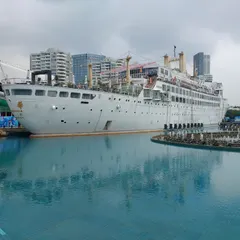
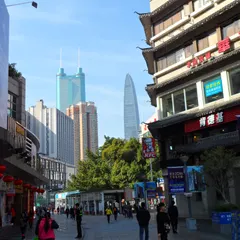
The other trace of pre-reform Shenzhen is the old Shenzhen Xu market, today Dongmen Pedestrian Street, and reform has its symbol a few kilometres away, in the stranded ship of Shekou Sea World.
The South Gate and its two endings
Nantou Ancient City South Gate (南头古城南门)
Summary of this stop
In front of the South Gate opens the barbican plaza, a former defensive space of the wall system now a tree-lined lawn, the antechamber of the enclosure. The arch, from the early Ming, is 10 metres wide and 4.5 high and has lost the tower that crowned it. It is the entrance to the city of the Dongguan garrison battalion built in 1394, year 27 of the Hongwu reign: a wall with a base of earth and yellow sand, a perimeter moat and an enclosure of 680 metres east to west by 500 north to south.
Two inscriptions sum up that military vocation. Inside the tunnel the Ming plaque with the characters “Ning Nan” is preserved; above the arch, the inscription “Lingnan Zhongzhen”, “stronghold of Lingnan”, written by Jin Wenmo, magistrate of Xin’an in the Kangxi era.
The gate also holds a dark episode that each side tells its own way. In August 1858, in the midst of the Second Opium War, Nantou suffered a British assault. According to the British version, the gunboat HMS Starling approached under a flag of truce and was met with gunfire; days later marines and infantry landed, set ladders against the wall, blew up the gate and burned the city before returning to Canton. According to the Chinese version, more than 3,000 British soldiers arrived with large ships, steamers and some fifty boats, and Xin’an’s defenders, soldiers and residents, fought for six hours until they repelled them without their ever occupying the city. In front of the arch, the narration sets the two accounts against each other and reveals the bitterest detail of that day.
Dock stelae among 2020 cafes
Dongguan Guild Hall (东莞会馆)
Summary of this stop
The north-south street is the axis of the cross of streets that preserves the Ming layout. The rehabilitation begun in March 2019 opened on 26 August 2020 a stretch of more than 330 metres with 18 points of interest, now flanked by shops, cafes and exhibition spaces, in an enclosure that keeps more than 1,000 buildings. South Zhongshan Street, which leads straight to the South Gate, is one of the nine that gave the city its popular nickname.
On one side stands the Dongguan Guild Hall (Bao’an Gongsuo), the merchants’ hall of the Dongguan traders where prices were negotiated and the only guild building preserved in Shenzhen. It is three bays wide and two deep, faces west to east and bears a central plaque written by Liang Jin’ao in the Tongzhi era. Inside it keeps four stelae describing Nantou’s markets, shops and docks in the Qing era.
That city of merchants faced the Pearl River estuary, and the estuary brought visitors from far away. In June 1517 the Portuguese diplomat Fernão Pires de Andrade reached the river mouth and asked Nantou’s naval commander for permission to sail his ships up to Canton; in 1521 Wang Hong’s Ming fleet defeated the Portuguese at Tunmen. In front of the hall, the audio guide builds the bridge between the Qing stelae and today’s cafes.
Capital of two metropolises, ringed by blocks
Baode Square (报德广场)
Summary of this stop
At the centre of the enclosure, Baode Square is a small open space surrounded by houses of different eras, with a terrazzo basketball court from the 1990s that the rehabilitation chose to keep. It seems little for what it represents.
In 1573, the first year of the Wanli era, 7,608 families from the Dongguan region, 33,971 people, moved to the city by government order, and Nantou became the seat of the new Xin’an county. The name came from a formula, “renew the old and turn danger into peace”, and its territory covered roughly present-day Shenzhen and Hong Kong. The magistrate’s seat was right next door, beside the Baode temple.
Afterwards power moved east, following the train: the Kowloon-Canton railway made Shenzhen’s market prosper and in 1953 the county capital moved there. After the creation of the Special Economic Zone in 1980, the old capital was wrapped in more than 900 multi-storey houses built without planning, some with stone cut from the wall itself. From the court, the narration reconstructs how the centre of an entire territory ended up hidden among blocks.
Wen Tianxiang, in the house of his surrendered brother
Xinguo Wengong Temple (信国文公祠)
Summary of this stop
The Wen Ancestral Temple of the Duke of Xinguo is the city’s largest and best-preserved old building. It was raised by the descendants of Wen Bi, brother of Wen Tianxiang. Inside, the statue of Wen Tianxiang stands beneath a plaque with the characters “Haoran Zhengqi”, “upright and boundless spirit”, and behind it appears in full his poem “Crossing the Lingding Sea”, written in 1279 when, a prisoner of the Yuan, he was crossing the Pearl River estuary, the Lingdingyang, on an enemy ship: the same waters that bathed Nantou.
The paradox is documented. That same autumn of 1279, Wen Bi handed the city of Huizhou over to the Yuan and went on to serve them as a senior official. The temple of the martyr who preferred to die rather than surrender was thus built by the descendants of the brother who did surrender. History has judged that surrender in opposite ways, and Wen Tianxiang himself left in a poem the line “who has no ties of blood; the grief is as deep as the sea”. In front of the statue, the audio guide dwells on the wound of a lineage split between loyalty and surrender.
The last stretch of wall, saved by a park
Monument to the Liberation of Neilingding (解放内伶仃纪念碑)
Summary of this stop
On the northern edge of the enclosure, inside Zhongshan Park, stretches of the base of the 1394 wall survive; almost all the rest of the perimeter has disappeared. The first great loss came with the Kangxi-era Great Coastal Evacuation (1661–1669): the population was displaced north and walls and houses were dismantled to build a border wall 50 li inland. In 1666 Xin’an was merged with Dongguan, and in 1669 it was re-established with its seat again in Nantou.
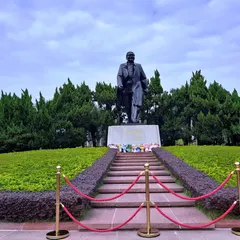
What remains owes its survival to a tribute. In 1925, the year of Sun Yat-sen’s death, the Bao’an county magistrate Hu Yu, a gentleman from Hong Kong, promoted a small 1.3-hectare park in his memory beside the north wall: it is today’s Zhongshan Park, the oldest in Shenzhen. That same year, in July, the first cell of the Communist Party of Bao’an county was founded inside the city. The park was reopened enlarged on 12 November 1999, on the 133rd anniversary of Sun’s birth, with a great stone head of Sun Yat-sen directed by the sculptor Qian Shaowu, considered the largest in the country.
Beside the remains of the wall stands the Monument to the Liberation of Neilingding. The 390th Regiment erected it in 1950 on the South Gate drill ground, in memory of the fallen in the capture of Neilingding island on 18 April that year, and in 1995 it was rebuilt here. The route ends with the thread that joins the two shores: in 2023, the 450th anniversary of Xin’an county, Shenzhen and Hong Kong held joint commemorations and more than 2,000 Hong Kong students visited the ancient city during the summer. Beside the wall, the audio guide’s last stop measures what Nantou was by how little is left standing.