Village of painters
Dafen Oil Painting Village Audio Guide (Dafen Youhuacun)
A 0.4 km² Hakka village that since 1989 has hand-painted, on an assembly line and into the small hours, sunflowers and Mona Lisas for export, and where today, among more than 1,200 galleries, the copyists are starting to sign work of their own.
- 60 min of audio
- Copies and original work
Dafen was born in the early Qing dynasty as a village of the Wu lineage, with a mostly Hakka population, and lay outside the Second Line, the inner border of the Shenzhen Special Economic Zone. That marginal position decided its fate: in 1989 the Hong Kong dealer Huang Jiang moved his export oil-painting workshop here, fleeing the rents of the special zone and the checkpoint that stopped his painters from the mainland from reaching work. In the early 1990s his workshop brought together nearly 200 painters and produced at least 100,000 paintings a month, organised like a machine-free assembly line. In 2004 Dafen was included in the first batch of national demonstration bases of the cultural industry.
The contrast is summed up by the story of Zhao Xiaoyong, one of its Van Gogh copyists: in twenty years he painted more than 100,000 copies, at a few hundred yuan each. In 2014 a client invited him to Amsterdam and, in front of the Van Gogh Museum, he discovered that his buyer's gallery was a souvenir shop reselling his paintings for ten times more. Back in Dafen he painted his first original work, The Studio. That shift, from copying to signing, is what runs through the whole village today.
Highlights
- Entrance sign — The two characters of a Hakka village and the dealer who fled the Second Line in 1989
- Main gallery street — Van Goghs and Mona Lisas, heirs of a machine-free painting factory
- Back alleys — Studios where people painted and slept, with the night radio on until the small hours
- Dafen Art Museum — A concrete facade with the village plan engraved in niches
- Huang Jiang Art Plaza — 23 galleries of original work bearing the founder's name
On the outskirts of Shenzhen, next to Buji, the Dafen Oil Painting Village (大芬油画村, Dafen Youhuacun) covers barely 0.4 km². In that space are concentrated today more than 1,200 galleries and some 8,000 painting professionals, 20,000 if the neighbouring districts are counted, with an output of 3.5 billion yuan in 2025. A little over three decades ago it was a Hakka village of the Wu lineage; since 1989 it became the world’s largest oil-painting factory, where thousands of painters copied sunflowers, landscapes and Mona Lisas by hand and in series for export. Today some 400 resident artists already sign original work.
The history of the Dafen Oil Painting Village begins with a move and is told in several ways. The Hong Kong dealer Huang Jiang spoke of 26 disciples and of rents soaring in the special zone as the reason for the move; other accounts speak of a dozen or so painters, or twenty-odd, and attribute it to the border control that stopped painters from the mainland from reaching his workshop. One of those accounts, disputed, describes a village of some three hundred residents where at nightfall the dogs would not stop barking and no one dared leave home; of the sixty or so apprentices who came, only about twenty are said to have stuck it out. Nor does the name have a single story: the spelling 大芬, “great fragrance”, has been fixed since the Jiaqing era (1796-1820), but Huang Jiang said that in 1989 it was called 大粪村, “dung village”, for its filth, a nickname that also circulates as popular tradition.
Its weight in the art market is measured in figures that do not always fit. It is documented that in 2005 the village’s oil-painting trade reached 279 million yuan. Its market share, however, circulates in incompatible versions: 70% of the oil paintings sold in Europe and North America made in China and 80% of those coming from Dafen; 60% of all new oil paintings in the world at its peak; or 70% of sales in many Western markets around 1999. The figure of “more than 10 billion” copies painted is implausible. Between 2005 and 2007 the German photographer Michael Wolf portrayed the copyists posing in alleys with their Hoppers, Lichtensteins, Hockneys or Mona Lisas; in the studios, a Van Gogh “Sunflowers” went for 7 dollars, because the price was calculated by canvas size and paint used, and in his book Real Fake Art (2011) he printed the price of the copy opposite each portrait. Copying also has its grey area: the official rule limits it to works by artists dead for more than fifty years, but in Dafen works by Georgia O’Keeffe, who died in 1986, and by living artists such as Yue Minjun or Fernando Botero have been copied.
To know what to see in the Dafen Oil Painting Village does not end at the shopfronts. Between galleries and rental buildings survive low houses and a lineage hall of the original Hakka village; the Sunrise Art Center occupies a former three-storey Hakka house of grey brick and dark tile, damaged by a typhoon and restored by the painter Chen Qiuzhi in 2006 as a gallery with a courtyard. The 2021-2023 renovation spread murals over walls and party walls, and several open studios let inexperienced visitors copy a painting guided by a painter, a tourist extension of the old trade. The architecture of the Dafen Oil Painting Village culminates in its museum, whose facade draws the plan of the alleys themselves.
The audio guide covers the village in four stops and one hour of narration: from the entrance sign to the gallery street, the studios of the back alleys and the museum plaza. The thread is a single one: these streets were a painting assembly line, and the trade of copying by hand, piecework and into the small hours is what today lets some of its residents finally sign work of their own.
The same logic of copying and mass production moved the counters of Huaqiangbei, and the old rural market that gave the city its name is today Dongmen Pedestrian Street.
The dealer who fled the Second Line
Dafen Oil Painting Village (大芬油画村)
Summary of this stop
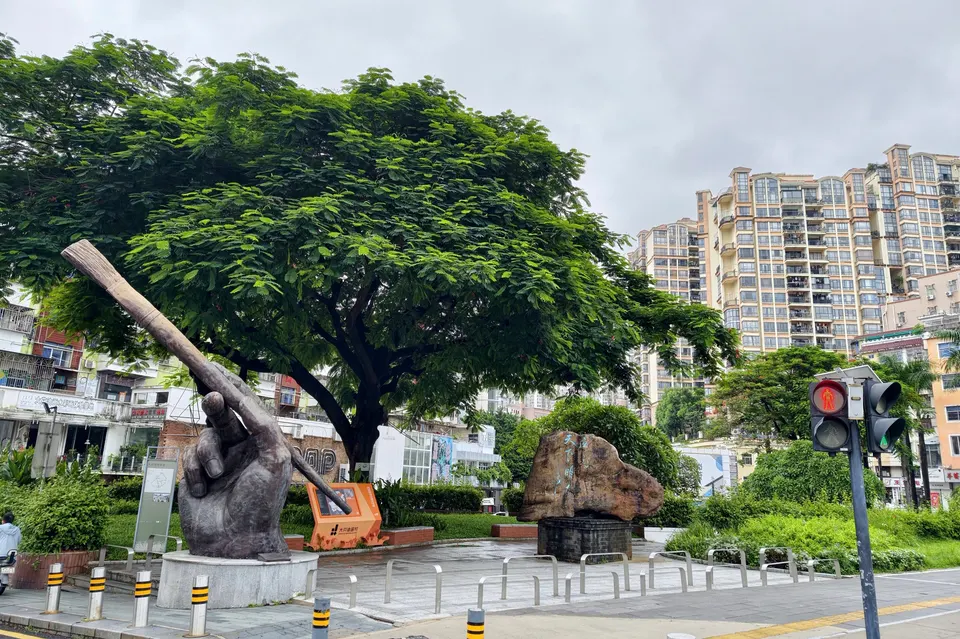
The access from Busha Road is marked by the sign 大芬油画村 and, to its left, a monumental sculpture that serves as the place’s first frame. The first two characters hold the village’s story: founded in the early Qing dynasty by the Wu lineage, with a mostly Hakka population, it was written 大分, “great division”, until in the Jiaqing era (1796-1820) it adopted the current spelling, 大芬, “great fragrance”.
Before the reforms, Dafen was a cluster of Buji neighbours lying outside the Second Line, the inner border that separated the Shenzhen Special Economic Zone from the rest of the territory. That is the key to everything. Huang Jiang, who had opened an export oil-painting workshop in Guangzhou in 1984 and moved to Shenzhen in 1986, had his first workshop inside the zone, in Huangbeiling. After about three years, painters arriving from the mainland could barely cross the checkpoint, and rents had jumped to 4,000-6,000 yuan a month.
In 1989 he settled in Dafen with 26 disciples, by his own account: here, 1,000 yuan rented 250 m² of ground floor. Next to the entrance, the art plaza that bears his name now brings together 23 galleries and shops of original work in about 1,200 m². In front of the sign, the narration tells how an inner border decided where the world’s largest painting factory would be born.
Sunflowers on an assembly line
Copy storefronts on the main street
Summary of this stop
The main street is a succession of adjoining storefronts: copies of Van Gogh, Monet or the Mona Lisa next to landscapes, portraits and abstracts made to order, with frames and canvases spilling onto the pavement. Each of those paintings is the heir of a machine-free factory. In the early 1990s, Huang Jiang’s workshop came to bring together nearly 200 painters, many of them sons of local farmers who left the rice paddy to learn to paint. Organised like an assembly line in the style of the special zone’s factories, it produced at least 100,000 oil paintings a month, with orders of more than 100,000 paintings at a time; in the 1990s, a sample sent to Walmart earned it an order of 50,000 paintings to be delivered in fourteen days.
The guild keeps one episode as a founding feat. It is said that in April 1992 a French client ordered 360,000 paintings with a deadline of a month and a half and a penalty for delay. Huang divided his twenty-odd painters by motif: some painted only the sky, others the mountains, others the water and others the trees, each always repeating the same thing. When the buyer arrived to inspect the goods, the result looked to him as if it had come out of a photocopier, and he was satisfied.
The scale went far. In 2005 Dafen’s oil-painting trade totalled 279 million yuan, and at the 2010 Shanghai Expo the facade of the Shenzhen pavilion was a giant Mona Lisa made of 999 oil paintings hand-painted by 507 painters from the village. In front of the storefronts, the audio guide reconstructs how a landscape is painted between twenty hands.
A Van Gogh in 28 minutes, in the small hours
Studios in the back alleys
Summary of this stop
Behind the main street, in the Laowei alleys, the village’s old houses carry “gallery” or “studio” signs, stairwells have become workshops and painters work on stools in front of their doors. Here the piecework trade lived. Zhao Xiaoyong, who arrived in late 1996 from a ceramics factory, specialised in Van Gogh because it sold best: in twenty years he painted more than 100,000 copies, dispatched a 50 × 60 cm self-portrait in 28 minutes and in 2004 passed 1,000 orders a month, in workshops where one person painted the background, another the eyes and another the ears. In 2014 a trip to Amsterdam revealed how much his paintings were worth in other hands, and on his return he painted his first original work.
The working day had its own rhythm, documented by the studios’ tradition: painting began at two or three in the afternoon and continued until three or four in the morning. At night, each studio tuned in to the radio programme “The Night Sky Is Not Lonely” (夜空不寂寞), made for migrants far from home, and Zhao’s group even phoned in to the station. In the busiest years, seven or eight relatives shared a rented room, with boards nailed to the wall and straw mats on the floor.
That minimal space had an abrupt end. In May 2017 the Shenzhen government declared 148 sites in Dafen a “serious fire risk”, and that summer the residents’ committee dismantled the flagged workshops, in a village where a single room served as both studio and bedroom and canvases dried hanging beside the laundry. In these alleys, the narration dwells on what each copy cost in hours of sleep.
A museum with the village on its facade
Dafen Art Museum (大芬美术馆)
Summary of this stop
Set against the hillside, the Dafen Art Museum is a grey concrete block by the studio Urbanus, opened in 2007 after a competition. Its facade overlays the village’s street grid rotated at an angle, engraved in rectangular niches meant for the neighbourhood’s painters to fill with colour. In 2008 BusinessWeek and Architectural Record chose it best public project at the China Awards “Good Design is Good Business”. In front of its ground floor opens a public plaza, renovated in 2023 with a sheet of water evoking Dafen’s old watercourse; the museum reopened on 25 February that year with an exhibition of Giorgio Morandi.
The building also stars in a documented episode. In 2007 the artist Christian Jankowski photographed its rooms under construction, leaving an empty wall at the centre of each image, and handed the photos to the village’s copyists: they were to paint the scene and hang on that wall the painting they would choose if they ran the museum. Later, a curator of the museum itself invited him to bring the canvases back, and they were hung on those same walls, now finished.
The plaza is also the place to understand the change of course. At the Canton Fair in autumn 2008, where Dafen used to close contracts of 20 to 50 million yuan, the village returned with almost no orders; before 2009, 70% of the business was export and 30% domestic sales, and after the crisis the proportion reversed. Today, among more than 1,200 galleries, some 400 resident artists sign original work. In front of the facade, the audio guide’s last stop tells how a village of copyists learned to sign.