Historic market
Dongmen Pedestrian Street Audio Guide (Dongmen Buxingjie)
The Ming-era village market that lent its name to Shenzhen is today a 176,000 m² pedestrian grid where a rebuilt clan academy, mainland China's first McDonald's and the livestreams of influencers share the same streets.
- 45 min of audio
- Ming-era market
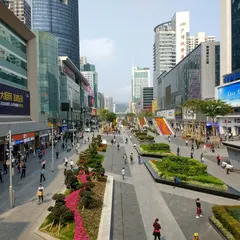
In the mid-Ming dynasty, the clans of four villages, Chikan, Luohu, Getang and Hubei, set up a market among their lands: the Shenzhen Xu. It had four gates, and the east gate, the busiest, ended up naming the whole market: Dongmen. A memorial to the throne of 1856 about the robbery of a herbal medicine shop is the oldest archival document bearing the name Shenzhen, and in 1979, when that name passed to the new city, the old market kept that of Dongmen Laojie. On 1 October 1999 the renovated pedestrian street was inaugurated: eight roads closed to traffic, a historic-style street and three large plazas.
The contrast lies in what looks old. The Siyue Academy, the brick-and-timber building that gives the impression of being the oldest in the district, was demolished in 1996 and rebuilt in 1999 on another plot; the stretch of old street on Renmin Bei was fixed with bricks salvaged from the demolished houses. Meanwhile, a few streets away, brass plaques recall the queue that in 1990 ran from the second floor of mainland China's first McDonald's down to the plaza.
Highlights
- Jiefang and Dongmen Zhong crossing — The site of the east gate that named the market and, later, the city
- Siyue Academy — Clan school that sheltered strikers in 1925, rebuilt in 1999 far from its plot
- Former Hong'an restaurant — Ye Ting's command post and a Japanese headquarters in 1938 and 1940
- Mainland China's first McDonald's — 20 tills, 500 seats and a queue to the plaza in 1990
- Bronze relief of the old market — 16.5 metres and 21 trades of the old Shenzhen Xu
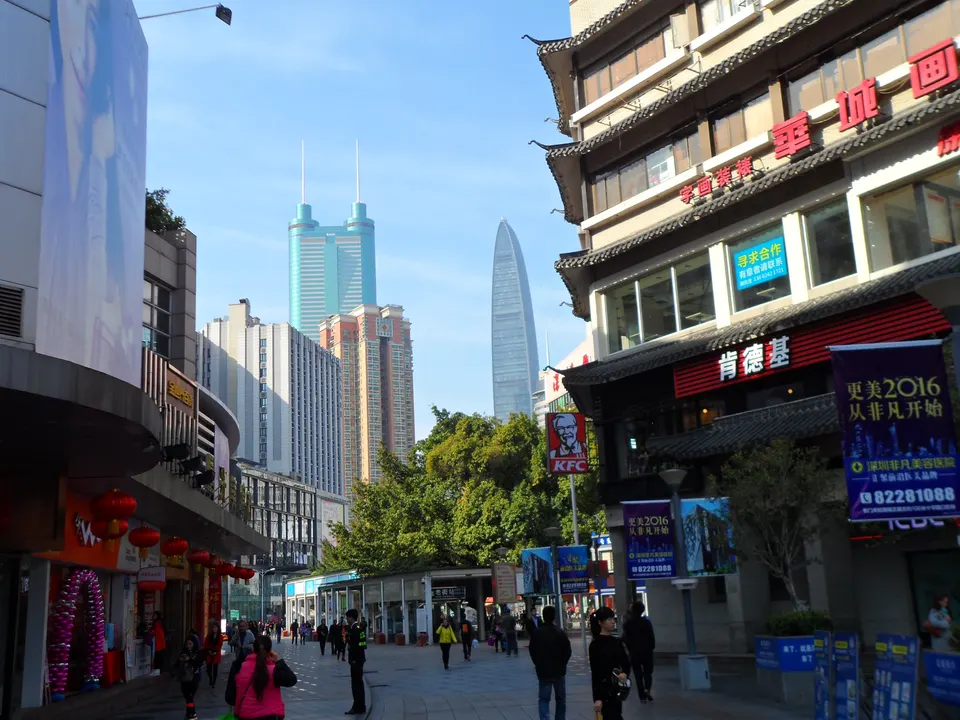
Among shopping centres and arcades, Dongmen Pedestrian Street (东门步行街) occupies the site of the Shenzhen Xu, the rural market that the clans of four villages raised in the mid-Ming dynasty and that ended up lending its name to the whole metropolis. Its exact age is disputed: depending on the source, “some 300 years”, “more than 300”, “more than 400” or a Ming origin of around 500 circulate. What is not disputed is its weight: in Shenzhen it is often said that whoever has not walked the old street of Dongmen cannot say they have been to the city.
The history of Dongmen Pedestrian Street reads in layers. In 1911 the Canton-Kowloon railway placed its station in the market itself; in 1938 came the Japanese occupation, with its headquarters in a restaurant on Nanqing Street, its military police on Xihe Street and a barracks in the Yongmu hall school. From those years survives the story of Chen Minxue, a boy from the market who lost the family inn in a bombing, went at 11 to the occupiers’ Japanese school in exchange for three liang of rice a week and, at 14, began passing information to the Dongjiang guerrillas. In 1979 the market ceded its name to the new city and became Dongmen Laojie, and on 1 October 1999 the great pedestrian renovation was inaugurated, although other references place the transformation more vaguely across the 1990s.
The architecture of Dongmen is, above all, a rebuilt architecture. The long Lingnan-style arcades, with their decorated cornices, form sheltered corridors of shops, and since March 2024 a 588-million-yuan renovation has been renewing the underground networks across 12,300 m², restoring the facades of 24 key buildings and replacing the street lamps with 78 smart poles. In Laojie Plaza and Shidai Plaza, groups of large bronze bells are dedicated to time, an apt theme for a district that has remade itself so many times.
To know what to see on Dongmen Pedestrian Street beyond the crowds, the audio guide covers it in five stops and 45 minutes: from the crossing where the east gate stood to the Siyue Academy, the old headquarters on Nanqing Street, the entrance of mainland China’s first McDonald’s and the bronze relief in Cultural Plaza, where influencers now livestream. The thread is a single one: every era has set up its stall here again.
The other great vestige of pre-reform Shenzhen is the Nantou Ancient City, seat of Xin’an county; today’s trade is divided between the counters of Huaqiangbei and the galleries of the Dafen Oil Painting Village.
The east gate that named a city
Jiefang and Dongmen Zhong crossing
Summary of this stop
At the crossing of Jiefang Street with Dongmen Zhong Street no visible trace of the gate remains, but here stood the eastern entrance of the Shenzhen Xu. Of its four gates, the east one was the busiest and the most surrounded by shops, and its name, Dongmen, “east gate”, ended up designating the whole market.
The name of Shenzhen also has its first document here. On the 30th day of the first lunar month of 1856 the herbal medicine shop of the licentiate Liu Dayuan was raided in the market, and the memorial to the throne that Ye Mingchen drafted about the robbery, a 400-centimetre scroll that mentions “Shenzhen Xu” seven times, is preserved in the First Historical Archives of China: it is the oldest archival document to record the name. In 1979, when Shenzhen became the name of the new city, the market kept that of Dongmen Laojie, “old street of Dongmen”.
Jiefang Street itself holds another surprise beneath its name, which means “Liberation”. According to documented tradition, in the mid-1950s, to let vehicles pass, three streets of the old market were merged into a single road. Which they were, and what became of the one named after the district, is the twist the narration reserves for this crossing.
A clan academy rebuilt on another plot
Siyue Academy (思月书院)
Summary of this stop
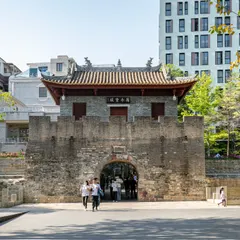
In Laojie Plaza stands the Siyue Academy, a low brick-and-timber building with two courtyards and a Lingnan-style gabled roof, in contrast with the shopping centres around it. It was the family school of the Zhang clan of Shuibei, Hubei and Xiangxi, dedicated to their thirteenth-generation ancestor, Zhang Siyue, and in June 1925, during the great Canton-Hong Kong strike, it served as a reception post for strikers going back and forth between the two cities.
Its recent history is that of a building that moved. Declared a municipal monument on 27 July 1988, it was demolished in March 1996 by the Dongmen renovation and rebuilt between 1997 and September 1999 away from its original plot, 22 Nanqing Street, as a museum of the old street’s history. How much it preserves of the original is a matter of debate: some descriptions say it keeps the plan and structure but not the original facade or decoration; others present it as a move of a few streets or as a reconstruction with old brick.
Very close by, the second phase of the renovation, at 40 million yuan, engraved in the marble paving the old Yazaijie bird market, the “street of the ducklings”, on its site, and fixed the look of the old street on a 120-metre stretch of Renmin Bei Street with bricks salvaged from the demolished houses. In front of the academy, the audio guide dismantles what in Dongmen seems old.
The dining hall that changed sides twice
Facade of the former Hong'an restaurant
Summary of this stop
At 13 Nanqing Street a Republican-era building is preserved, the former Hong’an restaurant. Today it houses the memorial of the Old Headquarters of the Dongjiang Guerrillas, because here General Ye Ting set up his command post against the Japanese invasion. Inside, a plaque with the word “Tiejun”, “Iron Army”, opens the exhibition “Ye Ting and Shenzhen”.
The same dining hall has a darker story. According to documented tradition, in October 1938, when the Japanese army took the Shenzhen Xu, its headquarters appropriated the Hong’an, and in 1940, when a reinforced regiment of some 1,300 men returned, the command settled again in the same building. On nearby Xihe Street, where the military police were lodged, a neighbour, Liang Baihe, witnessed a sergeant beating an old man of over 80 who had neither bowed nor greeted in Japanese. In front of the facade, the narration reconstructs how a three-storey restaurant changed sides twice.
Twenty tills and a queue to the plaza
Entrance of the first McDonald's
Summary of this stop
In the Guanghua building, in Xihuagong, on Jiefang Street, brass plaques at the entrance recall a date: on 8 October 1990 the first McDonald’s in mainland China opened here, with an investment of 30 million Hong Kong dollars. Its 20 tills were not enough, the 500 seats filled and the queue ran from the second floor down to the plaza outside.
The street had been a gateway to the outside before. In 1911, with the opening of the Canton-Kowloon railway, Shenzhen station was placed in the market itself, at the mouth of today’s Jiefang Street, and it was the junction between the interior and Hong Kong until in 1950 it moved next to the Luohu border crossing. The last chapter came on 1 October 1999, when the renovated pedestrian street closed eight municipal roads to traffic across 176,000 m². In front of the plaques that almost everyone steps on without looking, the audio guide joins the train, the 1990 queue and the closure to traffic into one story.
From the village stall to the livestream on a phone
Bronze relief of the old market
Summary of this stop
In Dongmen Cultural Plaza, the “Map of the Old Dongmen Market” is a bronze relief of 3 by 16.5 metres, about 50 m², depicting 21 trades of the old Shenzhen Xu: the fishmonger, the cloth row, the gold row, bazaar stalls and food stalls. It is the image of the market founded in the mid-Ming dynasty by the clans of Chikan, Luohu, Getang and Hubei, whose first streets were Shangdajie and Yazaijie.
A few metres away, trade goes on with other tools. Since October 2023 Dongmen has been the great meeting point of streamers, the “livestream street”, and since January 2024 each outdoor livestream is booked through a mini-app and limited to fixed zones in Cultural Plaza and West Plaza, where singers, dancers and sellers broadcast surrounded by onlookers. In the plaza, the route ends with the local saying that one has not visited Shenzhen without stepping on Dongmen, and with the idea that the market of the four villages never really closed.