
Panoramic Viewpoint
Fjellstua viewpoint Audio Guide (Aksla)
418 stone steps climb from the Byparken to the Fjellstua terrace, high on Mount Aksla. From the top some 200 summits can be counted, and a single glance explains why the fire of 1904 was able to run the whole length of Ålesund.
- 8 min of audio
- Views and Ascent
Fjellstua is the viewpoint and restaurant leaning out over Ålesund on the western flank of Mount Aksla. It is reached by 418 stone steps that set off from the Byparken, a public garden laid out by the municipality in 1885 along the contours of the hillside, and the terrace at the top opens a view of almost 270 degrees over the town centre, the archipelago and the Sunnmøre Alps. The Fjellstua platform sits at around 130 metres above the sea; the mountain's highest viewpoint, Rundskue, reaches some 195, and the round figure usually given for Aksla is 189.
What can be seen from up there is not simply a postcard: it is a diagnosis. Ålesund is packed onto narrow stone islands and peninsulas — Aspøya, Nørvøya, Hessa — wedged between fjords and the Atlantic, and that dense timber weave explains why, in the early hours of 23 January 1904, a fire that started in a canning factory on Aspøya destroyed almost the entire town in some fifteen hours. Below, the stone and Art Nouveau Ålesund on view today is exactly the one raised on those ashes.
Highlights
- 418 steps — The Bytrappa, cut by the Ålesund Byselskap from 1885, took some fifteen years of work
- Gange-Rolv statue — 2.65 m of bronze depicting the Viking who founded Normandy, a gift from Rouen unveiled in 1911
- Byrampen — The viewing platform halfway up, born of the 2014–2016 refurbishment
- Almost 270° view — Some 200 summits, 80 of them above 1,000 m, and up to 14 Sunnmøre municipalities
- Kniven — The railed rock spur from which the classic photograph of the town is taken
Every town has a viewpoint; few have one that works as an explanation. The climb up Mount Aksla to the Fjellstua terrace is the route that turns Ålesund from a postcard into a map: at the top, the stone islands and peninsulas the town rests on come into view all at once, and with them the logic of the fire that in 1904 erased almost all of it. The secret history of Fjellstua begins long before the steps, in 1885, when the municipality laid out the Byparken across the western slope and the civic society Ålesund Byselskap took on the work of carving a path towards the summit.
There are 418 steps, some fifteen years of labour to open them and a height gain that makes itself felt; there is also a road — Borgundfjordveien and the Fjelltunnelen — up to the car park beside Fjellstua, with the Bytoget tourist train carrying visitors up when the weather allows and a restriction on heavy vehicles in force since 2025 for safety reasons. But what to see at the Fjellstua viewpoint is not exhausted by the final panorama: the ascent strings together a Viking statue, a landing with a name of its own and a ledge over the void, and the EarGuide audio guide accompanies that climb stop by stop.
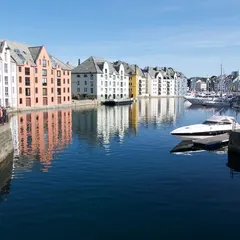
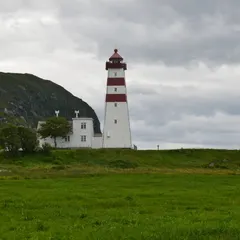
Visible below are the Brosundet Canal and the rooftops of the district around the Art Nouveau Centre, and facing the Atlantic, on the island of Godøya, Alnes Lighthouse awaits.
The viking who founded Normandy
Byparken
Summary of this stop
The first stop does not even climb: it is taken in the Byparken, in front of a bronze figure 2.65 metres tall planted among the trees. This is Gange-Rolv, Rollo, son of Ragnvald, jarl of Møre, and the man who around 911 became the first lord of Normandy after the pact with the Frankish king Charles the Simple sealed at Saint-Clair-sur-Epte. His great-great-grandson was William the Conqueror, who took England in 1066: the line of the English royal house also starts from this figure.
The statue is not originally from here. It is a bronze copy of the one in Rouen, a gift from that Norman city to Ålesund on the millennium of the founding of Normandy, and it was unveiled in September 1911. Only three pieces of this size exist in the world: the one in Rouen, the one in Ålesund and the one in Fargo, in the United States.
The local claim holds that Rollo came from the same islands that can be made out from the viewpoint — some versions say Giske, others neighbouring Vigra — and that is where a dispute lasting more than a century begins: since Dudo of Saint-Quentin, around 1020, Danish tradition claimed him as a Dane, while Norwegian, French and British historiography today leans towards a Norwegian origin. Ålesund did not wait for the verdict and put up its statue. How each version holds together, and why the town decided not to wait, is what the narration takes apart at the foot of the bronze, right where the stairway begins.
The stairway that took fifteen years
Byrampen
Summary of this stop
The second stop waits halfway up, on the Byrampen platform, and arrives at the precise moment when the legs are grateful for an excuse to stop. From here the town already lies spread out below and the effort begins to make sense. The 418 steps underfoot were an initiative of the Ålesund Byselskap begun in 1885, and opening the path across the mountainside took around fifteen years of work.
Not all the steps are the ones the first generations trod. Between 2014 and 2016 the old natural stone stairway, worn and dangerous in places, was renewed by replacing part of the stone with concrete, and the decision raised hackles: some experienced it as the loss of the path they had always known, others accepted it as the lesser evil if the climb was to stay safe. Byrampen, the viewing platform where this stop is made, came out of that very refurbishment and quickly became the corner where the photographs are taken.
It is worth looking up before continuing. The mountain rises to between about 180 and 195 metres depending on the point measured, and the Fjellstua terrace sits at around 130: there are steps still to come. What was gained and what was lost with the concrete, and how that small neighbourhood argument sounds told by someone who lived through it, is material the audio guide unfolds on this landing.
All of Ålesund from the terrace
Fjellstua
Summary of this stop
The third stop is the reward. From the wraparound terrace of Fjellstua the view opens almost 270 degrees: to the east and south, the jagged, snow-covered wall of the Sunnmøre Alps; to the west and north, the archipelago breaking up towards the open sea. Around 200 summits can be counted, some 80 of them above 1,000 metres, and on clear days as many as 14 Sunnmøre municipalities come into view.
The pavilion that serves the coffee has a history of its own, and not a minor one. Fjellstua is the oldest restaurant in Ålesund: a master shoemaker built it in timber in 1903, exactly one year before the great fire. In the early hours of 23 January 1904, while the wooden town burned entire at its feet, the pavilion was saved by standing high on the mountain, far from the flames. The irony arrived thirty years later: in 1934 Fjellstua itself burned down, and it had to be rebuilt.
Knowing that changes the taste of the svele eaten on the terrace. This viewpoint stood here, watching the whole town burn, before burning on its own. What was seen that night from this exact spot, and how those who were up here remembered it, is what the narration deals with while the view does the rest.
The edge over the islands of stone
Kniven
Summary of this stop
The last stop moves a little away from the terrace, over to Kniven, the railed rock spur that leans vertically above the rooftops and the water. It is the point of the classic photograph of Ålesund, but also the best place to grasp the town as a shape. From the edge, the built-up centre reads effortlessly: narrow stone islands and peninsulas — Aspøya, Nørvøya, Hessa — pressed between the fjords and the Atlantic, with water coming in from every side.
That geometry is the explanation for the disaster. A wooden town compressed onto strips of rock, with the houses stuck to one another and the south-westerly wind blowing along those corridors, had few defences: the fire born on Aspøya in the early hours of 23 January 1904 ran through almost the whole centre in some fifteen hours, burned close to 850 houses and left barely 230 standing.
What is seen below, as a consequence, is the town of afterwards: the stone and Art Nouveau Ålesund raised on the ashes, with its regular grid and its façades all of the same age. Seeing the complete plan from here and recognising in it both the catastrophe and the response is the natural close of the ascent, and the moment when the EarGuide audio guide links this viewpoint to everything waiting below.