
Open-Air Museum
Sunnmøre Museum Audio Guide
More than fifty old houses brought here piece by piece, a fleet of traditional boats including the only original åttring still preserved and, underneath it all, one of the few genuine towns of medieval Norway. This is what to see at Sunnmøre Museum.
- 10 min of audio
- Medieval History
Sunnmøre Museum was founded in 1931 at Borgundgavlen, on the edge of Ålesund, on the initiative of the youth association Sunnmøre frilynde Ungdomssamlag, with Rasmus Buset and Anders Vassbotn among its driving forces. No nobleman and no ministry put it there: it grew out of the determination of young people who wanted to save a way of life slipping through their fingers. Today it gathers more than fifty old buildings moved to the site — around 55 by 2009 — from farms and mills to boathouses and fishermen's cabins, spread across a site of some 120 hectares.
What makes this more than a reconstructed village is the ground it stands on. The site lies over Borgundkaupangen, a medieval market town whose settlement goes back to the first half of the eleventh century and which, by the thirteenth, was the largest place on the Norwegian coast between Trondheim and Bergen. Excavations begun in the 1950s have brought some 45,000 objects to light, one of the largest medieval archaeological assemblages in Norway. Ålesund did not begin with the fire of 1904: it began here, and here it once went out.
Highlights
- More than fifty houses — Farms, mills, fishermen's cabins and boathouses reassembled across 120 hectares
- The only original sunnmørsåttring — Centrepiece of a collection of more than forty traditional boats
- Fjørtoft and Kvalsund replicas — Iron Age and Viking Age vessels rebuilt at full scale
- Borgundkaupangen — The buried medieval market town that has yielded some 45,000 objects
- MK Heland — The 1937 fishing boat that crossed the North Sea on the Shetland bus
Ålesund presents itself to the world as a city of 1904, born whole out of a fire. Sunnmøre Museum, on the outskirts, contradicts that story the moment anyone steps inside. Here there are walls of blackened logs, roofs of living turf and thresholds so low they force a bowed head; and underneath, literally underneath, the remains of Borgundkaupangen, a medieval trading centre that was one of the few real towns of the Norway of its day. The secret history of Sunnmøre Museum is that double floor: a village brought in from outside, assembled on top of a city that vanished.
The museum was founded in 1931 and has been accumulating layers ever since: more than fifty rebuilt houses, more than forty traditional boats, a medieval museum standing over the excavation and a small fleet moored in the fjord. Grasping what to see at Sunnmøre Museum means walking it in order, from the village to the boat hall, from the excavated grass to the stone church and finally to the quay — the five-stop route that the EarGuide audio guide follows.
The story of the town rebuilt after the 1904 fire is told at the Art Nouveau Centre, and Ålesund Church was likewise built after the blaze.
A Sunnmøre village put back together
Sunnmøre Museum
Summary of this stop
The first stop is taken among the turf-roofed houses, and the first surprise is that not one of them was born on this spot. These are more than fifty old buildings — around 55 by 2009 — brought piece by piece from farms, fishing stations and hamlets across the district and reassembled on this slope beside the fjord, on a site of some 120 hectares. There are farms, mills, boathouses and fishermen’s cabins, and together they document the building traditions and the working life of Sunnmøre from the Middle Ages to the early twentieth century.
The museum’s origin explains its character. It was founded in 1931 at Borgundgavlen on the initiative of the youth association Sunnmøre frilynde Ungdomssamlag, with Rasmus Buset and Anders Vassbotn among its promoters: not a project of the state but of young people from the district determined to keep what was disappearing. That is why what unfolds here is not a row of monuments but a working village, with its byre, its mill and the shed where the boat slept.
One question is left hanging, and it pulls the rest of the visit along: why assemble an entire imported village here, precisely here. The ground was not chosen by chance, and the answer — which is not visible — is the one the narration begins to unfold on the way down to the large building.
The last åttring and the Viking ships
Båthallen, Sunnmøre Museum
Summary of this stop
The second stop goes into the boat hall, where the smell of tar and old wood arrives before the exhibits do. The collection runs to more than forty vessels, mostly traditional working boats of the sunnmørsbåt and møringsbåt types, and its jewel is the only original sunnmørsåttring still preserved: an eight-oared boat particular to the region, the model used to go out onto a sea that forgave no mistakes.
Alongside them stand full-scale replicas of Iron Age and Viking Age craft, rebuilt from finds made in the district itself, such as the Fjørtoft and Kvalsund ships. The Kvalsund one carries a particularly unsettling history: that roughly 18-metre rowing vessel turned up in 1920 sunk in a peat bog at Herøy, near Ålesund, dated by dendrochronology to around 780–800 AD, right on the threshold of the Viking Age, and it is regarded as a link between pre-Viking boats and the great sailing ships that followed.
The detail that changes everything is how it was found: deliberately taken apart and with no human remains, which points to its having been thrown into the water as an offering. A vessel intentionally broken and handed over to a bog stops being a model and becomes the shadow of a rite, and what is known and what is merely supposed about that gesture is material the audio guide unfolds beneath the suspended hulls.
Beneath your feet, a medieval city
Borgundkaupangen
Summary of this stop
The third stop moves out onto the ground of Borgundkaupangen, and here the protagonist is the soil. This quiet meadow was a kaupang, a medieval market whose settlement goes back to the first half of the eleventh century and which became, in the thirteenth, the largest place on the Norwegian coast between Trondheim and Bergen. Borgund was one of the few towns of medieval Norway in the strict sense.
There is even a document that proves it. A decree of King Olav Håkonsson, dated 1384, ordered the inhabitants of Sunnmøre to trade at Borgund, and that letter is the oldest written source naming it a by, a town. That a king had to compel his people to come here says a good deal about the importance of the place, and also, read the other way round, about something beginning to go wrong.
Because the kaupang declined. Through the fourteenth and fifteenth centuries the fish trade shifted towards Bergen and the merchants of the Hansa, and by the end of the Middle Ages the urban settlement had died out; only the parish church remained in use. Walking on grass knowing there were once streets, houses and wharves beneath it is a different experience from visiting a visible ruin, and it is exactly where the narration lingers longest.
The stone churches and 45,000 remains
Borgund kyrkje
Summary of this stop
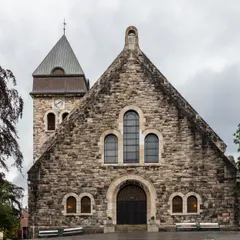
The fourth stop stands before Borgund church, the one building of the old settlement that never stopped standing. It preserves walls of the Peterskyrkja — St Peter’s church, from around 1130 — and in 1632–33 stones from the ruined Margaretakyrkja, St Margaret’s, were reused to raise its transept. Medieval Borgund had three stone churches, and perhaps four; the exact number is still debated, because only part of the settlement, two graveyards and one of the churches have been excavated, with another located, so the topography of the town is still being reconstructed.
What is quantified is what has come out of the ground. The archaeological excavations begun in the 1950s — the first major campaign in 1954, followed by dozens of seasons — have recovered some 45,000 objects, one of the largest medieval assemblages in Norway, today divided between the Medieval Museum on the site itself and the University Museum of Bergen.
And there is the cause of the end. The Black Death reached Norway in 1349 and struck Borgund squarely: local historical memory holds that it carried off more than half the inhabitants. Added to a cooling climate, the collapse of the fisheries and the growing strength of the Hansa in Bergen, it left the kaupang without people and without trade. How a town goes out, and what is left of it when only its church survives, is what the audio guide recounts in front of these walls.
From the medieval knarr to the wartime boat
Museumsbrygga
Summary of this stop
The last stop goes down to the museum quay, where the thread of the sea ties together ages that seemed unconnected. Moored in the water of the Borgundfjord lies the Borgundknarren, a sailing copy of an eleventh-century merchant ship found in Roskilde fjord, in Denmark: the kind of vessel that trade in medieval Borgund was carried on, returned to the same fjord that once watched it work.
A few metres away rests MK Heland, a wooden fishing boat built in 1937 and donated to the museum in 1971. From November 1941 it crossed the North Sea again and again on the so-called Shetland bus, the clandestine line linking occupied Norway with the Shetland Islands: it took refugees out of the Ålesund area — on 27 February 1942 it reached Lunna with 23 people aboard — and came back loaded with weapons and resistance agents. Many of those boats were lost in the winter storms; Heland held on in reserve until 1943 and is today one of the few that survive.
An 18-metre hull with 23 fugitives aboard, at night, in a gale, between mines and patrols, fills a peaceful-looking quay with sudden danger. A thousand years separate the knarr from Heland and yet both do the same thing: cross this sea because there was no other way. That is the arc the EarGuide audio guide closes on the water, with both vessels in view.