
Historic Harbour
Brosundet Canal Audio Guide
The real centre of Ålesund is not a square but an arm of the sea between two islands. Cod warehouses turned into hotels, a fisheries museum that predates the 1904 fire, and a red lighthouse from 1858 that is still lit. This is what to see at Brosundet.
- 8 min of audio
- Maritime History
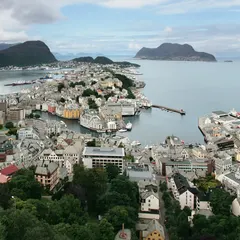
Brosundet is the strait dividing the two central islands of Ålesund, Aspøya and Nørvøya, crossed today by the Hellebroa bridge. When the old medieval trading post at Borgund faded away around 1500, the fishing settlement gathered around this sheltered channel, and the present-day town grew out of it. The rise that followed was administrative: limited loading-port rights in 1793, full rights in 1824, and market-town status (kjøpstad) in 1848, always with this natural harbour as its axis.
The word to learn here is klippfisk, literally 'rock fish': cod salted and then dried in the open air on the bare stones of the coast. In the second half of the nineteenth century, as the fleet grew, klippfisk became Ålesund's main export and opened an intense trade with southern Europe and South America. The wooden warehouses — the sjøbuer — that lined this canal burned along with almost the whole town in January 1904 and were rebuilt afterwards; today they hold hotels, restaurants and shops, their walls still rising straight out of the water.
Highlights
- The sjøbuer of the canal — Former fish warehouses given new uses, their walls built to the very edge of the water
- Hotel Brosundet — Peder Devold's 1904 pakhus by J. Z. M. Kielland, converted by Snøhetta in 2007
- Fiskerimuseet (Holm-bua) — A sea warehouse from around 1858, the best-preserved group of buildings from before the fire
- Cod liver oil — The Oluf Holm AS industry that exported on a large scale from Molovegen
- Molja lighthouse — The red 1858 tower at the mouth, automated since 1889 and still burning
Ålesund is visited for its façades, but it is understood through its water. Brosundet is the strait that splits the centre in two, a still arm of the sea between the islands of Aspøya and Nørvøya in which the town has its literal origin: when the medieval trading post at Borgund faded out around 1500, the fish people gradually gathered in this sheltered inlet where boats could come in and lie quiet. The secret history of Brosundet is that of an urban centre that was never a square but a quay, and that still works as one.
The administrative milestones arrived late and confirmed the obvious: limited loading port in 1793, full port in 1824, market town in 1848. What held all of it up was dried, salted cod, the klippfisk exported to southern Europe and South America. To grasp what to see at Brosundet, the canal is best walked from the inside out, from the inner quay to the mouth, which is the order in which the EarGuide audio guide tells it: four stops, from the fish to the light.
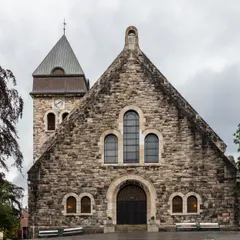
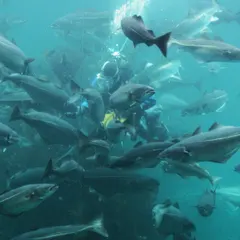
A few steps from the canal is the Art Nouveau Centre, Ålesund Church is close by, and the sea that flows in through Brosundet can be seen up close at the Atlantic Sea Park.
The heart of Ålesund is water
Brosundet
Summary of this stop
The first stop stands on the inner quay of the canal, where the two banks almost touch. What lies in front of the visitor is not a decorative feature of the town but its real centre: a strait, an arm of the sea separating the two islands on which the old town rests. In the Middle Ages the area’s trade was carried on further east, at Borgund; around 1500 that post faded and the activity moved here, to this sheltered anchorage. Ålesund began as exactly that: a good place to tie up a boat.
What was tied up was, almost always, cod. Klippfisk — “rock fish” — is cod split, salted and laid out to dry in the open air on the bare stones of the coast until it is hard as a plank and able to survive months of travel. It is not a culinary detail: it is the economic engine from which much of what can be seen here came.
Seen with that idea in mind, the canal changes meaning. The water does not accompany the town, it explains it; every wall that steps into Brosundet is there because of the fish. How that drying cycle worked, and what had to happen for a cod pulled from this sea to end up on a table in Lisbon or Rio, is what the narration deals with at the start of the route.
The warehouses that burned and came back
Hotel Brosundet
Summary of this stop
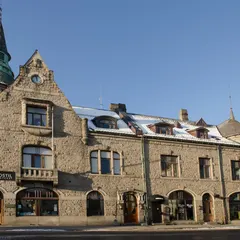
The second stop is taken in front of Hotel Brosundet, at Apotekergata 5, with the water lapping directly at the base of the building. The house was raised in 1904 as a pakhus — a warehouse — for Peder Devold’s fish trading company, to a design by the architect Jens Zetlitz Monrad Kielland, and served as a fish store until the nineteen-eighties. In 2007 the Snøhetta studio turned it into a hotel without erasing its warehouse condition.
The whole row shares the same biography. The wooden sjøbuer that lined the canal burned along with almost the entire town in the great fire of January 1904 and were rebuilt in the years that followed; today those fish and goods warehouses hold hotels, restaurants, shops and apartments, and still raise their walls from the very edge of the water. It is the reason Brosundet is considered the true centre of Ålesund: it has not changed place, only trade.
And the turn has its wit. The old pakhus of Hotel Brosundet is summed up by saying that the warehouse takes in fresh seafood again, just as it did a hundred years ago, only now it goes to the table instead of to export. The same gesture — fish coming in from the water — repeated a century later with another meaning says a good deal about what has happened to this town, and the audio guide develops it right in front of the façade.
The fish that made the city, and its price
Fiskerimuseet
Summary of this stop
The third stop pauses at Molovegen 10, before the Fiskerimuseet, the Fisheries Museum. It occupies the so-called Holm-bua, a sea warehouse raised by consul Frederik Hanssen around 1858, and its importance goes beyond the collection: it is the best-preserved group of buildings in Ålesund from before the 1904 fire. In a town where practically everything is the same age, these walls are an exception.
The street also tells of another industry. When the firm Oluf Holm AS took over the Molovegen warehouse and a good part of the neighbouring buildings, it went into the large-scale production and export of medicinal cod liver oil, another of the businesses that grew straight out of the sea. Nothing of the fish was wasted, and each by-product opened a new export line.
Beneath that prosperity lies a harder story that the postcard does not show. The wealth piled up here came out of the sea in winter, and that sea took its share: on the Sunnmøre coast, as throughout Norway, fishing was as important as it was dangerous, and for generations the town depended on men who gambled their lives on every trip out. Behind every bale of exported klippfisk were boats that did not come back. How that risk was lived with from land, and what remains of it in the museum, is the part the narration keeps for the interior.
Sleeping inside a lit lighthouse
Molja fyr
Summary of this stop
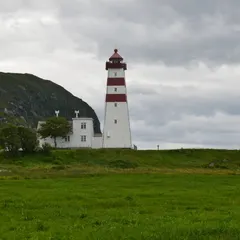
The last stop walks to the end of the breakwater, where the Molja lighthouse stands. The tower was built in 1858 as a small light at the tip of the mole to mark the mouth of Brosundet — molje is the Sunnmøre dialect word for breakwater — and the State, through the Fyrvesenet, took over the Ålesund harbour light in 1877, automated it and left it unmanned in 1889. It is painted red and is the municipality’s millennium site, the tusenårssted.
More than 150 years after it was built it still does its job: the beacon, automated since 1889, remains lit at the mouth, guiding boats towards the inner harbour. In a canal where almost everything has changed use, that makes it the most continuous element of the route.
And the most unusual. The tower, barely a small room at the end of the mole, is today room number 47 of Hotel Brosundet, redecorated by Snøhetta; unlike almost every lighthouse turned into accommodation, this one is still a working lighthouse, with the light running while the guest sleeps and breakfast arriving on foot along the breakwater from the main building, some four hundred metres back. What it is like to spend a night inside a lit navigation light, facing the open Atlantic, is the closing the EarGuide audio guide saves for the end of the mole.