
Atlantic Lighthouse
Alnes Lighthouse Audio Guide (Alnes fyr)
A red-and-white striped wooden tower on the far tip of the island of Godøya, facing the open Atlantic. It began as a lantern holding four candles and is today one of the most visited lighthouses in Norway, with a café and a gallery in the keeper's house.
- 7 min of audio
- Coast and Islands
Alnes Lighthouse stands on Alnestangen, the north-western point of the island of Godøya in the municipality of Giske, some 27 kilometres from Ålesund, with open sea in front of it and no land to shelter it all the way to the horizon. Below it lies Alnes, for a long time the largest fishing village — the largest fiskevær — in all of Sunnmøre. The way there runs through a chain of undersea tunnels; the last of them, the Godøytunnelen, opened in 1989, is 3,844 metres long and drops to 153 metres below sea level.
The tower visitors climb today is not the one usually quoted. Many tourist sources speak of the 'lighthouse of 1876', but that year marks the appointment of the first permanent keeper, when the light went over to continuous operation; the present tower — the fourth raised on this point — was built in 1937: some 22.5 metres of timber over a load-bearing frame of angle iron, painted in red and white stripes so as to stand out against a grey sky or snow. Its character is Oc(2) 8s, with a range of about 16 nautical miles for the white light.
Highlights
- The 1937 tower — 22.5 metres of timber over an angle-iron skeleton, in red and white stripes
- Oc(2) 8s — An occulting light with a range of about 16 nautical miles for the white sector
- The keeper's house — A cultural centre since 1993, with a café, an art gallery and a lighthouse exhibition
- Paintings by Ørnulf Opdahl — The landscape painter of this light, resident on Godøya since 1971, donated the display inside the tower
- The Godøytunnelen — 3,844 metres and 153 metres below the sea to reach the island from Ålesund
Reaching Alnes Lighthouse means passing underneath the sea. Godøya is linked to Ålesund by a chain of undersea tunnels, and the last of them, the Godøytunnelen opened in 1989, runs for 3,844 metres and descends to 153 metres below the surface before returning the visitor to daylight. At the end of the island, on the north-western point, Alnes opens out: a handful of low houses pressed against the rock, a small harbour and, planted above everything else, a wooden tower in red and white stripes.
The secret history of Alnes Lighthouse begins with something far humbler than that tower: four candles set inside a lantern around 1852–1853, a private light so that the boats could find the harbour mouth. Understanding what to see at Alnes Lighthouse means following that path from fragility to permanence, from the village to the tower and from the lantern to the café in the keeper’s house — the four-stop route that the EarGuide audio guide accompanies.
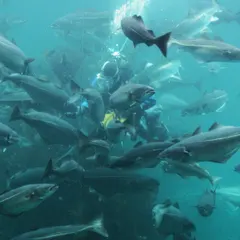
Back in Ålesund, the Atlantic Sea Park shows life beneath the same ocean, and the best view of the town is from the Fjellstua viewpoint.
The largest fishing village in Sunnmøre
Alnes
Summary of this stop
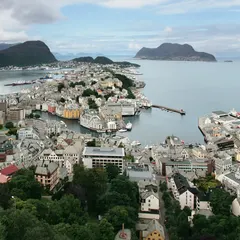
The first stop is taken down below, in the harbour of Alnes, before looking up at the tower. What the visitor finds is a quiet cluster of houses on the north-western point of Godøya, in the municipality of Giske, some 27 kilometres from Ålesund; what would be hard to guess is that this corner was for a long time the largest fishing village in all of Sunnmøre, the coastal region south-west of the city.
Life here depended on what lay straight ahead, and straight ahead there is no sheltered fjord and no calm bay: there is open Atlantic, with nothing to stop it as far as the horizon. That sea provided the living and with it the danger, and a village hanging off the last point of land needed, above almost everything else, a signal to tell the boats where home was.
The modern approach tells another story: that of an island community which stopped depending on the boat when the Godøytunnelen, with its 3,844 metres and its maximum depth of 153 metres, connected it by road in 1989. How a fishing village changes once it can be reached by car from under the water is one of the questions the narration raises before the climb up to the foot of the tower.
The light that went out and came back
Alnes fyr
Summary of this stop
The second stop stands at the base of the wooden tower. The tower looks solid, but inside it is a skeleton of angle iron dressed in boards, painted in red and white stripes to stand out against a grey sky or snow; it rises some 22.5 metres, and looking out from the top has to be earned up a narrow, steep staircase. It is the fourth light raised on Alnestangen and it was built in 1937, a date worth holding on to because it contradicts the commonplace.
Numerous tourist sources refer to the “lighthouse of 1876” as though the visible tower dated from that year. Norwegian sources document something else: 1876 is the year a permanent keeper was appointed and the light went over to continuous operation, not the year of the tower now climbed. Before that, the Alnes light had begun around 1852–1853 as a private lantern of barely four candles set in a small lamp housing, to help the boats find the mouth of the harbour.
That beginning was fragile and troubled. Local accounts record that there were years, around the 1860s, when the light simply went out: with no funds and with the authorities unconvinced of its importance, the point fell dark again. Only when it became clear how many vessels depended on this corner of the island was the permanent keeper of 1876 secured. Modernisation came later: in 1928 the old gas and paraffin light was replaced by an electric lamp fed from the municipal grid, and today the character is Oc(2) 8s with a range of about 16 nautical miles. That the safety of a whole village should have hung for a time on a budget argument is one of those things that sounds different when heard at the foot of the tower.
The sea that gives and takes away
Alnestangen
Summary of this stop
The third stop comes at the top, on the lighthouse gallery, after the staircase. From here the horizon opens all the way round and the position of the place is grasped at once: to the north-west, the Atlantic with no land to interrupt the water; on the other side, the jagged summits of Godøya and the neighbouring islands. The lighthouse was raised for exactly this, to guide the fishing fleet safely back to the harbour of Alnes from an exposed point with no shelter of any kind.
Seen from the lantern, the bargain this coast keeps with the sea lies in plain view. The same ocean that fed people carried boats away, and the difference between returning and not returning could come down to whether that light was lit. For more than a century, someone had to live up here to guarantee it.
That ended in 1982, when the lighthouse was automated and the last keeper left; since then the tower has belonged to the municipality of Giske. The emptiness left by a keeper’s house without a keeper — and what is lost when a light no longer needs anyone — is the note the audio guide leaves hanging before the descent.
The house that lit up again
Alnes fyrkafé
Summary of this stop
The final stop goes down to the white wooden building at the foot of the tower, the keeper’s former home. After an extensive restoration, the complex has worked since 1993 as a cultural centre, with a café, an art exhibition room and a display on the history of lighthouses. The house emptied in 1982 filled up again, though with a different trade.
Inside the tower there is also a surprise the visitor passes on the way up. The paintings hung along the staircase are the work of Ørnulf Opdahl, one of the great Norwegian landscape painters, born in Ålesund in 1944 and resident on this same island of Godøya since 1971. Opdahl has spent half a lifetime painting precisely the low, greyish light of the Sunnmøre sea — the one in front of the gallery — and donated to the centre the exhibition that hangs inside the lighthouse: the climb is made looking at, on canvas, the same light that a moment later is seen for real at the top.
Below, the café has become known for its home baking and above all for its lighthouse cake, the fyrlagkake, which has turned into an attraction in its own right: there are people who cross the undersea tunnels to Godøya as much for the view from the tower as to sit down with a slice facing the sea. A lighthouse born so that people would not die in the Atlantic, and which today draws visitors for a cake, sums up the full turn the place has taken without any solemnity — and it is exactly where the EarGuide narration closes the route, with the tower lit up behind.