
Art Nouveau
Art Nouveau Centre Audio Guide (Jugendstilsenteret)
The old Swan Pharmacy holds the best preserved Art Nouveau interior in Ålesund and explains, inside a single building, how a wooden town burned in fifteen hours and rose again in three years. This is what to see at the Jugendstilsenteret.
- 8 min of audio
- Jugendstil architecture
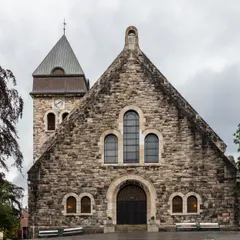
The Jugendstilsenteret occupies the former Swan Pharmacy, the Svaneapoteket at Apotekergata 16, a building that the architect Hagbarth Martin Schytte-Berg (1860-1944) designed and built between 1905 and 1907 on ground still warm from the fire. It is one of the most recognisable Jugendstil pieces of the rebuilt Ålesund: granite dressed in two textures, one fine and one rough, and undulating cornices that in 1907 resembled nothing this coast had seen before.
In 1984 it became the first Jugendstil building in the town to be listed as a protected monument, and since 6 June 2003 — when Queen Sonja of Norway opened it — it has housed the Norwegian national centre for Art Nouveau, sharing its entrance with the KUBE art museum, installed in the former Norges Bank branch of 1906. The detail that unsettles almost everyone who stops in front of the façade is not the swan of the name: it is the owl, the bird of knowledge, tangled among ornaments in the Urnes style, the medieval repertoire of the Norwegian stave churches.
Highlights
- Granite façade — Stone dressed fine and rough, with the undulating cornices that defined the town's Jugendstil
- The owl and the Urnes style — A decorative programme that crosses European Art Nouveau with medieval Norwegian ornament
- The pharmacy interior — Cabinets and rooms designed by Schytte-Berg himself; the most complete Art Nouveau ensemble in Ålesund
- The Time Machine — The multimedia installation 'From ashes to Art Nouveau' that recreates the night of 23 January 1904
- KUBE — The neighbouring art museum, in the former Norges Bank branch of 1906, with a shared entrance
Some towns explain themselves in a square, and some explain themselves in a building. Ålesund belongs to the second group, and that building stands at Apotekergata 16. The old Swan Pharmacy — Svaneapoteket in Norwegian — was raised by Hagbarth Martin Schytte-Berg between 1905 and 1907, barely a year after the fire had carried off almost the entire town, and today it houses the Jugendstilsenteret, the Norwegian national centre for Art Nouveau. The secret history of the Jugendstilsenteret is not in its display cases but in the coincidence between what it tells and what it is: a museum about a catastrophe installed inside the answer to that catastrophe.
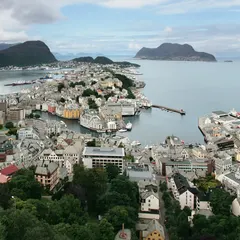
The figures help measure the leap. In the early hours of 23 January 1904 some 850 houses burned and barely 230 were left standing; by the end of 1907 there were 675 new buildings, 391 of masonry and 284 of wood. Working out what to see at the Jugendstilsenteret is, in practice, learning to read the rest of Ålesund: the architecture of the Jugendstilsenteret works as a key to the whole stone town that begins the moment one steps out of its door. The full route, with its four stops chained from the pavement to the interior, is the one the EarGuide audio guide accompanies on site.
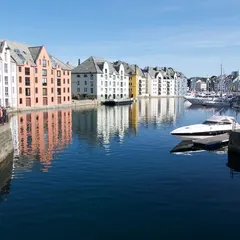
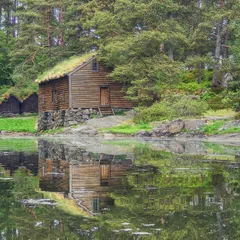
A stone’s throw away, the Brosundet Canal is the heart of the rebuilt town, and the region’s traditional way of life is preserved at the Sunnmøre Museum, with its old houses and boats.
The Swan Pharmacy, decorated with owls
Jugendstilsenteret
Summary of this stop
The first stop sits on the pavement of Apotekergata, facing the granite façade. Visitors find a building that is small for what it represents, planted on its corner with a self-assurance that needs no extra metres: the stone appears dressed in two different finishes, one fine and polished, the other coarse and rough, and above, the cornices resolve into undulating lines that at the time had no precedent in the town. Schytte-Berg did not draw the walls alone; he conceived the whole house as a single piece, from the stone on the street to the last cabinet inside.
That obsessive care had consequences. In 1984 this property became the first Jugendstil building in Ålesund to be listed as a protected monument, an acknowledgement that it preserves the most complete Art Nouveau ensemble in the town. Of all the houses a visitor will walk past afterwards, this was the one the country decided to shield before any other.
And here the play of the gaze that gives the stop its name appears. The animal that governs the decoration is not the swan of the sign but the owl, the bird associated with knowledge, hidden among ornaments inspired by the Urnes style, the medieval repertoire of the Norwegian stavkirker. That crossing — a swan’s name, the wisdom of the owl and the imagery of the Viking wooden churches — sums up the Norwegian road to Art Nouveau, which instead of simply copying Paris or Vienna reached for the country’s own dragons and interlace. Spotting the owl is easy; what it means that it is there, and not some other animal, is what the narration unpicks in front of the stone.
The night all of Ålesund burned
Apotekergata
Summary of this stop
The second stop barely requires moving: it is enough to turn on one’s heels and look down Apotekergata. What lines up on either side — stone façades, turrets, wrought iron — is all exactly the same age, and that uniformity is the scar. Around two in the morning on 23 January 1904 a fire broke out at the Aalesund Preserving Co. cannery, on the island of Aspøya. A south-westerly gale did the rest: in some fifteen hours, a wooden town packed onto two islands was reduced to ashes.
The numbers still impress more than a century later. The fire destroyed close to 850 houses and left barely 230 standing; more than 10,000 of the roughly 12,000 inhabitants were left without a roof in the depth of the Norwegian winter. And yet there was only one fatality: Ane Heen, aged 76, who went back into her burning house to look for her handbag. A single death in a levelled town is a statistic that is hard to absorb, and it is that disproportion that turns the story of the fire into something more than a date.
The exact origin of the fire was never established with certainty. The version most repeated in the town holds that it all began when a cow kicked over a lantern or a paraffin lamp in the cannery, but the cause was never proven and is still debated. Whether that cow existed or not is probably the detail best enjoyed while listening to the narration on the very spot where it all started.
From the ashes, a city in three years
Tidsmaskinen
Summary of this stop
The third stop moves inside the building, into the near-total darkness of the Time Machine (Tidsmaskinen), the multimedia installation titled Fra aske til jugendstil — “From ashes to Art Nouveau” — where projected firelight and the roar of the gale rebuild the night of 1904 and what came afterwards. And what came afterwards was a reconstruction at dizzying speed: between 1904 and 1907 Ålesund remade itself almost entirely in the Jugendstil style, with 675 new buildings raised on a new town plan drawn up by the municipal engineer Fredrik Næser.
The feat has an unusual generational component. The work brought together around thirty architects, most of them trained in Trondheim and in Charlottenburg (Berlin), and very young: among the qualified ones the average age was around 33, the youngest, Olaf Larsen, was 21 and the oldest, Karl Norum, 52. They received all at once the opportunity almost no architect gets in an entire career — designing a whole town, street by street, in the style of the moment — and that explains the Jugendstil coherence, uncommon in Europe, that distinguishes Ålesund today.
Help also arrived from outside, and by sea. Wilhelm II of Germany, who used to spend his summers in the Sunnmøre fjords, sent four ships loaded with personnel, food, medicines and material to put up barracks and temporary shelters. In gratitude, one of the main streets of the rebuilt town is still called Keiser Wilhelms gate today. How imperial generosity, Næser’s plan and a crew of near-beardless architects fit into a single three-year story is what the installation — and the audio guide alongside it — finishes putting in order.
The intact interior and the machine that goes dark
Jugendstilsenteret og KUBE
Summary of this stop
The last stop leaves the darkness behind and moves into the preserved rooms of the old pharmacy office. Here visitors find what almost never survives in an Art Nouveau building: the complete interior. Schytte-Berg designed what is inside from top to bottom, including the wooden cabinets that cover the walls, and that ensemble remains the best preserved Art Nouveau interior in Ålesund. The waxed wood absorbs the sound of footsteps and the atmosphere changes abruptly from the cold stone of the street.
From these rooms one reaches the KUBE art museum, installed in the former Norges Bank branch of 1906, next door to the building. The two houses have shared an entrance and a management since Queen Sonja of Norway opened the centre on 6 June 2003: a bank from the year after the fire and a pharmacy from two years after it, joined today by the same door.
There is, besides, a note of melancholy at this stop. The Time Machine, which has told this story for more than twenty years to hundreds of thousands of visitors, faces its final season, with closure scheduled for 31 October. An installation about the disappearance of a town that is itself disappearing carries an echo that is hard to ignore, and it is exactly where the EarGuide narration closes the circle before returning the visitor to the streets the fire made possible.