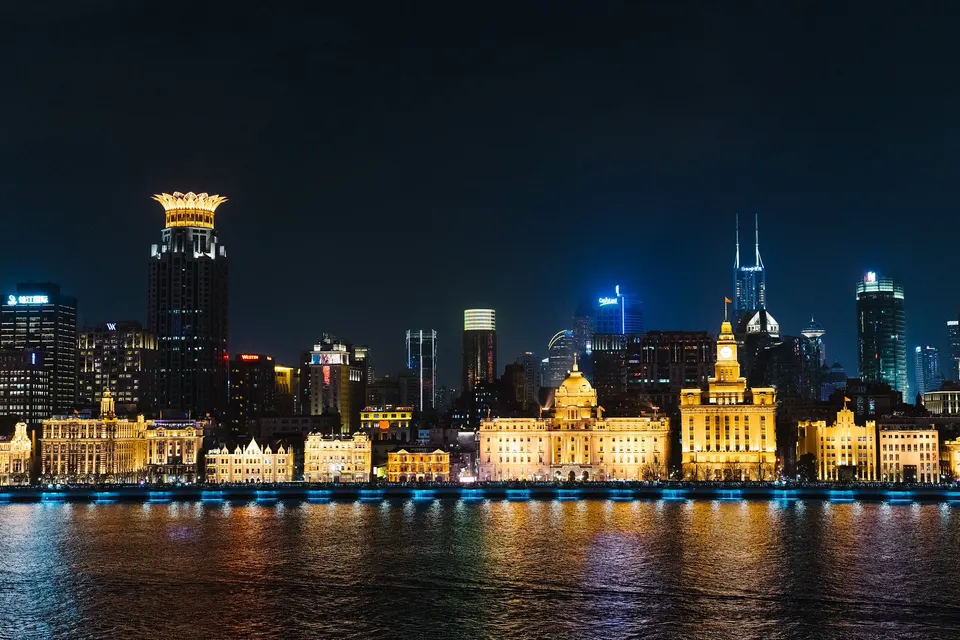
Concession-era waterfront
Bund Audio Guide (Waitan)
A mile of banks, customs house and stone hotels raised on a former mudflat of the Huangpu, facing the skyscrapers of Pudong: the showcase of concession-era Shanghai, with a clock whose tune has changed with every political turn.
- 60 min of audio
- Concession-era architecture
Before 1843 this bank was a mudflat, the Huangpu Tan. The stretch beside the old walled city and north of it was called Waitan, the “outer bank”, as opposed to the “inner bank” to the south. From 1844 its northern part was a British concession, and in 1848 the street was paved and the embankment reinforced and christened the Bund, a word of Hindustani origin meaning dyke or embankment. Along that embankment rose banks, a customs house and stone hotels, to the point that in 1935 the Bund held 50.72% of the paid-up capital of China's banks, 61% of the country's cash reserves and 77.84% of its deposits.
The Customs House clock tells the rest of the story by itself. It chimed the Westminster quarters from 1928, switched to “The East Is Red” in the 1960s, went back to Westminster in 1986 for Elizabeth II's visit, dropped to a single chime in 1997 ahead of the handover of Hong Kong, and since 1 May 2003 has played “The East Is Red” again. Across the river, the skyscrapers of Lujiazui look back at the row of granite that the concession banks put up.
Highlights
- Customs House clock tower — Four 5.3-metre dials and bells whose tune has changed with every political turn
- Former HSBC building — A dome on Ionic columns, two bronze lions with names of their own and mosaics saved under stucco
- Green pyramid of Sassoon House — The 1929 Peace Hotel on the corner of Nanjing Road, setting of the Bloody Saturday of 1937
- Waibaidu Bridge — The steel bridge that was the border with Japanese-occupied Hongkou between 1937 and 1941
- Signal tower — An iron ball marked noon; in 1993 the whole tower was moved 22.4 metres toward the river
On the west bank of the Huangpu River, between the Waibaidu Bridge and the signal tower on Yan’an Road, stretches the Bund (外滩, Waitan): a mile-long waterfront where the foreign concessions lined up banks, a customs house and stone hotels facing the bank that the Pudong skyline now occupies. It was the showcase of treaty-port Shanghai, and in that stone stage set every political turn in China has left its mark.
The history of the Bund begins in the mud. Before 1843 the riverbank was a mudflat; from 1844 its northern part was a British concession, and in 1848 the street was paved and the bank reinforced. In 1868 the Public Garden, today Huangpu Park, opened at its northern end, and in 1935 this street held 77.84% of China’s bank deposits. From the 1950s most of its buildings passed to state and municipal bodies, and the statues of foreign figures on the waterfront were removed; in 1994 the municipality set up a company to swap the buildings and return the Bund to banking. The waterfront itself changed shape too: a flood wall in 1959, a major overhaul in 1992–1993 and another between 2008 and 2010, which buried six lanes in a tunnel and reopened the promenade on 28 March 2010, on the eve of the Expo.
The architecture of the Bund is that of the golden years of the concessions. The firm Palmer & Turner signed the HSBC building (1921–1923), the largest bank building in the Far East, and the Customs House (1925–1927), with its clock tower; Victor Sassoon raised Sassoon House between 1926 and 1929, 77 metres to the cornice and topped with a copper pyramid that is now green; beside it, the Bank of China combines Art Deco with a Chinese-flavoured crown. How many buildings make up the ensemble depends on the criterion: the popular figure says 52, the 1996 national monument listing counts 27 along 1.3 kilometres, and the extended area of interest adds up to 115 heritage buildings.
To know what to see on the Bund, the audio guide walks it from north to south in five stops and 60 minutes: from the Waibaidu Bridge to the signal tower, via the Peace Hotel, the Customs House and the former HSBC. There is a single thread: this granite showcase raised on a mudflat has been a border, a stage for tragedies and a political prize, and every turn in China has left a mark here that can still be seen and heard.
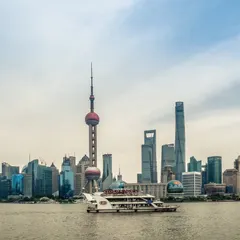
Just across the Huangpu, directly opposite, rises the Oriental Pearl Tower; a little over a kilometre to the south lies the Yu Garden, in the old Chinese city, and to the north, in Hongkou, the Shanghai Jewish Refugees Museum.
A mudflat, a garden and a border bridge
Waibaidu Bridge
Summary of this stop
The route starts at the southern end of the Waibaidu Bridge, the Garden Bridge, the steel structure over Suzhou Creek that closes the Bund to the north and was restored in 2008–2009. Beside it stood a concrete bridge from 1991, pulled down in the 2008–2010 overhaul that rebuilt the 10-lane avenue on two levels: six lanes went into a new tunnel and the freed space widened the promenade. On this bank, which before 1843 was a mudflat, the embankment that gave the place its name was reinforced in 1848: Bund, a dyke in a word of Hindustani origin.
Next to it lies the green triangle of Huangpu Park, the former Public Garden opened in 1868 and the oldest park in Shanghai, dominated today by the abstract concrete tower of the Monument to the People’s Heroes, from 1993. Chinese people had no official access to it until 1 July 1928. Its gate also carries a deeply rooted symbol of national humiliation, the sign “No dogs and Chinese”, although photographs of the period show something else: a set of ten rules in which the first reserved the garden for the foreign community and the fourth banned dogs and bicycles. The exclusion was real; the literal phrase, according to those images, was not.
The bridge has a dark history of its own. Between 1937 and 1941 it was the de facto border between the International Settlement and the Japanese-occupied district of Hongkou, and Japanese sentries made those crossing take off their hats and bow; in 1937, with refugees fleeing the fighting, a witness called it “the bridge of life”. Even its Chinese name is disputed: the popular explanation speaks of a hated toll and a free bridge opened alongside in 1873, but some explain it otherwise. Beside the steel of the Waibaidu, the audio guide tells what it meant to cross these few metres.
The green pyramid and the Saturday of 1937
Statue of Chen Yi
Summary of this stop
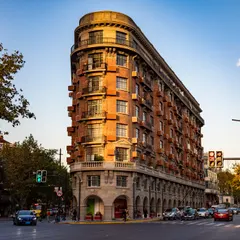
On the square that opens in front of Nanjing Road, the only bronze statue on the Bund depicts Chen Yi, the first Communist mayor of Shanghai. Above it rises the copper pyramid, oxidised to a pale green, of Sassoon House, built by Victor Sassoon between 1926 and 1929, with the Cathay Hotel and the magnate’s private penthouse; since 1956 it has been the Peace Hotel. It was here that Noël Coward, convalescing from flu, typed the final version of “Private Lives”, the comedy he would premiere in 1930 with Gertrude Lawrence. And in its bar the Old Jazz Band has played every night since the end of 1979, made up of veterans of Shanghai’s jazz scene who had to stop playing between 1965 and the late seventies, and which, with an average age of 82, has appeared in the Guinness book as the oldest jazz band in the world.
Right beside the hotel, the Bank of China is visibly lower than the pyramid. The difference is attributed to Sassoon: the Chinese account holds that the 34-storey project was cut to 17, about 30 centimetres below his roof, after a lawsuit settled in London, while the English version records it only as an attribution, without documenting the lawsuit.
This crossing was also the setting of two tragedies. On Saturday 14 August 1937, bombers of the Chinese air force trying to hit the Japanese cruiser Izumo, anchored on the Huangpu, missed their target and their bombs fell on Nanjing Road, between the Cathay and the Palace Hotel, on a crowd of civilians and refugees; the clock opposite the Cathay stopped at 16:27. This is the “Bloody Saturday”, whose death toll, adding another bomb near the Great World, ranges from more than 1,200 to about 2,000. And at around 23:35 on 31 December 2014, a crush on the stairs leading up to the riverside platform on this same square killed 36 people among some 300,000 gathered to welcome the New Year. Beneath the green pyramid, the narration joins the glamour and the mourning of the same corner.
A clock that changes its anthem
Shanghai Customs House
Summary of this stop
Above the granite building at No. 13 rises the stepped tower of the Customs House, with four dials 5.3 metres in diameter. The site has been collecting customs duties since 1846: first a Chinese-style yamen, then a temple-type building in 1857, another “church-type” one with a clock tower in 1893 and, finally, the present one, built between 1925 and 1927 by Palmer & Turner, which still works as a customs house.
The clock was made in England, with bells by John Taylor, the largest of 6 tonnes, and a mechanism by J. B. Joyce & Co. It arrived from London in August 1927, and its 6.25-tonne case was hoisted more than 72 metres while pedestrians on the Bund stopped to watch; it struck its first chime on 1 January 1928. Since then its tune has followed the political wind: Westminster, “The East Is Red” in the 1960s (during the Cultural Revolution the dial was remade with a sunflower), Westminster again in 1986, a single chime in 1997 and “The East Is Red” once more since 2003. There are nuances: a mechanism copied from Big Ben cannot play that anthem, which sounded as a recording over loudspeakers, and according to the English version the bells stopped playing a tune in October 2018, so its current state is unclear.
In front of the door, the esplanade is empty. From 1927 the statue of the inspector general of customs Robert Hart stood there, removed in September 1943. Before the tower, the audio guide lets the history of China ring out in the chimes of an English clock.
Lions with names and hidden mosaics
Former HSBC building
Summary of this stop
Next to the Customs House, No. 12 unfolds a neoclassical granite façade with a central dome on six Ionic columns. This is the former HSBC building, by Palmer & Turner, built between 5 May 1921 and 23 June 1923: at 23,415 square metres it was the largest bank building in the Far East and was called “the most luxurious building from the Suez Canal to the Bering Strait”. From the 1950s it was the seat of the Municipal People’s Government; today it is occupied by the Shanghai Pudong Development Bank.
On either side of the stairway two bronze lions stand guard, one roaring and one serene. The originals were cast in England from models by Henry Poole for the 1923 inauguration, and each carries the name of a manager: Stephen, the roaring one, after Alexander Stephen, and Stitt, the serene one, after Gordon Stitt. They were removed in 1966, have been in the Shanghai Museum since 1980, and the ones at the door are replicas from 1997. Passers-by used to rub their paws to attract good luck and prosperity, the same custom that has worn the bronze of the lions at the bank’s headquarters in Hong Kong.
Inside, the ceiling of the octagonal lobby holds eight mosaics of cities where HSBC had a branch, among them Shanghai, Hong Kong, Tokyo, London, New York and Bangkok; access depends on the bank’s opening hours. In 1956 an architect had them covered with stucco and paint to save them from destruction, and they did not reappear until the restoration of 1997. On the stairway, the audio guide tells how they survived.
The tower that moved 22 metres
Gutzlaff Signal Tower
Summary of this stop
At the southern end, beside Yan’an Road, rises the slender brick tower of the Bund signal station, also known as the Gutzlaff tower. At the mouth of the old Yangjingbang, the station announced the weather and the time from 1 September 1884, and every noon a large iron ball slid down its mast. The present tower was built between 1907 and 1908, and in 1993 it was moved whole 22.4 metres toward the river.
That move was part of the 1992–1993 overhaul, which pushed the bank out tens of metres over the Huangpu and erased the 1959 flood wall: 25 centimetres wide and 4.80 metres high. It was called the “lovers’ wall”, because from the 1970s couples, with no privacy in homes shared by several generations, met leaning against it. In its place came the raised promenade with a historicist balustrade that is walked today.
Around the same time, the banks began to return. From the 1950s most of the Bund’s buildings had been in the hands of state and municipal bodies; in 1994 the municipality set up a company to swap them and give them back to banking, and in July 1995 the Everbright Bank opened at No. 29 as the first to return. Opposite, the skyscrapers of Lujiazui complete the scene, and beside the tower the audio guide closes the route with the city that came afterwards.