Synagogue and memorial
Shanghai Jewish Refugees Museum Audio Guide
An Ashkenazi synagogue of 1927 on the former Ward Road, in the heart of the Hongkou ghetto, turned into the only memorial in China devoted to the nearly 20,000 Jews who escaped the Nazis to Shanghai, with the streets of the old ghetto still inhabited all around.
- 60 min of audio
- Hongkou ghetto
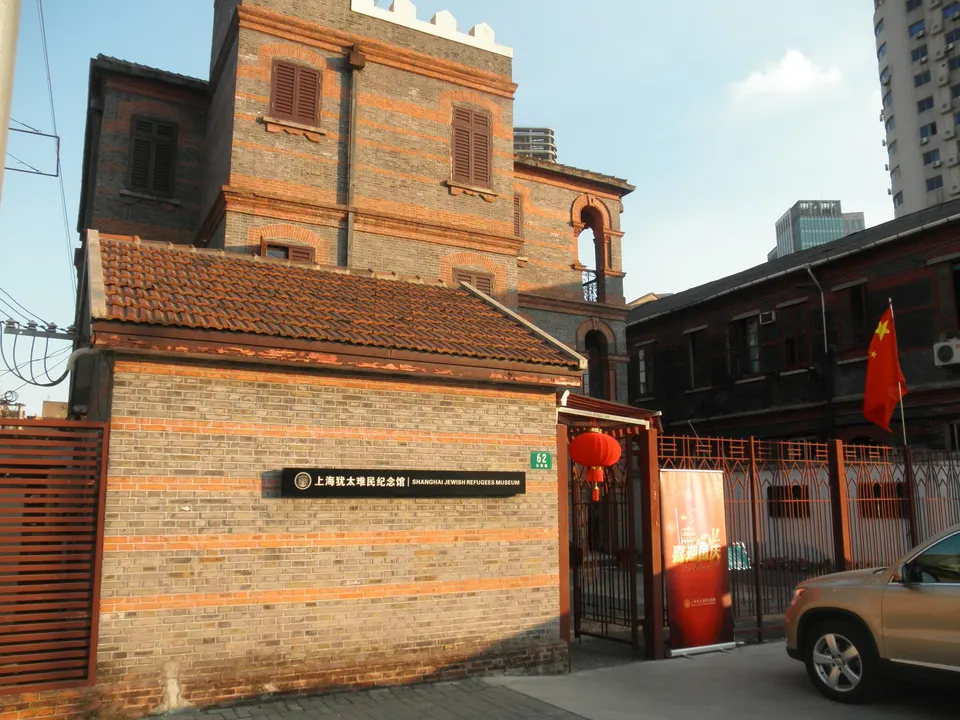
The Ohel Moshe congregation was born in 1907 in a rented room of Russian Jewish immigrants and took the name of one of them, Moshe Greenberg. In 1927 that community raised funds for a three-storey building with 300 seats at 62 Ward Road, today Changyang Road, also known as the Ward Road Synagogue. It closed in 1956, when almost all of Shanghai's Jews had left, and was a factory, a psychiatric centre and an air-defence office until in 2007 it was restored to its original plans and became the core of the museum.
In the 1930s and 1940s some 20,000 European Jews fleeing Nazi persecution reached Shanghai, by sea or by land, many with visas like those issued in Vienna by China's consul general, Ho Feng-shan. In February 1943 the Japanese authorities forced many of them to move to a restricted zone of less than 3 km² in Hongkou. Today a wall gathers 19,672 of their names and leaves a stretch blank for those still missing.
Highlights
- Ohel Moshe Synagogue — Three storeys raised in 1927 by the Russian Jewish community on the former Ward Road
- Rebuilt ark — A white semicircular dome remade in 2024 from photos of the 1920s
- Whistle and handbag — The self-policing whistle of 1943 and a handbag left as a pledge in 1940
- Wall of names — 19,672 refugees since October 2025 and a blank stretch for those still missing
- Huoshan Park — A 1994 monolith in Chinese, English and Hebrew marking the limits of the refugee zone
In the Tilanqiao district, on the street that used to be called Ward Road and today is Changyang Road, stands the Shanghai Jewish Refugees Museum (上海犹太难民纪念馆, Shanghai Youtai Nanmin Jinianguan). Its core is the former Ohel Moshe Synagogue, built in 1927 by the city’s Russian Jewish community, and its subject is the story of the nearly 20,000 European Jews who found in Shanghai their last port. It is the only memorial in China devoted to them, and it is not isolated: it is surrounded by the very streets of the old ghetto, still inhabited.
The history of the Shanghai Jewish Refugees Museum begins long before the war. The Ohel Moshe congregation was born in 1907 in a rented room; in 1926, according to the community’s documented tradition, the Hasidic rabbi Meir Ashkenazi, who had been a rabbi in Vladivostok, was only passing through on his way to the United States when he was asked to stay. Following the advice of the Lubavitcher Rebbe he accepted, pushed in 1927 for the new space for Ohel Moshe and was chief rabbi of Shanghai until 1949; the museum devotes an exhibition to him. The synagogue closed in 1956, was restored in 2007 to become a museum and between 2017 and 2020 grew to exceed 4,000 m² and almost 1,000 items, against a little over 1,000 m² and 150 items before. Even the figures of that memory have nuances: the museum speaks of some 20,000 refugees, other sources of more than 20,000 and some texts of 18,000.
The architecture of the Shanghai Jewish Refugees Museum is that of a neighbourhood building: three storeys with a gallery, exposed grey brick walls and a pointed red-brick roof. A 2024 restoration closed it for more than half a year and reopened it on 1 January 2025 with its mosaic and red-tile floors cleaned and relaid according to historical photos and plans. Around it, two houses where refugees lived have been turned into galleries, and on the same street still stand the former Ward Road refuge, in lane 138, which could house nearly a thousand refugees with a communal kitchen and a hospital and is today a group of ordinary dwellings, and, a few blocks away, the high wall of Tilanqiao Prison, the old Ward Road Gaol.
The memory of the district also holds its blackest days. As survivors recall, on 17 July 1945, under an overcast sky, American bombers arriving from Okinawa dropped their bombs on Shanghai and several fell on the ghetto: some 250 people died and some 500 were injured; 31 of the victims were Jewish refugees. Chinese and European neighbours came out together to help the wounded and load them onto rickshaws and tricycles.
To know what to see at the Shanghai Jewish Refugees Museum, the audio guide walks it in five stops and 60 minutes: from the synagogue façade, facing a rebuilt Viennese café, through the prayer hall, the refugee houses and the wall of names, to Huoshan Park, where a plaque marks the limits of the old ghetto. There is a single thread: in these few streets, thousands of Europeans who had lost everything found refuge, confinement and Chinese neighbours.
About 2.5 km to the south, beside the river, begins the Bund, and across the Huangpu rises the Oriental Pearl Tower.
A Russian synagogue facing a Viennese café
Ohel Moshe Synagogue
Summary of this stop
The route starts on the pavement of Changyang Road, in front of the brick façade of the Ohel Moshe synagogue. Its story began in 1907, when Russian Jewish immigrants founded an Ashkenazi congregation in a rented room and gave it the name of Moshe Greenberg, one of their own. In 1927 they raised funds for the building at No. 62 of what was then Ward Road: three storeys and room for 300 people.
The origin of those walls is not entirely settled. The museum and Chinese sources speak of a new synagogue financed by the Russian Jews, while other sources describe it as the remodelling of a three-storey building that already existed; nor do all agree on the colour of the façade brick.
Right opposite, at No. 67, appears a small house that seems from another era: the White Horse Café, opened in 1939 by the Viennese couple Rudolf Mosberg and his wife, demolished in 2009 to widen the street and rebuilt in 2015 at 1:1 scale with some of its original pieces and furniture. At its door, a sculpture shows a mother covering her son with an umbrella. Between one façade and the other, the audio guide reads the street as a map of arrivals.
The ark that came back from a photograph
Synagogue ark
Summary of this stop
The ground-floor prayer hall has had more lives than prayers. After its closure in 1956, when almost all of Shanghai’s Jews had left, the building was a factory, a psychiatric centre and the air-defence office of Hongkou district. In 2007 it was fully restored to its original plans and became the heart of the museum.
The piece that presides over the hall is recent and old at once. During the 2024 restoration, newly found photos showed what the original ark of the 1920s was like: a white semicircular dome over a two-door body. The straight-lined ark that had taken its place was remade over almost five months to give it back that form, and in the hall the mosaic and red-tile floors were relaid.
This same synagogue received on 14 October 1993 the prime minister of Israel, Yitzhak Rabin, who wrote in the visitors’ book the gratitude of the Jewish people to the people of Shanghai; a copy of those words later accompanied the museum’s commemorative medal minted in 1998. Before the ark, the narration reconstructs the journey of a temple that came close to forgetting itself.
A whistle, a handbag and a queue
Baojia whistle and rice-shop handbag
Summary of this stop
The two old houses southwest of the synagogue, where refugees lived, keep their original exterior and house the permanent exhibition inside. There the restricted zone of 1943 is told through minimal objects. One is a silver whistle: inside the ghetto, the Japanese organised a Jewish baojia of self-policing in which the refugees themselves patrolled so that their neighbours would not leave without permission. It was donated from Rio de Janeiro by the former refugee Hannelore Esquenazi.
In the same section a handbag waits. One afternoon in 1940, a Jewish couple with a child with a high fever asked the owner of a rice shop on Dongchangzhi Road for a loan and left it as a pledge, promising to return. They never did. Grandfather Jin kept it, passed it on to his granddaughter Jin Wenzhen and she gave it to the museum in the hope of finding their descendants.
The exhibition also holds an uncomfortable face. To leave the zone a monthly pass was needed, and the one who granted it, according to the refugees’ recollection, was the Japanese official Ghoya, who called himself “the King of the Jews”. W. Michael Blumenthal, on seeing his picture in the exhibition, said that the short man used to climb onto the table to hit the heads of those queuing with his shoe. In front of those display cases, the audio guide returns each object to the person who held it.
Almost twenty thousand names and a blank stretch
Refugees' wall of names
Summary of this stop
On the museum’s enlarged plaza extends the wall of names, opened by a sculpture group of six figures —a believer, an old woman, a man with a child and a young couple— beneath gulls in flight and the water of the Huangpu. The wall remembers the some 20,000 European Jews who reached Shanghai by sea or land in the 1930s and 1940s, many with visas obtained thanks to Chinese diplomats such as Ho Feng-shan, consul general in Vienna.
The wall was inaugurated on 3 September 2014 with 13,732 names, based on the list compiled by the former refugee Sonja Mühlberger. By 2020 there were already 18,578 and, with the stretch added on 21 October 2025, there are 19,672. The museum’s expansion, begun in 2017 and reopened on 8 December 2020, incorporated the refugee houses and took its area from a little over 1,000 to more than 4,000 m².
The end of the wall is left blank on purpose, reserved for the names still missing. Before that empty surface, the narration turns the figure into people and explains why the list remains open.
The plaque that draws the ghetto
Huoshan Park
Summary of this stop
The last stop leaves the museum for Huoshan Park, at 118 Huoshan Road. Opened in 1917 as Stadley Park and renamed in June 1944, it was a meeting and play place for the refugees. Since 1994 a black granite monolith, about 2 metres tall, has stood in it, marking in Chinese, English and Hebrew the approximate limits of the refugee zone: the ghetto was not a distant enclosure, but these very streets.
Very close by, on Zhoushan Road, the former Chusan Road, the refugees rebuilt on the ruins of the 1937 war what they called “Little Vienna”, according to the neighbourhood’s documented memory: Viennese restaurants, pastry shops, places like the International, the Café Europe, the Delikat or the Barcelona, and on the corner with Ward Road a sweet shop that served ice cream with cream in a cone. On the same Huoshan Road, the Broadway Theatre of 1928 keeps the rooftop that the refugees rented in 1939 as a ballroom and concert hall.
At 59 Zhoushan Road still stands, closed and uninhabited, the brick house with an arched gallery where W. Michael Blumenthal, who years later would be US Secretary of the Treasury, lived from 1939 to 1947. On 17 October 2026, at the age of a hundred, he returned to the museum and to the door of that house. Beside the plaque, the audio guide closes the route by drawing the ghetto over the district.