Ming classical garden
Yu Garden Audio Guide (Yuyuan)
A garden that a son began in 1559 to please his father and that merchants, guilds and restorers had to raise again and again after ruin, British occupation and a rebellion, in the heart of Shanghai's old walled city.
- 90 min of audio
- Jiangnan garden
A Ming-era private garden, begun in 1559 by Pan Yunduan for the old age of his father, the minister Pan En. Its design is attributed to Zhang Nanyang; it grew to some 4.7 hectares and earned the nickname “crown of the gardens of the southeast”. Today, on about 2 hectares, it gathers timber halls, the largest yellow-stone rockery that survives in Jiangnan, dragon-crested walls and an Inner Garden laid out in 1709, with a good part of its halls rebuilt after the destruction of 1853–1855 and the restoration of 1956–1961.
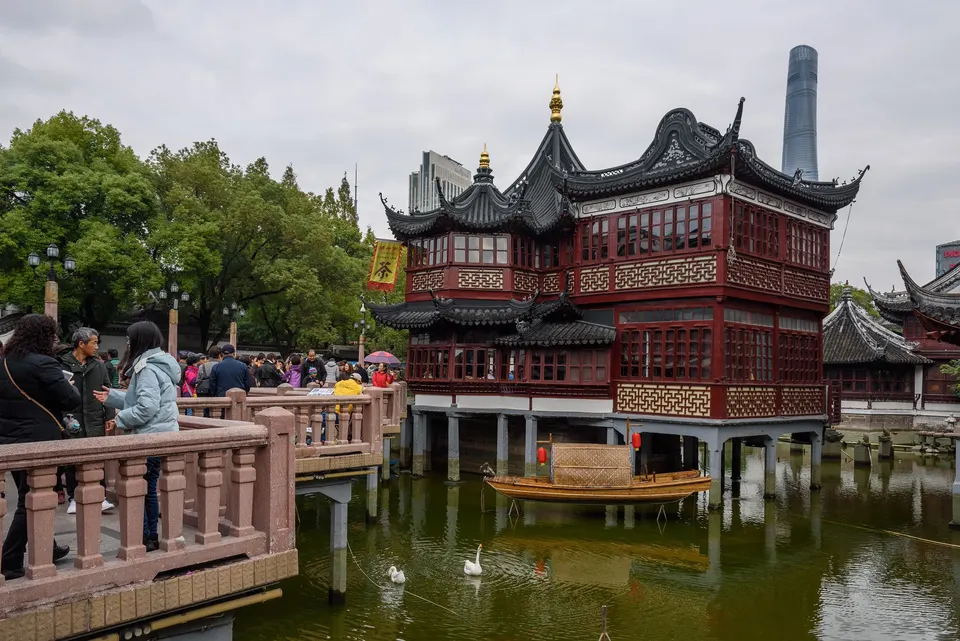
Nineteenth-century foreigners called the pavilion on the pond “The Willow Pattern Tea House”: it reminded them of the blue-and-white scene on a tableware very popular in England, with its pagoda, its bridge and its willow, and an 1857 photograph already labels it “View in Tea Gardens / Shanghae”. But that design was created in Shropshire around 1780, attributed to Thomas Turner, as an imaginary Chinese landscape. Whether Huxinting inspired part of the scene or the English simply thought they saw the plate from home here remains an open question.
Highlights
- Huxinting Pavilion — The 1855 tea house on the pond, joined to the bank by the Nine-Turn Bridge
- Great Rockery — Between 12 and 14 metres of yellow stone, the largest huangshi rockery that survives in Jiangnan
- Dianchun Hall — Command office of the Small Swords Society between 1853 and 1855
- Yu Linglong Rock — About 3 metres of perforated stone that reached the garden as a wedding dowry
- Old stage — Carved timber brought from Zhabei to the Inner Garden, laid out in 1709
In what was Shanghai’s Chinese walled city, beside the City God Temple, the Yu Garden (豫园, Yuyuan) hides behind its walls: some 2 hectares of timber halls, rockeries and linked ponds, divided by walls whose undulating grey-tile crests evoke the back of a dragon. It was begun in 1559 by Pan Yunduan as a gift for the old age of his father, the minister Pan En, and that gesture gives it its name: the character yu means to please and give satisfaction to one’s parents.
The history of the Yu Garden is that of a place that was lost and remade several times. The Ming garden, with design and rockeries attributed to Zhang Nanyang, grew to more than 70 mu, about 4.7 hectares, and earned the nickname “crown of the gardens of the southeast”. After the ruin of the Pan family, some merchants bought the site in 1760 and brought it back to life as the temple’s “Western Garden”. In 1842, during the First Opium War, British troops took the walled city; between 1853 and 1855 the rebels of the Small Swords Society had their command office here, and by the time Qing troops retook it almost nothing original was still standing. The restoration that began in 1956 reopened it in September 1961.
An old custom still beats around the garden. Since the Ming, Shanghai’s liveliest Lantern Festival night was spent around the temple and the Yu Garden: the lanterns were lit on the 13th day of the first month and put out on the 18th, and that night it was tradition to “walk the three bridges” of the old city to attract celebration, long life and that everything would turn out as wished, a custom especially dear to women. Since 1995 the garden has held its lantern festival every year, declared national intangible heritage in 2011, and crossing the Nine-Turn Bridge during it prolongs that rite. According to popular belief, the zigzag of the bridge is no whim either: evil spirits can only move in a straight line, and the turns keep them out.
The architecture of the Yu Garden is walked as a succession of enclosed worlds: halls open to ponds, rockeries with caves and paths, courtyards divided by dragon walls. To know what to see in the Yu Garden, the audio guide walks it in five stops and 90 minutes: it starts outside the paid enclosure, at the tea house on the pond, and continues from the Great Rockery to the Inner Garden. There is a single thread: this labyrinth of courtyards, born as a son’s gift to his father, is the sum of the times someone raised it again.
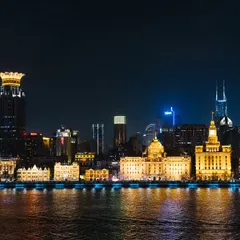
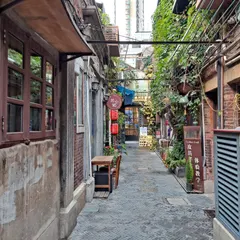
A little over a kilometre away, beside the Huangpu, stretches the Bund of the concessions. Another piece of traditional Chinese architecture is the Jade Buddha Temple, and alley life goes on in the shikumen of Tianzifang, in the former French Concession.
The tea house where tea was banned
Huxinting Tea House
Summary of this stop
The route starts outside the paid garden, facing the pond. In the centre rises the Huxinting Pavilion, a two-storey tea house with curved eaves, and the Nine-Turn Bridge leads to it, originally of wood and rebuilt in concrete in the 1920s. It is the most recognisable image of the Yu Garden, and also the one that has piled up the most lives. It began as the Fuyi pavilion of Pan Yunduan’s garden; later, more than 20 indigo-cloth merchants, among them Zhu Yunhui and Zhang Fuchen, bought the pond, the island and the pavilion, rebuilt it and joined it to the bank with the zigzag bridge, a work finished in 1784, year 49 of the Qianlong era, which fixes the layout seen today.
As the seat of the indigo guild, the pavilion was forbidden to operate as a tea house or tavern. Before that rule fell, other occupants arrived: on 19 June 1842, in the middle of the First Opium War, British troops took the walled city, set up their headquarters in the City God Temple and quartered soldiers in Huxinting. Some versions turn the pavilion itself into headquarters; others leave it as mere lodging for the troops. In 1855 the guild sold the building and the buyer opened the Yeshi Xuan tea house in it, the first in Shanghai.
With more than 240 years of history, it still serves tea: it reopened on 10 July 2025 after almost two years of protective restoration. On 15 October 1986, Queen Elizabeth II, the first British monarch to set foot in mainland China, crossed the zigzag accompanied by Jiang Zemin, then leader of the city, to take tea here, 144 years after soldiers of her country were lodged in the pavilion. The tea house still keeps her table, next to the one the writer Ba Jin used to take. At the foot of the bridge, the audio guide reconstructs how a private garden pavilion came to chain together so many lives.
A yellow mountain for a father
Great Rockery
Summary of this stop
Already inside the enclosure, beside the current entrance, rises the Sansui Hall, the great hall of the western area, rebuilt in the 1956–1961 restoration; in Qing times it hosted official ceremonies and the public reading of imperial edicts. Facing it, across the Yangshan pond, rises the Great Rockery: an artificial mountain of yellow stone with peaks, cliffs, caves and gorges. It is the oldest and largest yellow-stone (huangshi) rockery that survives in the Jiangnan region. Its height is given as between 12 and 14 metres depending on the source, and its authorship is attributed to Zhang Nanyang, although some sources take it as certain and others only as possible.
That miniature mountain range is the heart of the gesture that gave rise to the garden. In 1559, year 38 of the Jiajing era, Pan Yunduan began to transform the vegetable plots west of the family home, the Shichuntang hall, into a garden for his father’s old age. His posts far from Shanghai delayed the work for years, and the date it was considered finished is still debated: one version points to 1577, after some twenty years of pause; another, to the end of the Wanli era, with Pan already retired. The result exceeded 4.7 hectares, more than double today’s 2.
The name of the garden sums it up: yu, to please and give satisfaction to one’s parents. In front of the yellow stone, the audio guide explains how an act of filial piety ended up turned into landscape.
The rebel headquarters beneath the dragons
Dianchun Hall
Summary of this stop
Farther in, Dianchun Hall holds the most violent page of the garden. After the ruin of the Pan family, in 1760 a group of rich merchants bought the site of the old garden and rebuilt it; 24 years later it stood again as the “Western Garden”, an annex to the City God Temple. That second life broke on 7 September 1853, when the Small Swords Society rose up, took the walled city and installed its command office in this hall.
From here its operations were planned until February 1855. When Qing troops retook the garden, the hall was destroyed and almost all the original buildings had disappeared. Today Dianchun is a museum with weapons, “sun and moon” coins and rebel proclamations.
Over the walls snake the dragon walls, undulating grey-tile crests that evoke the animal’s back; one stretch is named “Dragon Crossing the Clouds”. According to popular belief, they are not quite dragons: the five-clawed one was reserved for the emperor, and Pan Yunduan is said to have given them only three or four to escape the accusation of usurping an imperial symbol. In the courtyard, the narration proposes counting those claws and checking whether the legend holds up.
A perforated rock as a dowry
Yu Linglong Rock
Summary of this stop
In front of Yuhua Hall, Pan Yunduan’s former study, furnished with Ming rosewood pieces, stands the Yu Linglong Rock: a boulder riddled with holes, about 3 metres high, 1.5 wide and 80 centimetres thick, considered one of the three great rocks of Jiangnan.
Its arrival in the garden has something of a family chronicle. In the Zhengde era (1506–1521) it belonged to Chu Yu, who placed it in his Sanlintang garden; his daughter brought it as a dowry when she married Pan Yunliang, and so it entered the Yu Garden. Popular tradition tells another story: a rock destined for the imperial garden of Emperor Huizong of the Northern Song, rescued from the Huangpu River after a shipwreck. Even its measurements vary depending on who gives them.
Legend has it that the rock breathes: if incense is burned at its foot, the smoke comes out of its roughly seventy-two holes at once, and water poured onto its top escapes through each of its openings. In front of Yuhua Hall, the audio guide tells how a stone came to travel as a wedding gift.
A borrowed stage in the Inner Garden
Old stage of the Inner Garden
Summary of this stop
The route ends in the Inner Garden, laid out in 1709 and tiny: 2.186 mu, about 1,460 square metres. In it stands an old stage of carved timber that was not born here: it stood in the headquarters of the northern money-changers’ guild, in Zhabei, and was moved to the garden during the restoration. In the same Inner Garden, the small Nine Dragons Pond hides four stone dragon heads in the joints of its east and west walls; the name comes from its reflection in the water and from the dragon-body shape of the pond itself.
That the garden should end in front of a stage has its logic. In the diary that Pan Yunduan kept between 1586 and 1601, almost three quarters of the entries refer to performances and shows held in the garden, with the Leshou Tang hall as the main stage. The garden was born for its owner’s theatre, and today it keeps a stage brought from another district.
That move was the work of the restoration begun in 1956: five years, more than a million yuan and the reconstruction of the Sansui Tang, Yuhua Tang, Huijing Lou and Jiushi Xuan halls, up to the reopening of September 1961. That work also left outside the wall the lotus pond, the Huxinting Pavilion and the Nine-Turn Bridge, the pieces with which the route begins. In front of the stage, the last stop of the audio guide ties up the loose ends of a garden that never stopped being remade.