Shikumen alleys
Tianzifang Audio Guide
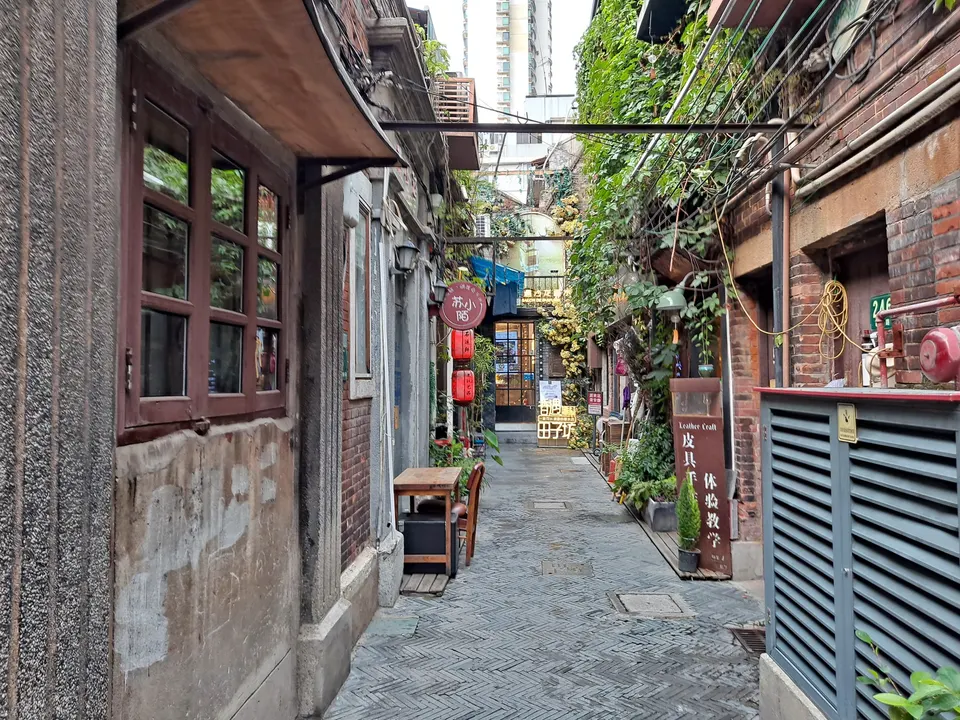
A maze of shikumen alleys and neighbourhood factories on the southern edge of the former French Concession, which was due to fall to the wrecking ball to make room for offices and was saved because painters and residents rented out their ground floors: shops and terraces below, the washing of those who still live there hung up above.
- 60 min of audio
- Shikumen architecture
Tianzifang covers barely 3 hectares around Taikang Road, a street of less than 500 metres laid out around 1926 in the French Concession. Its core is Zhicheng Fang, the “neighbourhood of ambition fulfilled”, a group of shikumen houses dated 1933 (some sources say 1930), with stone frames, black-lacquered wooden doors and grey brick walls. Around it are added houses, apartments and industrial sheds in different styles, spread over lanes 210, 248 and 274, today marked as gates 1, 2 and 3.
The rescue came at a price. In 2016 UN-Habitat chose Tianzifang as the only Chinese case in its “Shanghai Manual” for its bottom-up urban renewal; a year earlier, of 216 businesses, catering accounted for 33.74% and art and creative work only 8.33%. Critics speak of excess commerce and of a neighbourhood increasingly like the City God Temple, and in 2009 there were residents who, waiting for demolition compensation, complained of fumes and noise and even threw water on diners.
Highlights
- Taikang Road — The former Route Cassini of the French Concession, named after a warship
- Sheds of lane 210 — Old cranes and iron staircases from the neighbourhood factories
- Former studio of Chen Yifei — The first artist's workshop in the lane, with the sculpture Shanghai Girl
- Shikumen gateways — Stone frames and black-lacquered doors of Zhicheng Fang
- Lane 274 Pingyuanfang — Passages of less than 2 metres beneath the residents' washing
Beside Taikang Road, on the southern edge of Shanghai’s former French Concession, opens Tianzifang (田子坊): a maze of lanes of shikumen houses and neighbourhood factory sheds where the ground floors are shops, studios and terraces and the upper ones are still homes. Over the shop windows hang poles with washing and air-conditioning units, the sign that the neighbourhood is not a stage set. It is only 3 hectares, but in 2019 it received 14.85 million visits.
The history of Tianzifang begins long before the shops. In 1931 the painter Wang Yachen settled in the Yinyunlou building of Zhicheng Fang (another source places him in the area from the mid-1920s), and the Xinhua School of Art in Shanghai that he directed was in the same zone. Then came the factories: until the 1980s, in lane 210 residents worked downstairs and lived upstairs. When industry emptied out, in 1998, the painter Chen Yifei opened a studio in one of those sheds and in 2001 Huang Yongyu renamed the lane Tianzifang. In the first years of the art street, Er Dongqiang’s studio held an opera recital once a month that filled the room, and Chen Yifei is also credited with designing “The Gate of Art”, a sculpture considered an emblem of the district, although this episode is less well established.
What came next explains the neighbourhood walked today. The area came close to being demolished, and it was saved by the idea of “creative industry” and by residents who began renting out their ground-floor room without leaving the flat upstairs. In 2008 a management committee was created and in 2016 UN-Habitat held it up as an example of bottom-up urban renewal. Among the craftsmen still there is Li Shoubai, whom the lanes call “Mr Shikumen” for his insistence on spreading Shanghai’s haipai culture from his paper-cutting workshop; his daughter, Li Shiyi, returned from studying abroad and is today a recognised heir to that craft.
To know what to see in Tianzifang, the audio guide walks it in four stops and 60 minutes: from Taikang Road at gate 1, through the sheds of lane 210 and the passages between shikumen gateways, to lane 274 and the exit by gate 3. There is a single thread: this maze of shops exists because painters and residents arrived before the wrecking ball, and the price of that rescue can be read in every terrace that occupies the place of a workshop.
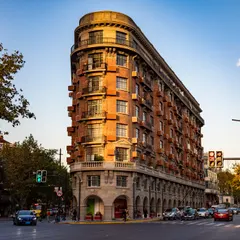
In the same former French Concession, about 3 km to the west, stands the Wukang Mansion; to the east, in the old Chinese city, lies the Yu Garden.
The street named after a French warship
Taikang Road
Summary of this stop
At gate 1, Taikang Road looks like an ordinary street of less than 500 metres. Its layout, however, is a layer of colonial history: it was opened around 1926, after the third extension of the French Concession in 1914, and was called Route Cassini, after a French warship. In 1943 it took its present name, that of Taikang County in Heilongjiang province.
For decades it was a street of neighbourhood factories. Between 1993 and 2003, the factories of the former Luwan district fell from 137 to 15, and most of those on Taikang Road closed or were converted. In 1998 the district government turned the empty shed of the former Shanghai People’s Needle Factory into a covered market and removed the street stalls that occupied the roadway.
That emptiness, sheds without machines and a cleared street, is exactly the gap through which what came next entered. On the pavement, the narration explains how a street with a French military name was left ready to become something else.
The sheds where Chen Yifei broke ground
Former studio of Chen Yifei
Summary of this stop
Crossing gate 1 you meet the sheds of lane 210, with old cranes and iron staircases preserved and heritage-protection plaques on the doors. Here food machinery, textiles and clothing were made, and until the 1980s residents worked on the ground floor and lived upstairs: home and workshop in the same building.
In 1998, invited by Zheng Rongfa and Wu Meisen, the painter Chen Yifei, back from the United States, was the first to open a studio in these sheds; some sources date the move to 1999. After him came Er Dongqiang, Wang Jieyin, Wang Jiajun and craft shops. His former studio is still open with works of his, and behind the door stands the bronze sculpture “Shanghai Girl”. In 2001 another painter, Huang Yongyu, christened the lane Tianzifang, a play on Tian Zifang, a figure of the Warring States whom one of the traditions holds to be the oldest recorded painter in China; sources do not quite agree on who that character was.
That same studio had a second life as a platform. In January 2015, nineteen experts met there and asked for the Shanghai shikumen to be nominated for World Heritage, in an initiative of the Shikumen Culture Research Centre led by Ruan Yisan of Tongji University. Among the sheds, the audio guide tells how a factory on the point of disappearing ended up speaking for a whole architecture.
The houses that were going to be offices
Shikumen gateways
Summary of this stop
In the passage between shikumen gateways, the stone frames and black-lacquered wooden doors give way to the old courtyards and ground-floor rooms, today shops and terraces. This is Zhicheng Fang, the “neighbourhood of ambition fulfilled”, a group of houses from 1933 (1930 according to other sources) that was doomed. According to a 2009 report, in 2004 the demolition plan was drawn up and the developer was already showing in its sales room the models of the planned office buildings; other sources place the threat in 2006 or speak of a project from 2003. Wu Meisen defended the idea of “creative industry” before the government and Chen Yifei also mobilised.
The decisive moment came from inside the houses. In November 2004, Zhou Xinliang was the first resident to rent out his home as a shop: he gave a fashion designer his ground-floor room and the courtyard, 32 square metres without a bathroom, for 3,500 yuan a month, and hung on his door a sign reading “voluntary intermediary of Tianzifang”. By early 2009, more than 300 of the more than 670 households had moved out and were renting their homes to businesses.
The rest stayed, under a formula that can still be read by looking up at the windows: upstairs you live, downstairs you rent. In front of the gateways, the narration reconstructs how a sign on a door weighed more than a set of office models.
More terraces than workshops at the exit
Lane 274 Pingyuanfang
Summary of this stop
Toward gate 3, lane 274, Pingyuanfang, and its neighbour 248, Tianchengli, narrow the way to stretches less than 2 metres wide, with cross passages and shops on every ground floor. Above, the poles with washing remain. In 2008 the Tianzifang Management Committee was created and the district invested 10 million yuan in sewers, septic tanks and façades: almost half of the 1,500 households in the lilong houses then got a flush toilet for the first time.
The success has figures on both sides. The core, lanes 210, 248 and 274 plus the Taikang Road frontage, covers only 3 hectares and in 2019 received 14.85 million visits. In 2015, of 216 businesses, catering accounted for 33.74% and art and creative work only 8.33%; between 2013 and 2015 creative businesses fell from 51 to 18.
And the lane keeps reinventing itself. Since the second half of 2024, with the visa exemption for South Koreans, Tianzifang is enjoying a second boom thanks to them: many arrive on foot from the former seat of the Provisional Government of the Republic of Korea, pass the White Rabbit candy shop and leave with close to a jin, half a kilo, for 50 or 60 yuan; the qipao shops notice it too. At the exit, the last stop of the audio guide makes the final tally of what the neighbourhood gained and lost by being saved.