Stele museum
Forest of Steles Audio Guide (Beilin Museum)
A stone library beside Xi'an's south wall: since 1087, a former Confucius temple has gathered the classics carved on 114 Tang slabs, a Christian stele from the year 781 and the calligraphy of the great masters, stones that someone rescued, hid or refused to let go.
- 75 min of audio
- Chinese calligraphy in stone
The Forest of Steles was born in 1087, in Northern Song times, when the official Lü Dazhong gathered, to protect them, the Tang steles left exposed to the elements after the wars at the end of the Tang dynasty and the Five Dynasties. In 1103 they reached the southeast corner of the city and the Confucius temple moved with them, so that temple, steles and prefectural school ended up in one compound. That is why the entrance keeps the layout of a Confucian temple, with its red screen wall, its semicircular pool and the Lingxing gate, in Ming and Qing buildings.
What speaks loudest in this museum is sometimes what is missing. On the merit stele of the eunuch Liang Shouqian, dated 822, only three characters were chiselled out: those of the name of Yang Chenghe, the powerful eunuch who had erected it and who in 835 was ordered to take his own life. His own funerary stele, with calligraphy by Liu Gongquan, lay buried in the wars at the end of the Tang and turned up in March 2021 at a building site on North Zaoyuan Street in Xi'an.
Highlights
- Shitai Xiaojing — Four slabs 590 cm tall with Emperor Xuanzong's calligraphy and papers hidden in their joints since the twelfth century
- Kaicheng Stone Classics — 114 Tang slabs with more than 650,000 characters, the official textbook of an empire without printing
- Nestorian Stele — A cross from the year 781 in Chinese and Syriac that Europe took for decades to be a Jesuit fraud
- Six Steeds of Zhao Mausoleum — Four original reliefs of Taizong's horses and two copies for the ones in Philadelphia
- Jingyun bell — A bronze of 711, about 6 tonnes, whose recorded voice rings every Chinese New Year's Eve
Beside Xi’an’s south wall, in what was the city’s Confucius temple and prefectural school, a library made of stone is kept: the Forest of Steles (西安碑林博物馆, Beilin Museum). Since 1087, inscribed slabs that survived the fall of the Tang capital, wars, earthquakes and bombings have been gathered here. How many there are depends on whom you ask: depending on the source, steles and epitaphs number from almost 3,000 to more than 4,000, and the whole collection from about 11,000 to 14,338 pieces.
The history of the Forest of Steles begins with a rescue. In 904, the warlord Zhu Wen took Emperor Zhaozong to Luoyang and dismantled Chang’an; in the reduced city that remained, Liu Xun, successor to Governor Han Jian, brought to safety the Kaicheng Classics and other steles that had been left outside, in the old Imperial Academy. In 1087, the official Lü Dazhong gathered them to protect them, and in 1103 they reached the southeast corner of the city, to which the Confucius temple moved with them. The museum’s own sources do not entirely agree: some place the move to the present site already in 1087 and others distinguish between the founding of 1087 and the arrival of 1103.
The stones have had stubborn guardians. During the war with Japan, the committee that managed the Forest, with Zhang Pengyi at its head, had whatever it could hidden; a fragment of the Han-period Stone Classics, from Yu Youren’s collection, ended up, according to the documented tradition, at the bottom of a dry well in the Zhang family home in Fuping, guarded by his family under strict rules, and did not return to the museum until 1952. In 2018, when the expansion project envisaged moving the Kaicheng Classics, a signed petition and repeated deliberations ended with the decision to leave them where they were, because moving them would damage the slabs.
To know what to see at the Forest of Steles, the museum reopened on 12 May 2025 now offers a broader route: besides the historic halls, a new north building, more than 2,000 pieces on display and the great steles in plain view, without the old steel frames or display cases. Among them are, at last all together, the seven steles written by Yan Zhenqing, from that of the Duobao Pagoda, from his 44th year, to that of the Yan Family Temple, from his 72nd. The audio guide covers them in five stops and 75 minutes of narration, from the temple courtyards to the basement of Taizong’s horses, with a common thread: none of these stones is here by chance.
The museum rests against the Xi’an City Wall, less than a kilometre from the Bell Tower; and anyone who follows the trail of imperial China back to its origin has an appointment outside the city with the Terracotta Army of the first Qin emperor.
A Confucius temple that keeps a Tang bell
Xi'an Beilin Museum
Summary of this stop
The museum’s entrance does not announce a museum but a temple. The red screen wall, the great Taihe Yuanqi arch, the semicircular pool (panchi), the Lingxing gate and the Ji gate follow one another along a single axis, in Ming and Qing buildings: the compound’s architecture keeps the layout of a Confucian temple. That temple was not here at first: in 1103, when the steles reached the southeast corner of the city, the Confucius temple moved with them, and since then temple, Forest of Steles and prefectural school have shared one compound.
Behind the Ji gate, to one side of the axis, waits the Jingyun bell. It was cast in 711 for the Jinglong Taoist temple of Chang’an, weighs about 6 tonnes and measures 247 cm; its mouth is hexagonal and lobed, its sides bear reliefs of cranes, lions, dragons and phoenixes, and at the top an animal, the pulao, crouches. A 292-character inscription by Emperor Ruizong runs around it. Opposite, across the axis, a stone horse of the Xia kingdom, the one founded by the Xiongnu, is displayed.
The bell is no longer rung, and yet it still sounds for all of China once a year. Beside it, the audio guide tells how a bronze piece of 711 still keeps its voice.
The six-metre stele and its secret
Shitai Xiaojing
Summary of this stop
In the centre of the axis rises a red-and-green double-eaved pavilion. Inside is the stone with which it all began: the Shitai Xiaojing, carved in 745, which brings together the Classic of Filial Piety with the preface and commentary of Emperor Xuanzong, written in his own hand in chancery script, beneath a heading in seal script by the crown prince Li Heng. It consists of four slabs 590 cm tall, 35 blocks of stone in all, on a three-step pedestal and beneath a crown of clouds and mythical animals. In 1087 it was one of the first pieces Lü Dazhong gathered to protect from the elements.
The secret appeared in 1973. The stele had tilted to the southwest because the ground had subsided, and on restoring it there came to light, hidden in the joints of the central pillar, fragments of documents in the Jurchen language, a rubbing of Huairen’s Preface to the Sacred Teaching and a New Year print by Dongfang Shuo. They had been left there by those who repaired it after the earthquake of 1160, in the time of the Jin dynasty.
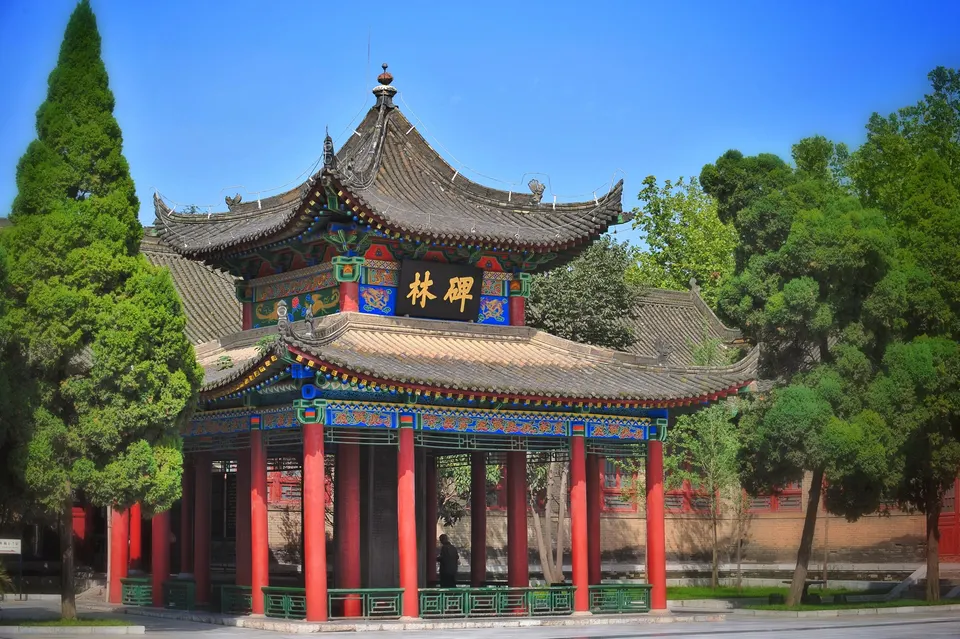
In the pavilion, the plaque with the characters 碑林, “forest of steles”, is the work of the senior Qing official Lin Zexu. The first character lacks a small slanting stroke at the top, and popular legend says that Lin Zexu wrote it while passing through Xi’an on his way to exile in Ili, dismissed for his campaign against opium. In front of the pavilion, the audio guide explains what tradition sees in that missing stroke.
The 114 slabs that saved the classics
Kaicheng Stone Classics
Summary of this stop
In Hall 1, the slabs are arranged in rows like the shelves of a library. These are the Kaicheng Stone Classics, carved between 833 and 837 by order of Emperor Wenzong: 114 slabs inscribed on both sides with the twelve Confucian classics and more than 650,000 characters. Of the six sets of stone classics before the Qing dynasty, it is the only one preserved complete. In an age without widespread printing, they served students as a model text and an official standard against which to check their handwritten copies.
They were saved by a narrow margin. When Chang’an was dismantled in 904, the slabs had been left outside the reduced city, in the old Imperial Academy, and Liu Xun moved them to the west corner of the old Tang Secretariat, north of today’s Drum Tower. In 1087 they were the first stones to enter the Forest of Steles.
The darkest episode came in 1938, with the Japanese army beside the Tongguan pass and bombings over Xi’an. According to the documented tradition, between August and October of that year the steles of halls 1 to 3 were wrapped in adobe and mud and the windows bricked up; in June 1940, amid air-raid alarms, a deep pit was dug in the compound to bury another 291 stones and two engraved maps, which did not see the light again until 1947. Among the rows, the audio guide reconstructs those months when the slabs disappeared under the mud.
A cross in Chinese stone from the year 781
Nestorian Stele
Summary of this stop
In Hall 2, on a tortoise-shaped pedestal, rises a limestone stele about 2.8 m tall with a cross at its head. It is the Xi’an Stele, or Nestorian Stele, erected in 781 at the Daqin monastery in Chang’an, with text by the monk Jingjing and calligraphy by Lü Xiuyan. It speaks of Christians in the Tang capital and does so in two languages: the first and last lines, the lower part and the edges carry Syriac script, with the signatures of 70 monks on the sides.
The stone spent centuries underground. It was buried around 845, during the religious persecution of the Huichang era, and reappeared almost 800 years later beside the Chongren temple, west of Xi’an, on the site of the old Christian monastery. The date of the discovery is not certain: sources place it in 1625, although others speak of 1623, within a range of 1621 to 1625; and as for its original Tang location, besides Chang’an, Zhouzhi district has been proposed. The Jesuit Álvaro Semedo was the first European to see it.
In Europe, however, it was held for generations to be a forgery or a text touched up by the Jesuits of the Ming court, a suspicion adopted by the French Jansenists and Voltaire. In 1907 the Dane Frits Holm arrived in Xi’an intending to take it away; the authorities moved it with its tortoise to the Forest of Steles, and Holm had to settle for an exact copy that passed through the Metropolitan Museum in New York and ended up, in 1917, given to the Pope. In front of the tortoise, the audio guide follows the trail of that stone among Chang’an, Rome and New York.
Taizong’s horses and the two absent ones
Six Steeds of Zhao Mausoleum
Summary of this stop
The basement of the new north building holds the Six Steeds of Zhao Mausoleum, the reliefs of the war horses of Emperor Taizong. Four are originals. The other two, Saluzi and Quanmaogua, are in the Penn Museum in Philadelphia, and in their place are displayed the copies that the museum craftsman Xie Dade carved in 1963 from rubbings and photographs.
The building is the newest part of the museum, which reopened on 12 May 2025 after its expansion with two areas, the historic compound and this north building, and more than 2,000 pieces on display. The main steles are now shown free-standing, without the steel frames or the glass cases that covered them for years. In the first basement, moreover, replicas of famous steles are designed so that blind people can trace the characters by hand. In front of the reliefs, the audio guide’s last stop tells the story of the two horses that are missing.