Imperial mausoleum
Terracotta Army Audio Guide (Bingmayong)
Thousands of life-size clay soldiers, each with his own face, still stand in formation facing east since farmers came across them digging a well in 1974. They stand guard 1.5 km from an imperial tomb that no one has yet opened.
- 120 min of audio
- Qin dynasty
The pits of the Terracotta Army are part of the Emperor Qin Shi Huang's Mausoleum Site Museum, in Lintong, about 40 km from central Xi'an. Work on the mausoleum began in 246 BC, when the future first emperor inherited the throne of Qin at the age of 13, and its soldiers were modelled in pieces, with faces retouched one by one, real bronze weapons and sculptors' signatures hidden in the armpits. Three pits deploy them like a real army: the great battle corps, a mixed formation of crossbowmen, chariots, infantry and cavalry, and a small command post with its officers.
What stands today is a patient reconstruction. Pit 1 was an underground building roofed with beams, reed mats and clay; that roof burned and collapsed onto the ranks, and every figure on display has been reassembled from fragments. Nor have they kept their colour: they were painted over a layer of lacquer which, on contact with Xi'an's dry air, curls up in fifteen seconds and flakes off in four minutes.
Highlights
- Pit 1 — About 6,000 figures in battle order facing east, with a vanguard of 204 archers and crossbowmen
- Restoration area — Warriors half reassembled and the laboratory opened in 2024 inside the pit itself
- Pit 3 — The command post of the other two pits, with high-ranking officers and a war chariot
- Kneeling archer — Carved down to the pattern of the sole and with traces of his original polychromy
- Bronze chariots — Two half-scale chariots with 14 kg of gold and silver ornaments, found unlooted
In Lintong, about 40 km from central Xi’an, the Emperor Qin Shi Huang’s Mausoleum Site Museum covers with great halls the three funerary pits of the first Qin emperor: the Terracotta Army, Bingmayong (兵马俑) on maps and signs. Thousands of life-size clay soldiers, each with his own features, still stand in battle order facing east, 1.5 km from the emperor’s mound, a wooded hill at the foot of Mount Li that remains unopened. Work on the mausoleum began in 246 BC, when the future Qin Shi Huang inherited the throne of Qin at the age of 13.
The history of the Terracotta Army in modern times begins with a drought. On 29 March 1974, farmers digging a well brought up fragments of clay figures; in April, the Lintong archaeologist Zhao Kangmin reassembled two warriors and identified them as the work of the Qin dynasty, and by 15 July that year the state archaeological team was already installed on the site. Who deserves the title of discoverer is still a disputed matter: in the village, versions circulated of three, seven and nine discoverers; the archaeological recognition is attributed to Zhao Kangmin, and the popular account highlights Yang Zhifa and his brothers. The figures are not settled either: global estimates speak of more than 8,000 soldiers in the three pits, while the museum’s data add up to about 6,000 figures in Pit 1, more than 1,300 in Pit 2 and 72 in Pit 3, for which other descriptions give 86.
The nickname that every guide repeats has a known author. In 1978, the then mayor of Paris, Jacques Chirac, visited the pits and said that if the world had seven wonders, this discovery could be called the eighth; the international press spread the phrase and the title stuck. The unprecedented realism of the figures in earlier Chinese sculpture has fed another debate: some researchers have proposed an influence from Greek sculpture, while others, among them the museum’s chief archaeologist, Zhang Weixing, hold that there is no substantial evidence of that link and reject the hypothesis as Eurocentric.
Even the stillness of the statues has its anecdote. On a Saturday in September 2006, a German art student, Pablo Wendel, dressed as a warrior, carried a small pedestal and jumped into the pit among the figures; he stayed so motionless that the guards had trouble finding him, and the police ended up carrying him out bodily. Since he had not damaged any piece, they confiscated the costume and sent him back to Hangzhou with a warning.
To know what to see at the Terracotta Army without getting lost among halls and walkways, the audio guide covers it in five stops and two hours of narration: from the head of Pit 1, where the vanguard faces east, to its restoration end, and then the command post of Pit 3, the display cases of Pit 2 and the hall of the bronze chariots. The thread is a single one: this army is not a postcard but the antechamber of something that remains closed.
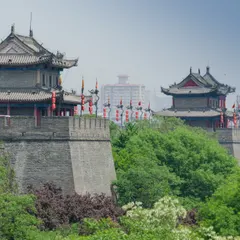
Back in Xi’an, the city shows its later layers: the Xi’an City Wall, raised by the Ming, and, against its southern stretch, the Forest of Steles, with the Confucian classics carved in stone.
A dry well facing the vanguard
Terracotta army
Summary of this stop
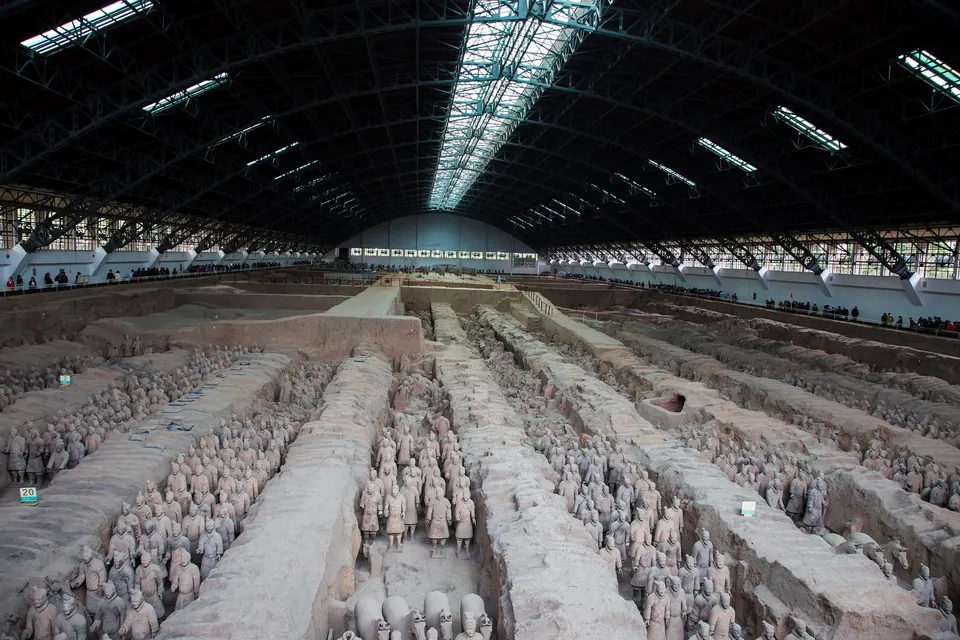
The first look is cast from the eastern railing of Pit 1, beneath the great vaulted hangar completed in 1979 over the whole pit. Its dimensions explain the silence it imposes: 230 metres east to west by 62 north to south, between 4.5 and 6.5 metres below the present ground and 14,260 m². From the density of what has been excavated, it is calculated to hold about 6,000 figures of soldiers and horses, as well as a great quantity of bronze weapons.
The army stands in battle order, facing east. Just below the entrance is the vanguard: a triple row of 204 archers and crossbowmen, without armour. Behind them advance columns of infantry interspersed with wooden chariots drawn by four horses.
It all began with a well. On 29 March 1974, in the middle of a drought, Yang Zhifa, his five brothers and his neighbour Wang Puzhi were digging a well 1.5 km east of the mound when fragments of clay appeared; in the village they took them for “tile gods” and feared they had disturbed the spirits. Yang Zhifa recalled that he thought he had come across an old potter’s kiln and could take away a few jars for free. What came next, between cartloads paid at 10 yuan each, lost land and resentful neighbours, is the story the audio guide tells in front of the vanguard, up to the day a US president asked him for an autograph.
The roof that collapsed onto the ranks
Pit 1 restoration area
Summary of this stop
At the west end of Pit 1, the perfect rows at the entrance dissolve into a field of fragments. That contrast reveals what the pit was: a roofed underground building. Eleven parallel corridors more than 3 metres wide, paved with small bricks, separated by walls of rammed earth and roofed with beams and wooden posts, reed mats and layers of waterproof clay; above, the earth rose 2 or 3 metres over the ground.
That roof burned. The figures in pits 1 and 2 show fire damage, remains of charred beams have appeared and the covering fell in on the ranks: every figure now displayed upright has been reassembled from fragments. The third excavation of the pit, from 2009 to 2022, over about 430 m², brought out more than 220 figures, 16 horses, 4 chariots, two drums with their drumstick and the pit’s first lacquered shield, and also showed that an access passage had been reopened in antiquity to get in.
Who got in and who set the fire? Later texts attribute the burning and looting to Xiang Yu, rival for the throne after the emperor’s death, and the lack of weapons, the burned beams and that reopened passage support that reading, although the authorship is not proven. Since 2024, the 50th anniversary of the discovery, a restoration laboratory has worked inside the pit itself, among half-reassembled warriors, and right there the audio guide follows the trail of the intruders.
Names hidden in the command post
Pit 3 officers
Summary of this stop
Pit 3 is the smallest: a “凹”-shaped plan, an entrance ramp to the east, 28.8 by 24.57 metres and 520 m². It was the command post of pits 1 and 2, with high-ranking officers and the remains of a war chariot. Here the gaze moves from the mass to the individuals.
Each warrior was assembled from pieces: head, arms, legs and torso separately, joined with clay. The faces started from about ten basic face types, and clay was then added to give each figure its own features; the arms were attached last, with the armour already carved, and the sculptors signed in the armpits. Their hands, closed or half open, are empty: the wooden weapons rotted and many bronze ones were looted. They were real weapons. More than 40,000 bronze pieces have been recovered, above all arrowheads tied in bundles of 100, and swords whose inscriptions date their manufacture between 245 and 228 BC; many bear the mark “made by the chancellor Lü Buwei”. For decades it was said that they shone intact thanks to a rust-proof chromium layer, but a 2019 study attributes that chromium to contamination from nearby lacquer and the good preservation to the soil, slightly alkaline and very fine-grained.
The figures that withstood two millennia underground prove fragile in the face of a visitor: on 30 May 2025, a man jumped over the railing and protective net of this pit and damaged two warriors. From that same railing, the audio guide deciphers what the hidden signatures tell.
The archer who kept his colour
Kneeling archer
Summary of this stop
Pit 2, with an L-shaped plan of 124 by 98 metres, about 5 deep and about 6,000 m², holds more than 1,300 figures and horses: crossbowmen, war chariots, infantry and cavalry, the set most varied in troop types of the three pits. A good part is still covered with earth, with test trenches open, and the finest pieces are in the display cases.
There waits the kneeling archer, from the crossbow corps at the eastern end of the pit: right knee on the ground, left leg bent and hands at the right side, holding a crossbow that is no longer there. He is modelled in more detail than the rest, down to the topknot, the armour plates and the pattern of the sole, and keeps traces of his polychromy. It is a rarity: the warriors were painted over lacquer with cinnabar, malachite, azurite and “Han purple”, a synthetic copper-barium silicate, but on exposure to Xi’an’s dry air that lacquer curls up in fifteen seconds and flakes off in four minutes, and that is why almost all the figures show the colour of clay today.
Among thousands of faces painted in pinkish tones, only one green one has turned up, that of a kneeling archer from this same pit. No one knows why: people have spoken of a craftsman’s slip, of camouflage, of war paint or of a soldier from some non-Chinese people, and two voices from the museum itself defend different explanations. In front of the display case, the audio guide lays those competing theories on the table.
Bronze chariots before an unopened tomb
Bronze chariots
Summary of this stop
In their own hall of the museum are displayed the two painted bronze chariots, at 1/2 scale of those of the imperial retinue, with four horses each, their driver and 14 kg of gold and silver ornaments. They appeared in December 1980 only 20 metres west of the mound, at a depth of 7.8 metres. The collapse of their timber chamber had crushed them, but no one had looted them and they kept almost all their parts.
They are a foretaste of what remains closed 1.5 km from the pits. The mound of Qin Shi Huang, at the foot of Mount Li, has not been opened, and high levels of mercury have been measured in its soil, consistent with the hundred rivers of mercury described by the historian Sima Qian in the Shiji. The same account tells how the tomb was sealed: automatic crossbows against anyone who dug close enough, the heavens above and the geography of the empire below, lamps designed never to go out and, on top, grass and trees so that it would look like a mountain.
According to Sima Qian, the sealing also had a human price, which reached the emperor’s harem and the very craftsmen who had set up the mechanisms. In front of the chariots, the audio guide’s last stop tells who, according to that chronicle, never came out of the tomb again.