UNESCO heritage
Small Wild Goose Pagoda Audio Guide (Xiaoyanta)
A Tang brick tower built to hold the scriptures the monk Yijing brought back from India by sea: it lost its top in the earthquake of 1556 and carries five centuries of cracks that, according to the chronicles, opened and closed with the tremors.
- 50 min of audio
- Tang dynasty
The Jianfu temple was born in 684 from an imperial house: a hundred days after the death of Emperor Gaozong, the former residence of his son Zhongzong was converted into a temple, first called Xianfu and renamed Jianfu by Empress Wu Zetian in 690. The pagoda came in the Jinglong era (707–710) to house the sutras that the monk Yijing had brought from India, where he travelled by sea from Guangzhou; here he translated the most important body of work after Xuanzang's. It is the oldest example of a square Tang brick pagoda with dense eaves. The wars at the end of the Tang ruined the temple and only the tower survived, until around the Yuanyou era (1086–1094) the temple moved into its courtyard.
The strangest part is written in stone. In 1551, the Ming official Wang He engraved above the north door that the earthquake of 1487 had split the tower from top to bottom with a crack one chi wide, about 30 centimetres, so wide that passers-by could see light through it, and that after another earthquake, at the end of the Zhengde era, the pagoda was left as before in a single night: people called it “shen he”, the divine union. Five years after that inscription, the great earthquake of 1556 tore off its two upper storeys. Whether those closings were a marvel, a legendary generalisation or the response of a bowl-shaped foundation is still debated.
Highlights
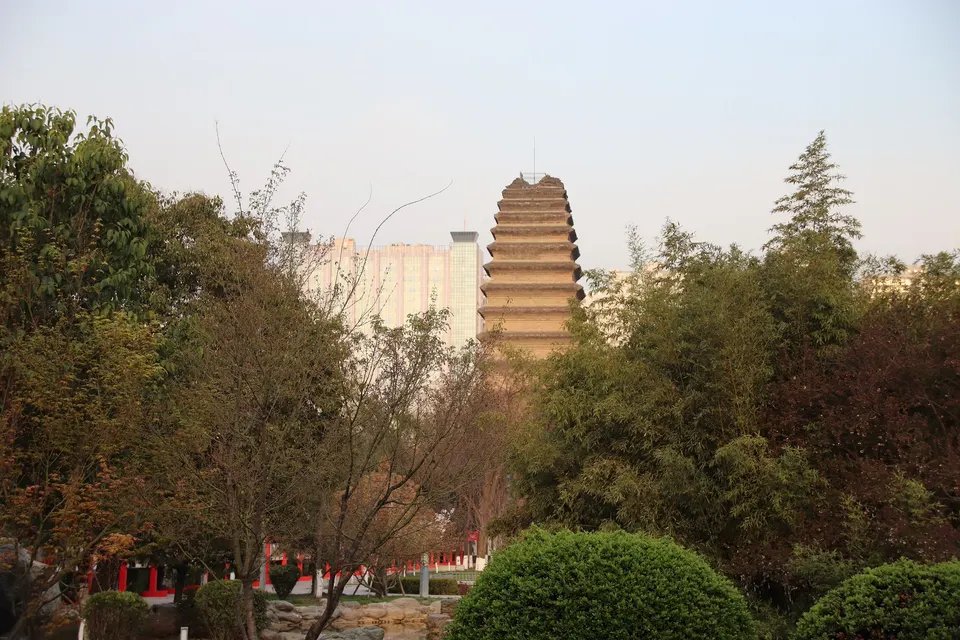
- Tang brick pagoda — Thirteen eaves ever closer together and a jagged top, with no finial, since the earthquake of 1556
- Green-stone doors — Musician apsaras, kalavinka birds, scrolls and clouds carved in Tang times
- Wang He inscription — The 1551 account of a crack through which passers-by could see light
- Jin bell of 1192 — 3.55 metres and about 8,000 kilos, rescued from the bank of the Wei River
- Military exam steles — The names of Ming and Qing graduates, among thousand-year-old pagoda trees
In Xi’an, the old Tang Chang’an, stands the Small Wild Goose Pagoda (小雁塔, Xiaoyanta), a square brick tower built in the Jinglong era of Emperor Zhongzong, between 707 and 709 or 710 depending on the source, to house the Buddhist scriptures that the monk Yijing brought from India. In the Tang city, the pagoda’s courtyard occupied the Anren district, separated by a street from the Jianfu temple, which lay in Kaihua, and the tower stood some 190 metres from the axis of Zhuque Avenue, the great north-south artery almost 130 metres wide.
The history of the Small Wild Goose Pagoda is that of a survivor. The wars at the end of the Tang ruined the temple and only the tower remained; by around 1086–1094 the temple had already moved into its courtyard. Between 1926 and May 1949 it was occupied by the Nationalist army, from 1938 as barracks and with the pagoda as military high command, and in 1949 numerous bullet marks were found on its body. Accounts of that year also tell that, with the management of the monument in limbo after the new regime arrived, neighbours carried off to their homes the furniture and objects of the temple, including those of the pagoda. More lives followed: a public school for students from Tibet in the 1950s, an exhibition centre during the Great Leap Forward, a socialist school and, in the Cultural Revolution, a compound of the People’s Liberation Army, which did not fully hand its management over to Xi’an’s heritage services until the 1990s.
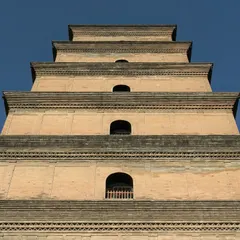
Its architecture reads from the bottom up: a tall ground floor and then thirteen eaves ever closer together, with a profile that curves inward and ends in a flat, jagged top. In 1989 it was measured at 43.4 metres high and 11.38 metres on each side at the base, although other sources give 43.3 or 43.395 metres. The platform, much wider than the tower, and the raised brick of the ground floor betray the timber eave that surrounded the first storey and disappeared in the thirteenth century. On the temple’s axis, the Cishi pavilion, of Ming date and with a double eave, keeps the wooden plaque “敕赐荐福寺” written by the Ming emperor Yingzong.
The modern city has reorganised itself around the tower. In 2013 Xi’an laid out a buffer zone around it with maximum-height bands, from a no-building zone to 9, 12, 18, 24, 36, 60 and 100 metres, calculated with visual analysis so that it remains a landmark; on 22 June 2014 the pagoda entered the World Heritage list as part of the Silk Roads of the Chang’an-Tianshan corridor. To know what to see at the Small Wild Goose Pagoda, the audio guide covers the compound in four stops and 50 minutes of narration, from the Jin bell to the pagoda and its two faces, as far as the steles beneath the pagoda trees. The thread is a single one: this jagged tower is not a ruin at rest but a building that has broken, closed up, been girded with iron and emptied out.
Its older sister, the Big Wild Goose Pagoda, kept Xuanzang’s sutras a little farther southeast. A little over a kilometre to the north begins the Xi’an City Wall, which encloses the streets of the Muslim Quarter.
A Jin bell rescued from the river
Jin bell pavilion
Summary of this stop
The route begins at the bell pavilion, east of the axis, where an iron bell cast in 1192, in the time of the Jin dynasty, hangs: it measures 3.55 metres and weighs about 8,000 kilos. It was not born here. It hung in the Chongjiao temple of Wugong, beside the Wei River, and was left buried on the bank when a flood destroyed the temple. Legend has it that, in the Qing period, a washerwoman heard a clang of metal under the water and alerted the authorities; searching the spot, the bell appeared, lost for more than four hundred years. Rescued in the Kangxi era, it was brought next to the pagoda.
Its morning toll gave its name to “the morning bell of the Goose Pagoda”, one of the Eight Views of Guanzhong, enshrined in a poem by the Qing poet Zhu Jiyi. Another legend attributes the custom to Yijing himself, who is said to have asked the abbot to ring a bell at dawn to rise for prayer and translation. In Republican times, with troops quartered in the temple, the bell cracked and its toll fell silent for years; in 1993 the crack was welded, and in 1998 a new bell was cast for visitors to strike. Beside it, another small iron bell of 1494 hangs from a frame.
The pavilion also holds the origin of the place: a temple that was born in 684 in the former residence of a future emperor, Zhongzong, and to which Empress Wu Zetian gave the name Jianfu in 690. Beside the bell, the audio guide follows the journey of that metal from the riverbed to the compound.
The top it lost in 1556
Small Wild Goose Pagoda (小雁塔)
Summary of this stop
Facing the south side, the silhouette says it all: thirteen eaves crowding upward and, at the top, a flat, broken end with no finial. Two storeys are missing. The great earthquake of 1556 destroyed the upper ones, and the pagoda went from 15 storeys to 13 and from about 45 metres to about 43. The tower had been born to hold the sutras of Yijing, who travelled to India by sea from Guangzhou seven years after the death of Xuanzang and who, on his return, translated at the Jianfu temple the most important body of work after that of his famous predecessor.
On the ground floor, the north and south doors keep frames and lintels of green stone carved in Tang times with musician apsaras, kalavinka birds, plant scrolls and clouds; above them, centuries of poems scratched by those who came later. The brick base, with stone stairs to the north and south, is too wide for the tower, and on the south side it is preceded by a Qing-era stone arch with the inscriptions “万汇沾恩” and “不二法门”.
The mystery goes underground. Beneath the centre of the base there is a brick crypt, with an antechamber, a passage and a rear chamber that would be the one for relics; it was discovered in Republican times without any Tang treasure, which suggests it was looted. Surveys also point to another, deeper crypt, whose contents are unknown. Facing the south side, the narration reconstructs the complete tower and what its subsoil may have held.
A crack that let the light in
North door and Wang He inscription
Summary of this stop
On the north face, the eye climbs a column of semicircular windows aligned on the same vertical, storey after storey. It is the tower’s weak line, the one that broke with the earthquakes. Above the door, the lintel keeps the inscription that the Ming official Wang He engraved in 1551: the crack from the earthquake of 1487 ran through the pagoda from top to bottom, one chi wide, and passers-by could see light through it as through a window; after the earthquake at the end of the Zhengde era, the tower was left as before in a single night. People of the time called that closing “shen he”, the divine union.
Tradition speaks of “three cracks and three closings”, in 1487 and 1521, in 1556 and 1563 or 1564, and in 1691 and 1721. One line of study considers it a legendary generalisation of several instances of seismic damage and repairs, with no real spontaneous closing; another takes the Ming and Qing chronicles seriously and looks for the cause in the structure: the windows aligned as a line of fracture and a bowl-shaped rammed-earth foundation of about 30 metres in radius. The debate remains open.
The north face also shows the remedies and wounds of the twentieth century. In 1965 Xi’an’s heritage commission repaired the cracks and the north and south arches, installed wooden floors and stairs and a lightning rod, and girded the tower with iron hoops on storeys 2, 5, 7, 9 and 11, still visible from outside. And in 1949, after years of military occupation, numerous bullet marks were found on its body. Beneath the inscription, the audio guide sets the marvel in dialogue with its explanation.
Names on steles, names scratched
Military exam steles
Summary of this stop
The compound ends among more than a dozen steles and more than ten pagoda trees over a thousand years old. One of the steles, of 1116, records the repair of the pagoda in Song times. Others keep an inherited custom: in the Ming and Qing periods, those who passed the provincial military examinations of Shaanxi imitated the old Tang practice of inscribing their names at the foot of the Goose pagodas and engraved their names on steles beside the Small Pagoda. Nearby rises a dharani pillar of 842, octagonal, with musicians in relief at the base and a canopy with eight dragon heads.
The custom of leaving one’s name had a less noble version. In 2013 a journalist discovered that the interior of the pagoda was covered in names and scribbles scratched by visitors, with dates from the 1970s to 2012, even on the bricks at the top and over the very signs asking people not to scratch.
The ending lifts the gaze toward old Chang’an: the temple and its pagoda in different districts separated by a street, the great Zhuque Avenue a short step away and, today, a city that limits the height of its buildings so as not to hide the tower. Among the steles, the audio guide’s last stop tells why a broken pagoda still orders the landscape of Xi’an.